Penenden Heath, ca 1908
 The arrival of the Romans (55 BC)
A new era began in August 55 BC, when Roman legions first set foot on British soil. Their commander Julius Caesar ostensibly aimed to punish the Britons for interfering in his Gallic campaign, but doubtless also had booty and glory in mind. The expedition was not conspicuously successful. Finding Dover Beach stoutly defended by Celtic spearmen, he decided to sail several miles north to an alternative landing-place. High winds had forced the transports bearing his cavalry to turn back, and it legendarily took the plucky example of the 10th Legion’s standard-bearer to encourage the 10,000 infantry to disembark. After stormy weather battered many of Caesar’s 600 ships, however, he felt obliged to withdraw. He learned his lesson. The following July, he returned with five legions and 2,000 cavalry, built a 50-acre fort, and wrought havoc in the South-East for two months. Though a plaque celebrates his landing-place at Walmer, recent archaeological discoveries suggest Pegwell Bay as the true location.
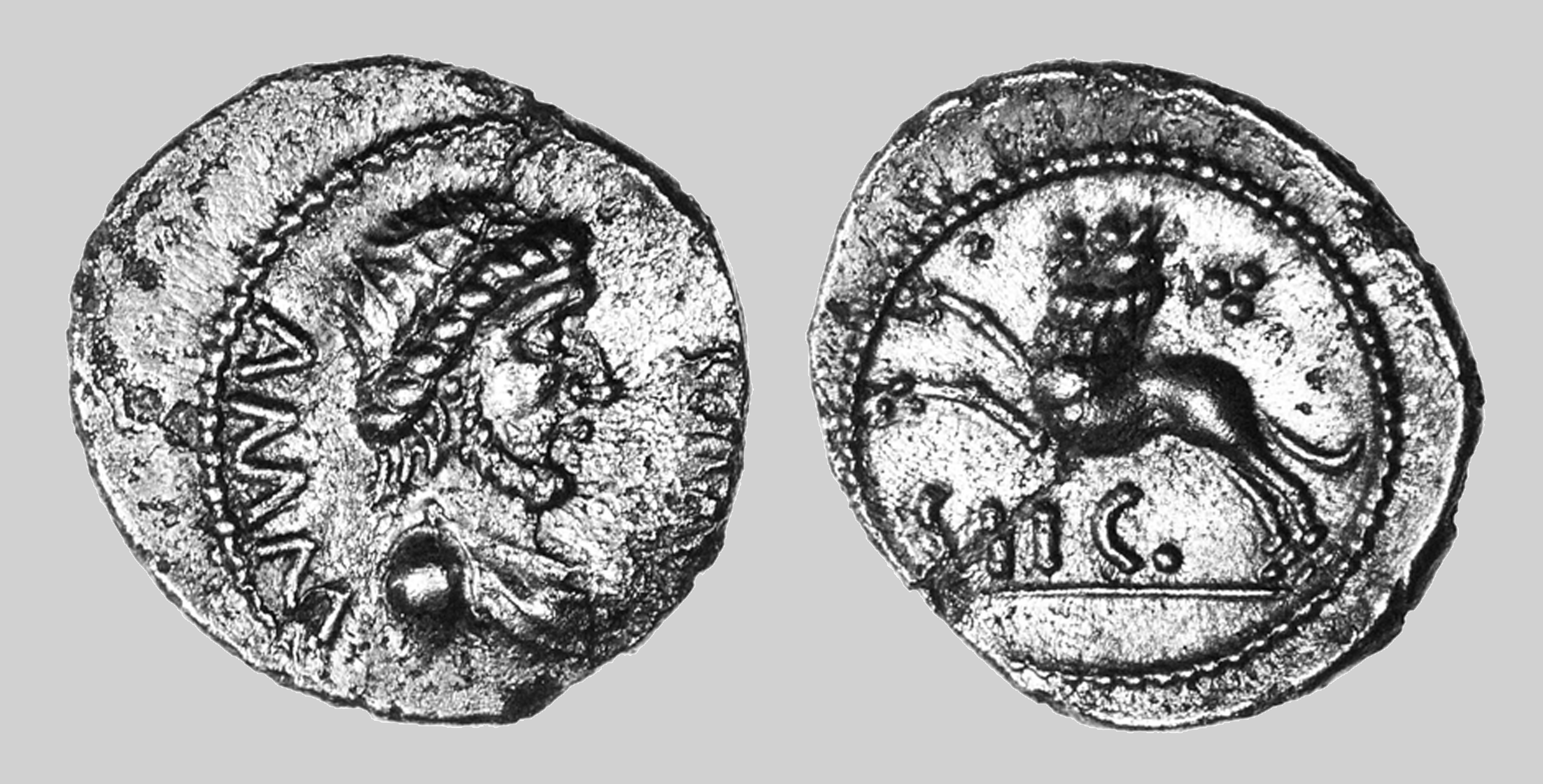 The flight of Amminus (~40)
The first known ruler specifically of Kent was a Brython called Amminus. He was a son of Cunobelin, the Catuvellauni warlord who presided over most of South-East Britain during and beyond the time of Christ. As evidenced by coin finds, Amminus specifically ruled the Cantii. The Roman historian Suetonius reports that he was unseated around the year 40 and fled Britain. The reason is unknown: he may have rebelled unsuccessfully against his ageing father, or his brothers Caratacus and Togodumnus may have deposed him because of his Roman sympathies. He fled to the Rhine with his supporters and bowed there to the megalomaniac Roman emperor Caligula, who trumpeted this supposed triumph. ‘Adminus’ encouraged Caligula to invade Britain; but, though plans were made, the notoriously undependable imperator did not see them through. Nevertheless, the Romans’ refusal to extradite him may have exacerbated his brothers’ hostility to Rome, which was to provide a key pretext for Claudius’s full-scale invasion in 43.
 The Battle of the Medway (43)
The first battle on British soil recorded in history took place in Kent. Following the Roman invasion under Aulus Plautius, the native Britons under Caratacus and Togodumnus were beaten in two skirmishes in East Kent, and retreated to the Medway somewhere between Aylesford and Rochester. According to the historian Cassius Dio, who provided the only account of the battle, the pursuing Romans arrived to find them massed on the western bank, and a battle ensued. Unusually, it lasted two days, suggesting that it was hard fought. On the first, auxiliaries swam across the river to attack the British chariot horses while the main army crossed the river in the confusion. On the second, Hosidius Geta’s legion mounted a surprise attack. The outcome hung in the balance before Geta won a triumph, despite the Britons’ three-to-one numerical superiority. Around 5,000 Britons were killed, and 850 Romans. The Celts retreated to the Thames, but were only delaying the inevitable.
 The Battle of Ebbsfleet (466)
The Dark Ages are so called not because they were uneventful or miserable, but because they left us next to no contemporary records. Those accounts that exist were mostly written long after the event, are short on detail, and seldom tally. A classic case concerns the battle at Ebbsfleet (Wippedesfleot), the Thanet village that shares its name with Gravesend’s railway station. We can deduce that, in 449, Germanic warriors were invited in by a Brythonic overlord to assist in his war with the Scots. They eventually turned on him and sought to take possession of Kent. A war followed, with landmark battles probably at Aylesford (455) and Crayford (457). By 466, the invaders were driven back to the place where they’d first entered Britain, and possibly forced to flee. Yet, determined to have their prize, they must have returned with a bigger army that drove out the Brythons for good. Undeniably Ebbsfleet heralded the dawn of the 400-year Kingdom of Kent.
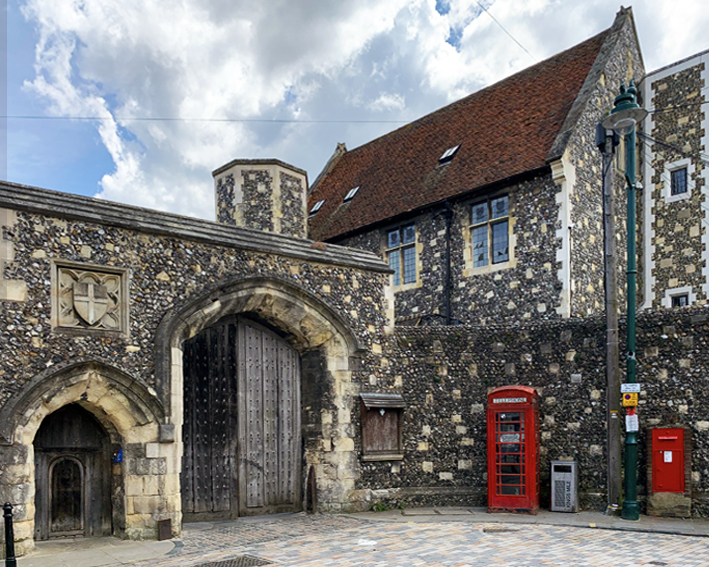 The foundation of the King’s School, Canterbury (597)
The King at the time when Kent’s premier school was founded was not the usual Edward, George or Henry; it was Aethelberht. The bewildering fact is that the King’s School was founded nearly a thousand years before both Eton and Harrow. Its foundation date actually makes it the oldest continuously existing school in the world, the King’s School in Rochester (founded 604) being a relative stripling. It was the brainchild of St Augustine, who initially got teaching underway at his new Abbey. It acquired its present name from King Henry VIII, who granted it a royal charter in 1541 after the Dissolution of the Monasteries. It started admitting girls in the 1970s, and became fully co-educational in 1990. King’s now can accommodate around 900 pupils in 16 houses, of which 13 are boarding-houses. Its most famous alumni are Christopher Marlowe and Sir William Harvey, although the one best known to today’s pupils is probably children’s author Sir Michael Morpurgo.
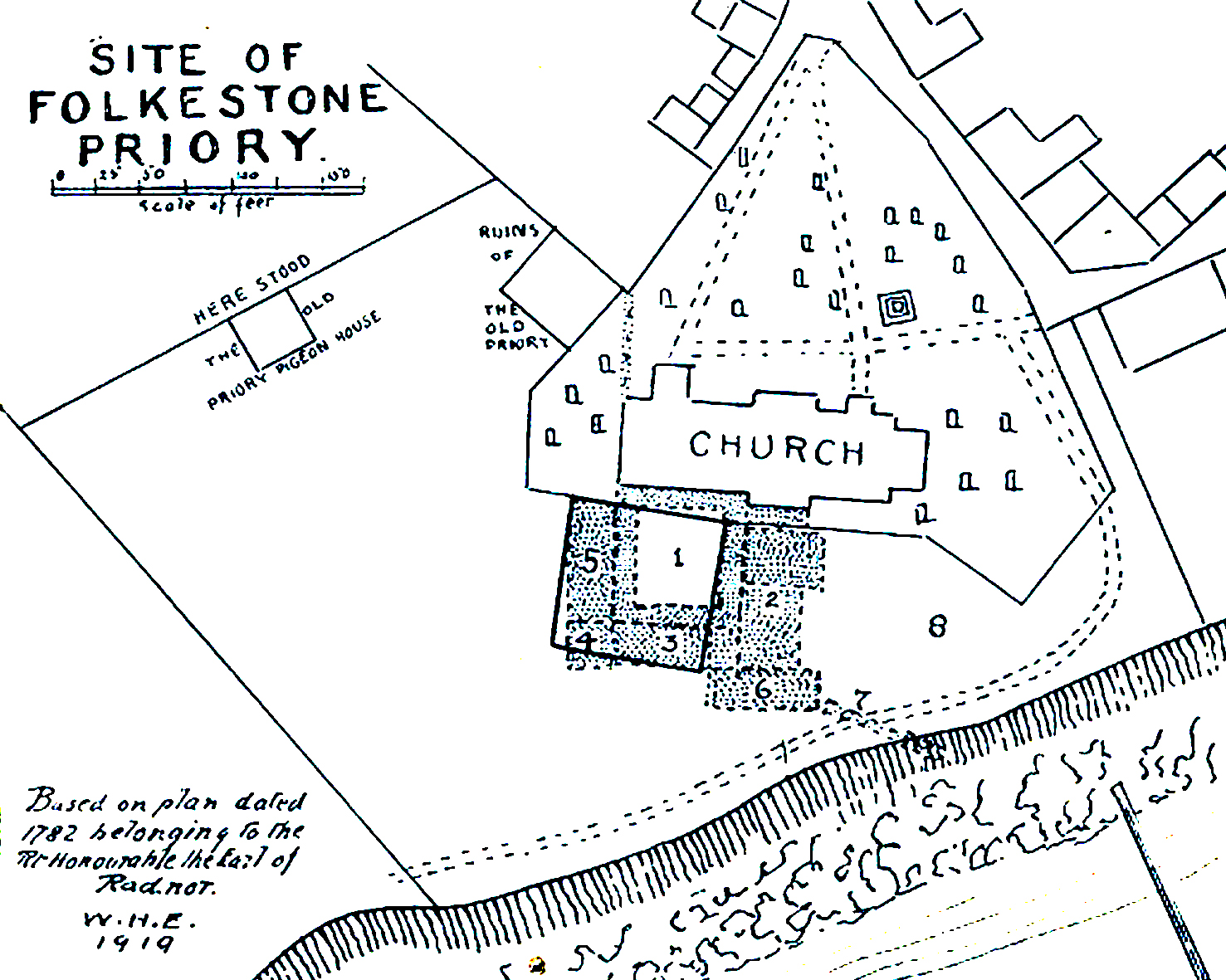 The foundation of Folkestone Abbey (ca 630)
There is no point in looking up Folkestone Abbey on Tripadvisor: it ceased to exist many centuries ago. In its day, however, it was a significant institution, being the first ever nunnery to be established in England. Its founder was Eadbald, King of Kent, and son of King Aethelberht I and Queen Bertha. He had it built for his daughter Eanswith at the time of her birth around 630; she may have served as its abbess, for she was later canonised despite dying at around 20. Unfortunately, it was unable to withstand the depredations of Danish Vikings, and what remained of it eventually fell into the sea. In 1137, however, a monastery known as Folkestone Priory was built nearby. Eanswith’s bones were reburied within the walls of its chapel, which stood on the site of today’s St Mary and St Eanswythe’s Church. Interestingly, the bones of a young female discovered there in 1885 have now been dated to the C7.
 The 1st Battle of Otford (776)
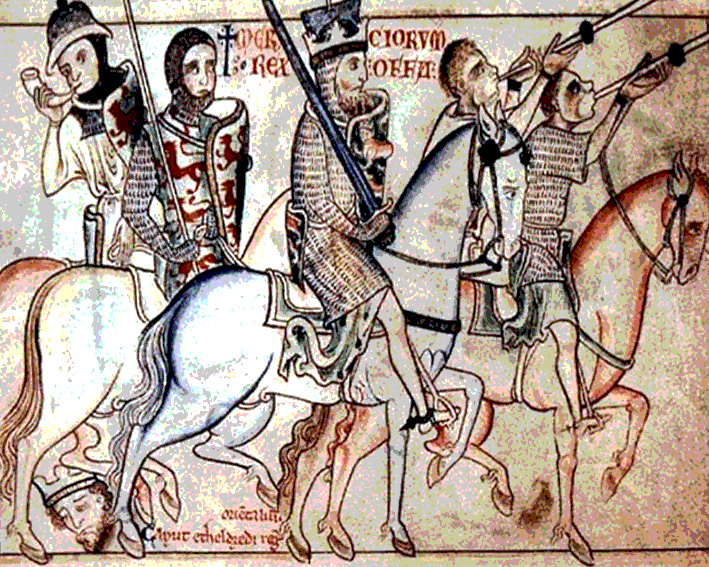
After the Kingdom of Kent had enjoyed three centuries of affluence and relative stability, the peace was disturbed in the usual manner: by a megalomaniac bent on empowering and enriching himself. The change was occasioned by the death of King Aethelberht II in 762. Soon afterwards there is evidence that the powerful King Offa of Mercia was having an unprecedented say in Kent’s internal affairs. By 785, Offa was plainly the direct ruler of Kent, having subsumed it into his Mercian domain. In between, the ‘Anglo Saxon Chronicle’ gives us tantalising evidence of a battle at Otford in which the Kentishmen took on their mighty opponent. The record does not say who won, but the fact that King Egbert issued his own charters afterwards suggests a temporary reverse for the master. The following year, however, he won an important victory over his main rival, Wessex, and was again able to turn the screw on Kent. Independence would not be restored until his death in 796.
 The 1st Battle of Sandwich (851)
By the middle of the C9, the threat from the East presented by red-bearded men in longboats was serious, and incessant. They didn’t always get their own way, however. In 851, King Aethelstan of Kent took on a large Viking fleet off Sandwich. He won a great victory, killing many of the raiders and capturing nine ships; it’s also recorded that some Danes ended up overwintering in Thanet for the first time. The battle has been labelled the first recorded sea battle in British history. It was doubly auspicious that the locals should have won it. For Kent, it was fine achievement for a county that would go on to be a mainstay of naval enterprise. For Britain, it was a classic victory over a world-class opponent for a nation that, a thousand years later, would possess the finest fleet in the world. Unfortunately, it would provide only short-term respite against an implacable foe.
 Alfred the Great’s last campaign (893)
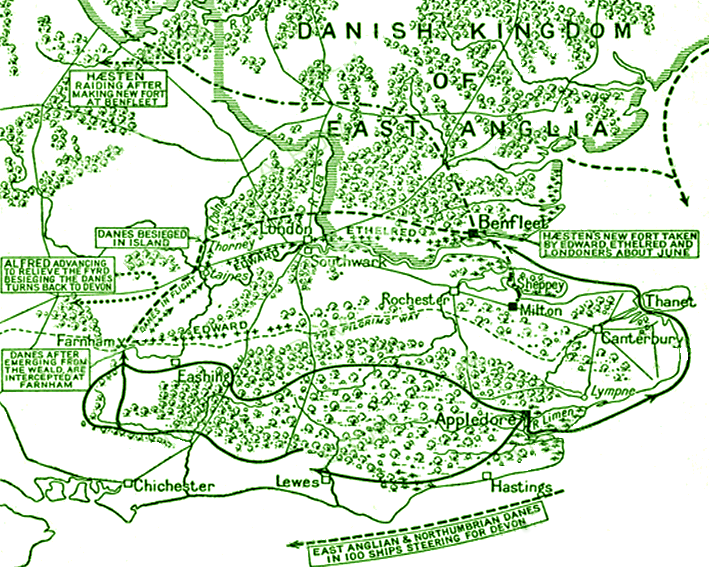
In the late C9, the Great Heathen Army from Denmark annexed the north of England, initiating a tribal division that persisted into the Middle Ages and beyond. Although King Alfred put a stop to the Danes’ southward encroachment at Edington in 878, the assurances he secured from the beaten enemy were broken 15 years later by a concerted invasion. Intent on settling with their families, 250 shiploads of Danes landed in the Rother estuary and established a large camp at Appledore, while 80 more disembarked from the Thames estuary at Milton. They headed west and north, but Alfred’s son Edward drove them into Essex, while the king hurried west to expel another force that had sailed from the Danelaw to take Exeter. Alfred’s son-in-law Aethelred then led an Anglo-Welsh army that crushed the remaining invaders on the Welsh borders. The English victory brought a century of relative peace, which lasted until Sweyn Forkbeard had fresh ideas in 1009.
 The Sack of Canterbury (1011)
Though Canterbury had more than once experienced Viking aggression, nothing prepared it for what happened in 1011. At the start of Sweyn Forkbeard’s 1009-12 campaign, his able general Thorkell the Tall had landed his army near Sandwich, intending to pillage Canterbury. The county paid him Danegeld of 3,000 pounds of silver to go away; yet, two years later, he was back. The city resisted his assault for three weeks, until the siege succeeded on account of the treachery of a certain Aelfmaer. Once in, the Vikings did all they were notorious for, including stripping the city bare, setting fire to the cathedral, and taking eminent hostages, one of them being Archbishop Aelfheah himself. After ordering his kinsmen not to pay a ransom, Aelfheah was pelted with animal bones at a drunken feast in Greenwich and murdered with an axe-butt. So traumatic was the experience that, when the Norman Vikings invaded 55 years later, Kent’s capital gave in without a fight.
 Cnut’s Kentish war crime (1014)
When King Sweyn died after just months on the English throne, his son Cnut was quickly driven out. He set sail for Denmark, taking with him his father’s noble hostages; and, at Sandwich, he paused to put them ashore. There was however a sting in the tail. On the beach, he had their hands, noses and ears cut off. This barbarity was an act of pure spite, meant as a rebuke to the English council that had sworn fealty to his father’s rule but shunned Cnut in favour of Ethelraed the Unready. These unfortunates would be a lasting reminder to Anglo-Saxon nobles of his contempt for them. It was plainly an effective tactic: English resistance folded when Cnut returned with a large army two years later. Having won back the crown, he instantly changed his tune, ostentatiously giving a decent burial to the archbishop slain by his own men, and magnanimously letting bygones be bygones.
 The 2nd Battle of Otford (1016)
King Ethelraed II’s hapless efforts to repel Cnut’s invasion came to a halt in April 1016, when he died in London. Luckily, his son Edmund Ironside was made of sterner stuff. Though most of England had given up, the young new king took the battle to the Danes. After winning back Wessex and relieving a siege of London, he headed for Kent, where Cnut was gathering his troops on the Medway. At Otford, he won a sterling victory that saw the invaders fleeing to Sheppey. Afterwards, however, he made a tragic error at Aylesford in accepting Eadric the Acquisitive back into the Saxon fold. Within weeks, during the seminal showdown at Assandun, Eadric and his men again defected, handing Cnut a decisive victory. Edmund was forced to come to terms, and within a month was dead, by fair means or foul. Cnut became undisputed king, and for once did something laudable: he had Eadric put to death.
 Godwin’s revolt (1051)
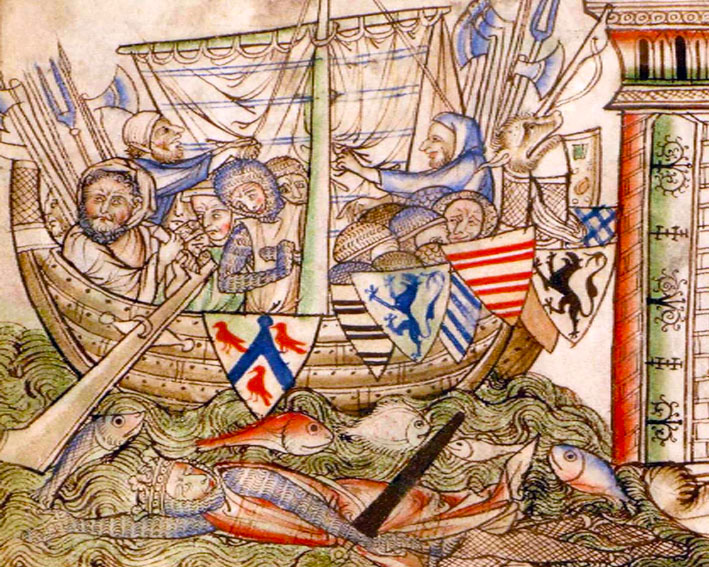
With his considerable estates in Kent and access to Kent’s elite fighting men, Sussex-born Godwin, Earl of Wessex (ca 1001-53) was arguably the most powerful man in England during the reign of his son-in-law, Edward the Confessor. In 1051, the King, perversely pursuing a strategic alliance with Normandy, provocatively appointed a Norman archbishop of Canterbury. When Eustace of Boulogne then arrived in Dover to take up the castellanship of the castle, a bloody uprising occurred. Outraged, Edward ordered Godwin to punish the townsfolk, but his sons marched instead on the royal court at Gloucester. There they were duped into talks, and all were banished. Returning with a Flemish army in 1052, Godwin forced the restoration of their estates and powers; but the truce proved short-lived. Edward supposedly promised the English throne to William the Bastard, setting the Norman on a collision course with Godwin’s younger son, Harold II. Their bitter encounter in 1066 would end terribly for all Britain.
 The Kentish Resistance (1066)
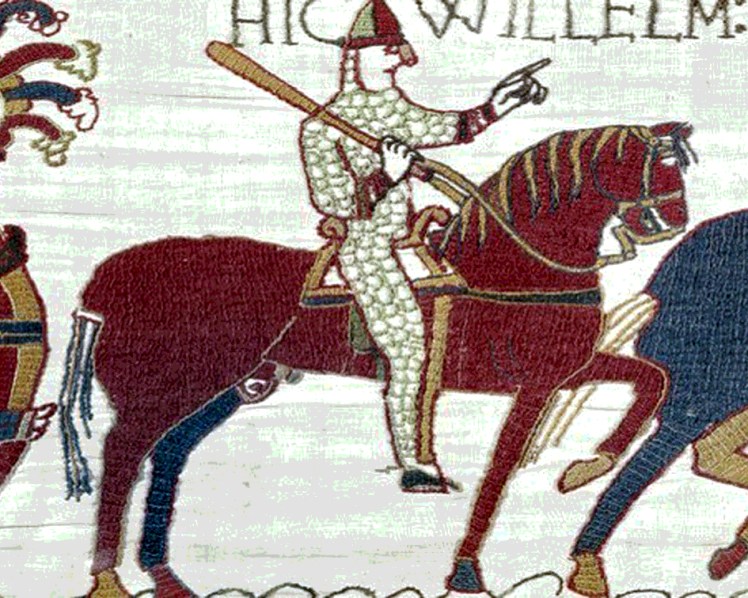
After extinguishing the English nobility at the Battle of Hastings, William the Conqueror showed zero tolerance to popular opposition. Dover and Canterbury fell without a fight. Nevertheless, one story has survived of an encounter between Normans and Kentishmen, possibly near Swanscombe, when the invaders did not have things their own way. In its crudest version, the invaders were chased out of Kent by a mob bearing staves. More subtly, a deputation approached William offering either the branch of peace or the sword of war; he opted for the former, and agreed to their demands. It may just have been symbolic of broader resistance by Kent people, but its basic truth is witnessed by subsequent events. Uniquely among counties away from the Welsh and Scottish borders, Kent was granted the status of semi-autonomous ‘County Palatine’, so retaining some of its own laws. The Conqueror was no respecter of rights, but knew a sturdy opponent when he saw one.
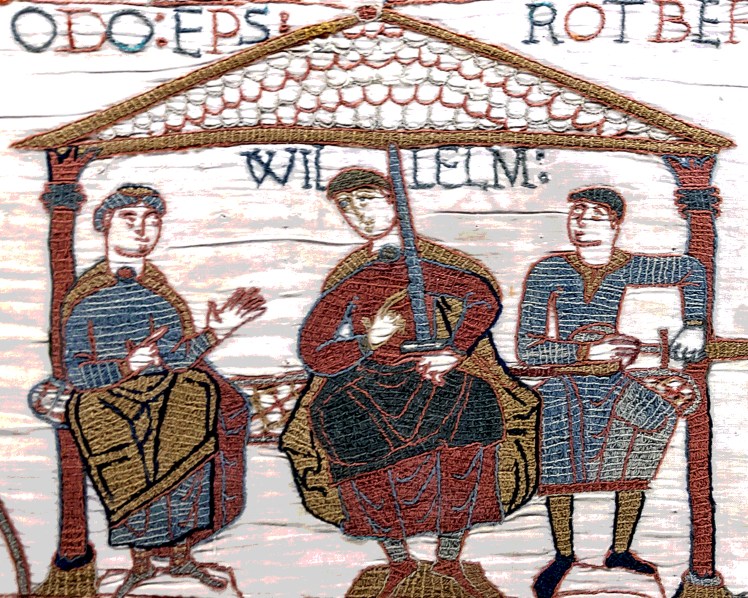 The Penenden Heath Trial (1076)
King William I’s invasion in 1066 was a historic slice of opportunism consolidated by unparalleled brutality. Because the Normans were outnumbered by about a thousand to one in their new land, he made liberal use of castle-building to overawe and oppress the populace. As the danger to himself subsided, however, he grew keen to build bridges. The first olive branch he offered was to the Church, which was hoping to recover some of its lost lands. He permitted a formal inquiry by many of the top nobles in England, even including some Saxons. It took place on Penenden Heath, north of Maidstone, and amounted to the trial of William’s rapacious half-brother Odo, who as Earl of Kent had been indicted by Archbishop Lanfranc. The nobles found against Odo and confiscated part of his possessions. William was no fool, however. Ten years later, he ordered the Domesday Survey, just so there’d be no doubt about who really owned England.
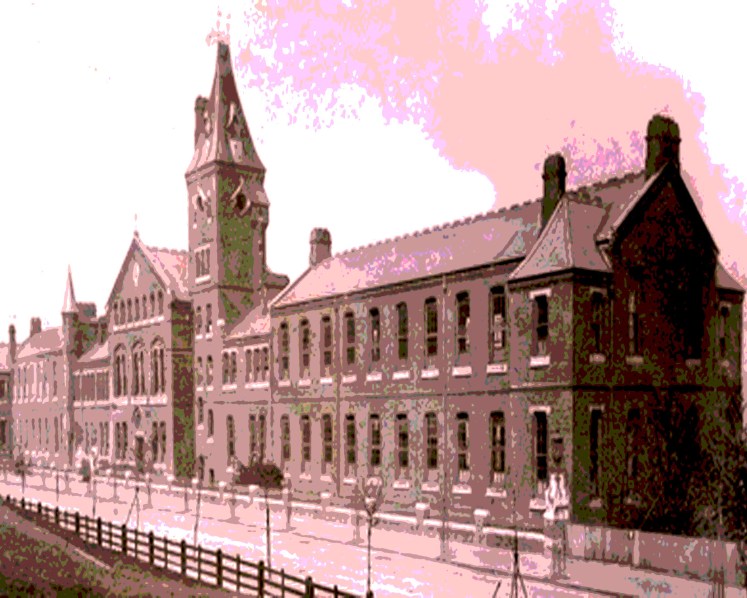 The foundation of St Bartholomew’s Hospital, Rochester (1078)
Rochester missed out on founding the world’s oldest extant school, but was compensated with Britain’s longest-running hospital. St Bartholomew’s was built by Archbishop Gundulf fifty years before its more famous namesake in London. Like the Harbledown Hospital founded six years later at Canterbury, it was intended as a leper colony, but also catered for the poor. In view of the nature of its occupants, it was built outside of the city wall in a part of Chatham under Rochester’s jurisdiction. After living mostly off the charity of the local Priory, it fell on hard times when Henry VIII dissolved the monasteries. It only recovered when the growth of the Royal Dockyard added so much to the value of the Hospital’s lands that the Crown even tried to sequestrate them. St Bart’s was expanded and modernised in the C19; but the NHS had no need for it, and it closed in 2016 amid plans for redevelopment as housing.
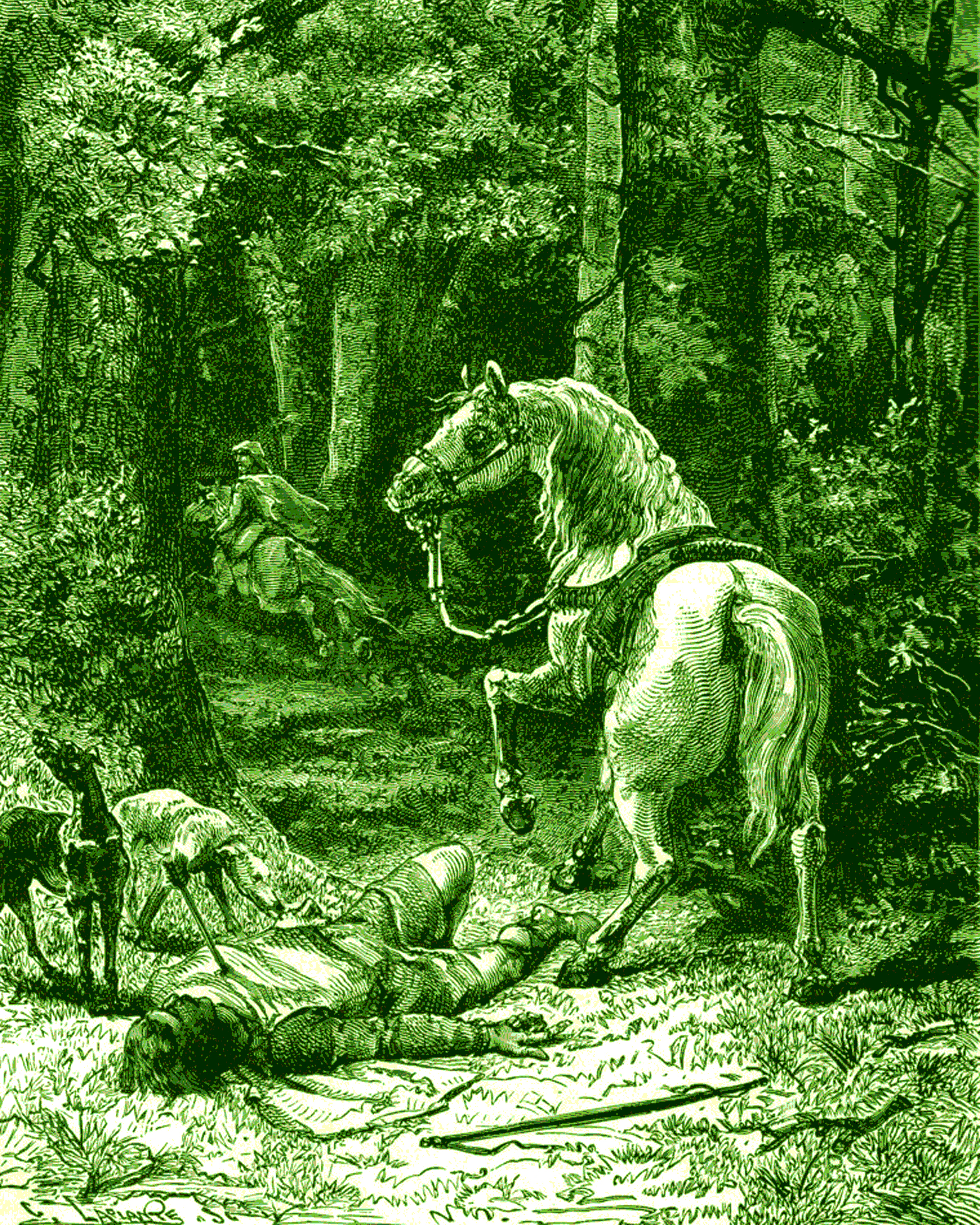 The strange death of King William Rufus (1100)
Tonbridge-born Walter Tirel, a Norman, was that rare phenomenon in English history: a regicide. Having married the daughter of the powerful Richard FitzGilbert, he found himself as close to the throne as were his brothers-in-law, the de Clares. In August 1100, they went hunting in the New Forest with King William Rufus and Prince Henry, sons of the Conqueror. Rufus gifted Tirel two new arrows, saying in Norman French, “Good archer, good arrows”; but, after the two were left alone together, the King was found dead with an arrow through his chest. Tirel had fled on horseback, and was never spotted in England again. Although the de Clares had been at war with the turbulent monarch, and Henry stood to succeed him, the chroniclers of the day – and even the Rufus Stone commemorating the deed – maintain that it was an accident: the arrow had supposedly glanced off a tree when aimed at a stag. If you’ll believe that…
 The 1st Siege of Leeds Castle (1139)
Leeds Castle, east of Maidstone, looks so tranquil that it is hard to imagine serious conflict there. The first occasion was in the C12, when King Stephen seized the throne. In 1119, Robert de Crèvecoeur had erected a stone fortress there – possibly a motte and bailey – on land that had been gifted by William II to his cousin Hamo. The Crèvecoeurs supported Empress Matilda’s claim to succeed her father Henry I, and in 1139 were in an awkward position when she invaded England with French troops. King Stephen’s forces under Gilbert de Clare laid siege to the castle. Although the Castle fell, Matilda’s forces eventually engaged Stephen in 1141 at Lincoln, where he was captured; but popular resistance to her accession barred her from formally becoming monarch. The Castle was at length returned to the de Crèvecoeurs, who managed to retain it for another hundred years before the Crown pinched it for good.
 Trial by combat on the Thames (1163)
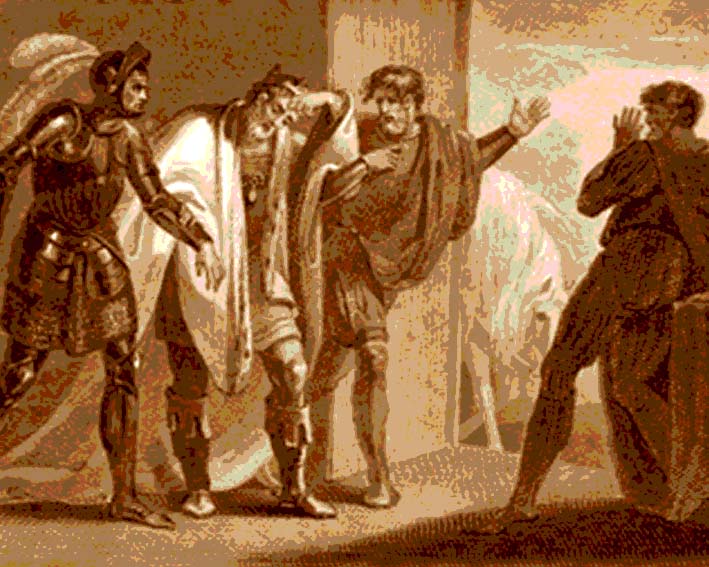
Henry of Essex, Baron Raleigh, was first noted for rebuilding Saltwood Castle before 1135, he being the local lord of the manor. He occupied several official posts under King Stephen and then Henry II, and as a king’s constable enjoyed the apparently cushy job of bearing the royal standard in battle. All was well until Robert de Montfort, who was in dispute with him over an inheritance, accused him of committing treason six years earlier, alleging that he had thrown down the standard and declared the king dead during a Welsh ambush. Despite Raleigh’s denial, the king ordered that he be tried by combat, facing de Montfort in public on an island on the Thames at Reading. Supposedly distracted by two ghostly apparitions, Raleigh was soon rendered unconscious and presumed dead; but he was restored by the Benedictines from the local abbey who carried him off. Having been disinherited, he remained there as a monk until his death.
 The assassination of Thomas Becket (1170)
The murder of the Archbishop of Canterbury, Thomas Becket, inside Canterbury Cathedral on December 29th, 1170 was a Kentish affair in more respects than the location alone. Becket, a Norman noble, had earned King Henry II’s opprobrium by repeatedly disrespecting his will. The four knights who were sent to deal with him were led by Reginald FitzUrse, who had estates at both Barham and Teston. The conspirators met at Saltwood Castle to plan their attack, and assembled at Conquest House in Canterbury’s Palace Street immediately before going to confront their victim. Although Becket had never been at all popular with the public, the manner and place of his murder caused outrage, and the Cathedral was presented with a perfect martyr who would help turn pilgrimages to Canterbury into a world-famous institution. As for the FitzUrse family, they prudently changed their name to Barham, but continued to display their bear emblem, still visible around Kent.
 The Great Fire of Canterbury Cathedral (1174)
In 1067, months after William the Conqueror was crowned King of England, England’s foremost religious building burned to the ground. Whatever the true cause, Saxons will have seen it as a sign of God’s anger. Mysteriously, after the Cathedral had been entirely rebuilt in Norman style, there was a repeat a century later. In September 1174, the building was again engulfed in flames, suffering major damage. Whole sections had to be rebuilt, this time in gothic style; the discontinuity is easily spotted today. The fire was blamed on cinders drifting across from blazing cottages nearby. However, a historian recently suggested that the actual cause was arson: Canterbury was in competition with Durham for pilgrims’ visits, so its monks were desperate to build a new shrine to the recently murdered Thomas Becket. Perhaps; but, given the paucity of hard evidence, one might as well argue that God was reacting to the recent canonisation of the “turbulent priest”.
 England’s first state visit (1179)
When 14-year-old Philip, heir to the Frankish throne, fell sick, his father Louis VII felt obligated to pray at Becket’s shrine in Canterbury Cathedral, and England’s Henry II hurriedly assembled an entourage to greet him on Dover Beach. It was a fraught encounter. Louis had been wed to Eleanor of Aquitaine, but the marriage was annulled when no son ensued, leaving her free to marry the English king. She and Louis had been close to Becket, and his murder at Henry’s ambiguous behest so infuriated her that she conspired with their eldest son Henry to rebel against the King, and urged Louis and other foreign potentates to invade; only vigorous military action had ended this Great Revolt. Now reconciled, Henry and Louis prayed before the martyr’s tomb before returning together to Dover, the unprecedented royal visit completed without mishap. Young Philip duly survived, but young Henry died unforgiven, and Eleanor remained imprisoned until her husband’s death.
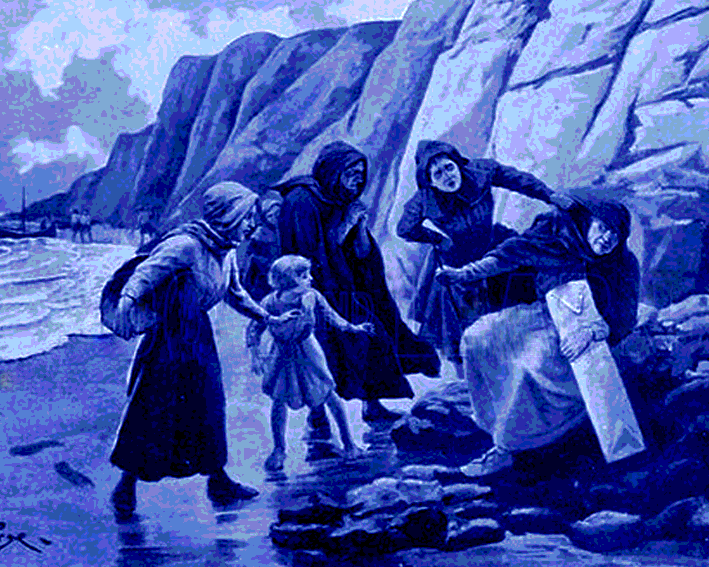 The Flight of William de Longchamp (1191)
Born in Normandy, William de Longchamp set out to ingratiate himself with Anglo-Norman royals. He worked first for Henry II’s son Geoffrey, but transferred his loyalty to the more ambitious Prince Richard. When the latter was crowned in 1189, he granted Longchamp the title of Chancellor, for which the Norman paid £3,000 when Richard went crusading shortly afterwards. Transformed overnight from non-entity to regent of England, Longchamp quickly alienated himself by refusing to learn English, living ostentatiously, and preferring his compatriots over Anglo-Normans in official appointments. Richard’s younger brother John rebelled against the upstart, who in 1191 was forced to flee the country. At Dover, where his brother-in-law was castellan, he disguised himself as a monk and then a woman, in which guise he was discovered; in another version, he was mishandled by a lascivious fisherman. Having eventually escaped, he traced the King to his place of imprisonment in Germany and paid the ransom that secured Richard’s release.
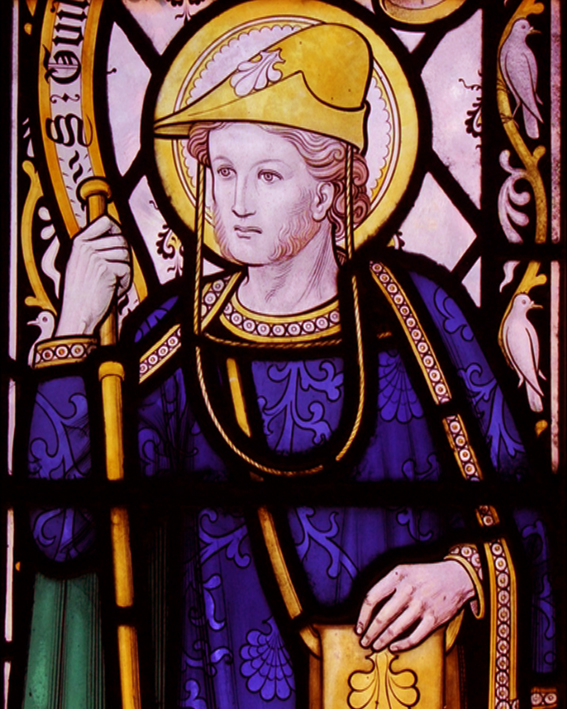 The murder of St William of Rochester (ca 1201)
William of Perth in Scotland was a well-to-do baker known for his kindness. He adopted an orphan he came across at a church, naming him ‘Cockermay Doucri’ or Foundling David, and taught him his trade. His piety led him to undertake a pilgrimage to Canterbury, taking his ward with him. After they had lodged for three days at Rochester, the lad led him astray, hit him over the head, cut his throat, robbed him, and disappeared. According to legend, a madwoman found William’s body and unaccountably placed a garland on his and her own head, curing herself of her madness. The brothers of Rochester decreed the occurrence miraculous, and buried the corpse in the Cathedral. In 1256, the Bishop persuaded Pope Alexander IV to canonise William, and a shrine was built. This now world-famous tale has inevitably provoked cynical speculation that it was cooked up by prelates seeking a lucrative competitor to Becket’s shrine at Canterbury.
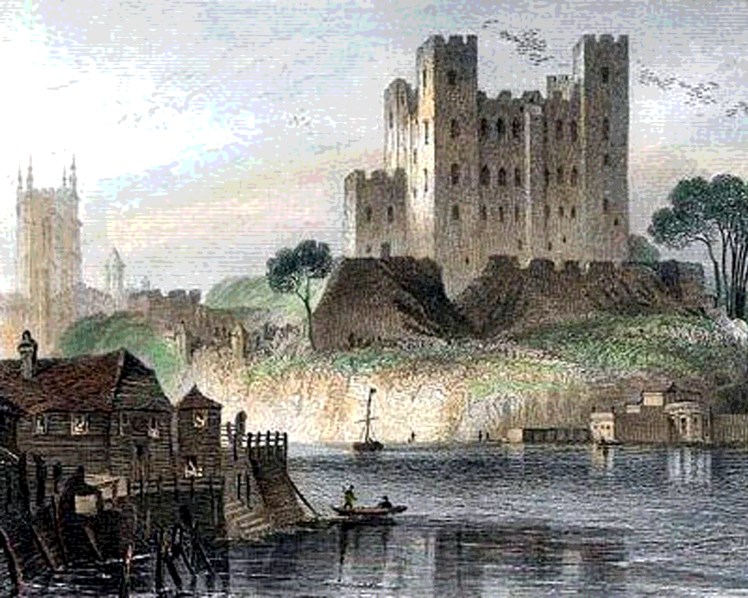 The Siege of Rochester (1215)
The signing of Magna Carta in June 1215 is usually presented as the end of a conflict. In truth, it was the start of a worse one. Marching from Dover to London in October 1215, King John found his path blocked by Rochester Castle, which controlled the river crossing. The rebel barons had taken the initiative by sending William d’Aubigny to reinforce it, and the city constable had admitted his troops. Ironically, John had commissioned expensive repairs not long before. He decided on a siege. Despite his best efforts, including lighting a fire in a mine that collapsed a corner of the keep, he could not break the defenders’ resistance. At length it was starvation that did for them. Apart from cutting off the hands and feet of some who had agreed to leave the castle early, the King was persuaded to treat his prisoners with uncustomary clemency. It was however the beginning of the end for him.
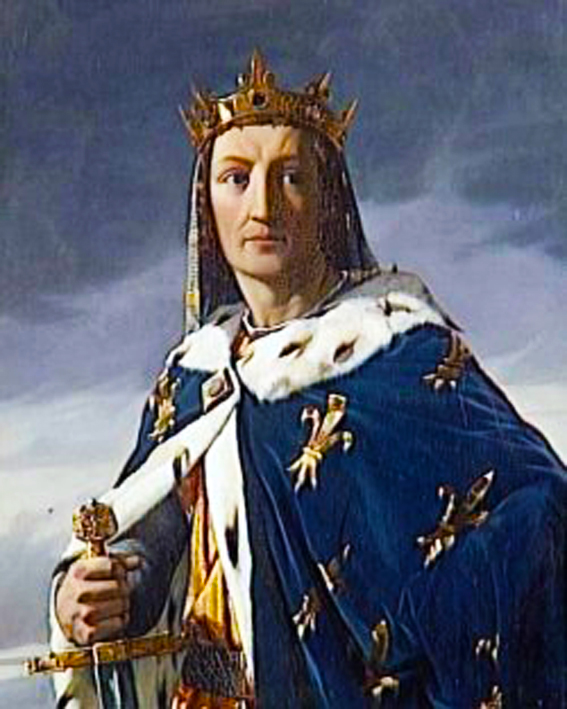 The French Invasion (1216)
The First Barons’ War (1215-17) was a civil war on English turf between Normans loyal to the atrocious King John and Normans prepared to do anything to dethrone him. The barons who’d forced the King’s hand at Runnymede were still unhappy, and next invited Louis, son of King Philippe II of France, to join them in deposing the King of England. Ignoring his father’s and the Pope’s warnings, Louis sent a vanguard of knights to London, and then an invasion fleet. His army landed in Thanet in May 1216. King John abandoned the county to its fate, and Louis marched unopposed to the capital. Like Hengist before him, he had arrived as a mercenary, but now had an appetite for conquest. He was proclaimed King of England by his supporters, and went off to suppress much of the South, while John skulked in the West. Nevertheless, Louis and Kent still had unfinished business.
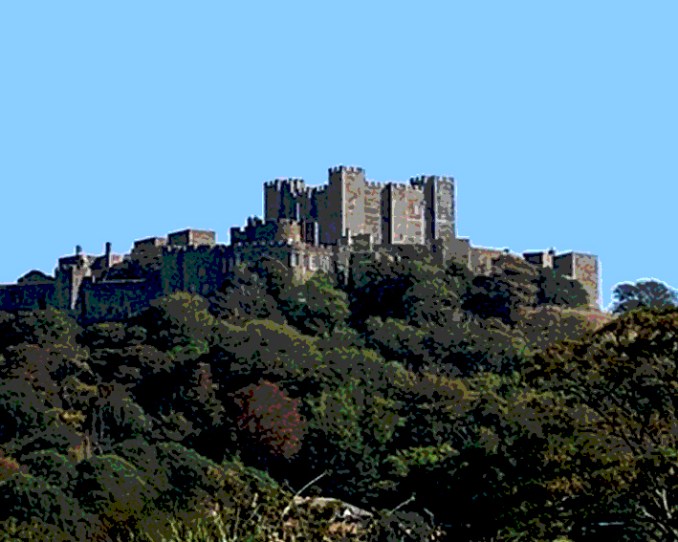 The Siege of Dover (1216-7)
Although young Prince Louis’s exploits in England had earned him the sobriquet ‘le Lion’, the war was not over. He had Canterbury and Rochester under his control, but the crucial port of Dover was still holding out. In July 1216, he headed back east to remedy the omission. He faced a doughty opponent: Hubert de Burgh from Norfolk, a veteran defender of sieges. The French successfully undermined the Castle barbican, and then brought down one tower of the gatehouse; but their massed assault was bloodily repulsed. After failing to starve the defenders out, Louis agreed a truce in October. King John died four days later, but de Burgh continued to resist on behalf of child king Henry III. Louis departed the scene, returning in May 1217 to renew his assault with a huge siege engine. Resistance remained fierce, however, both from the sea and Willikin of the Weald’s heroic guerrilla warfare. This time, Louis gave up for good.
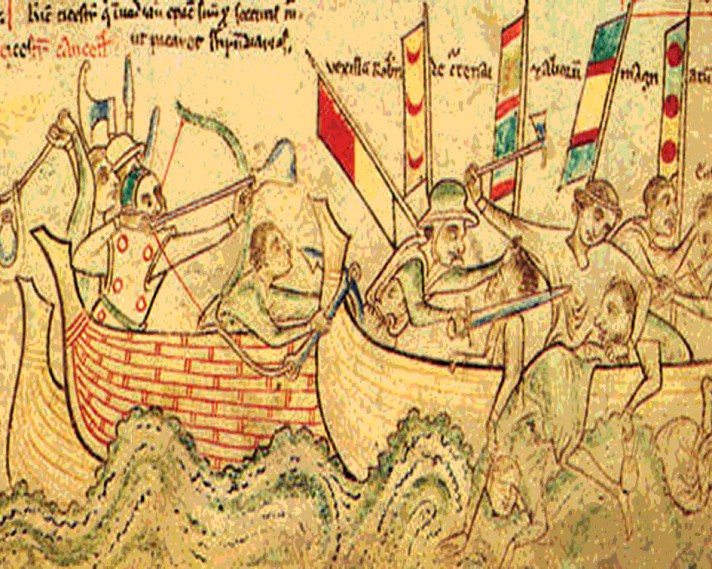 The 2nd Battle of Sandwich (1217)
De Burgh’s indomitability at Dover Castle tied up the invaders’ resources so seriously that Prince Louis’s allies in the North were emphatically defeated at Lincoln. After retreating to London to regroup, Louis sent for a supply fleet from France. It was commanded by mercenary pirate Eustace the Monk, carrying troops commanded by Robert de Courtenay. On August 24th, de Burgh led the English fleet, using a battle-plan worthy of Nelson. He allowed the heavily laden French fleet to pass Sandwich before setting sail, looping behind them to attack from the windward. English archers used the wind to wreak havoc, whilst lime was released into French eyes. The invaders were routed, and Eustace was beheaded on deck. Louis renounced his claim to the English crown and went home; there’d be no King Louis I of England after all. He’d been beaten by Kentish pluck, on land and at sea. In its consequences, it was like Waterloo and Trafalgar combined.
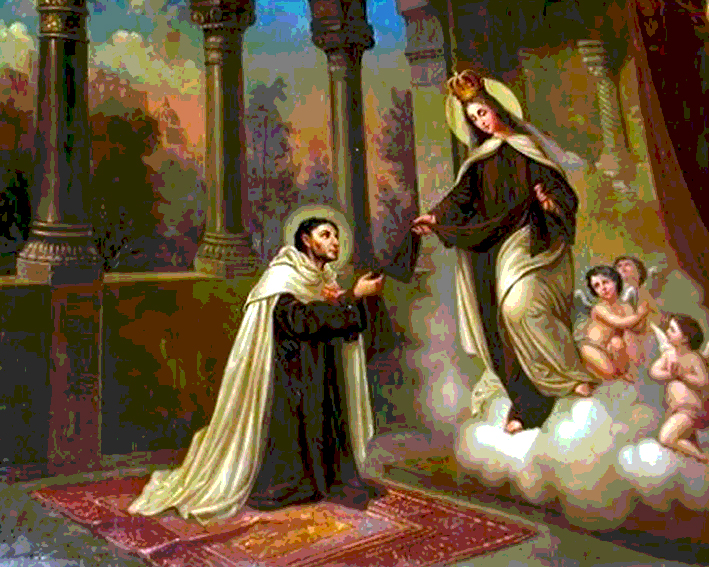 The Marian Apparition at Aylesford (1251)
St Simon Stock (d 1265) was a supreme ascetic, living in a hollow tree at Aylesford on water, herbs, roots, and apples. According to Catholic legend, the Virgin Mary appeared to him on July 16th, 1251 and gave him a brown scapular – a cloak now closely associated with Carmelites, the order of monks that sprang from hermits in the Mount Carmel range in Palestine. England’s first Carmelite priory had been founded at Aylesford in 1242 by returning crusader Ralph Frisburn, and Stock duly became its prior general in 1254. He died and was buried in Bordeaux, though a fragment of his skull was sent to be enshrined at Aylesford in 1951. Claims that the apparition was a later invention were refuted by a Carmelite friar in 1642, but his written evidence proved a forgery. Nevertheless, Pope John Paul II lauded the tradition in 2001, the 750th anniversary. Stock is remembered in the name of a Catholic school in Maidstone.
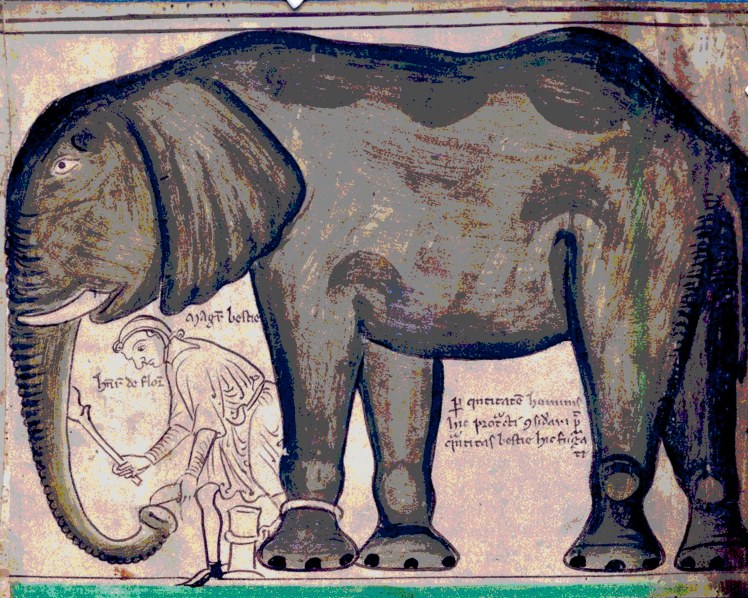 An elephant fit for two kings (1255)
In 1255, the Sheriff of Kent got an order from King Henry III that must have given him a mammoth headache. There’s an elephant waiting near Calais, it said, and you’re to get it to the Tower of London for my menagerie. The county had little practice in shifting pachyderms around, its only previous experience being one that arrived at Sandwich with the Romans in AD 43. This one was a gift from Henry’s French brother-in-law, Louis IX. It was ten years old and ten feet high, and Louis had been gifted it by the Egyptians, who were after an alliance against the Syrians. It’s not recorded whether the Sheriff ferried it straight to Deptford, or landed it at Dover and made it walk; but he did rack up nearly £7 in expenses. There’s a story that it made mincemeat of a Kentish bull that took umbrage at its presence, though that may just be a rural myth.
 The great South England flood (1287)
Anyone wondering why Tenterden is a Cinque Port nine miles inland need look no further than the flood of 1287. During the C13, there were six violent storms that wreaked havoc with Kent’s southern coastal towns. The mother of them arrived in February 1287, striking with such violence that there was widespread flooding. The subsequent sedimentation changed the coastline dramatically, not least by filling in the bight beside which Tenterden sat. Also affected was New Romney, hit by an avalanche of gravel that physically moved the town a mile inland. The Rother found a new outlet at Rye, which was elevated to the status of a Cinque Port at New Romney‘s expense. Also in Sussex, Winchelsea was obliterated, and had to be rebuilt on the top of a cliff, while Hastings lost its harbour when a cliff collapsed. Even so, England could consider itself lucky. That same year, a storm further east caused the death of 50,000 in Holland.
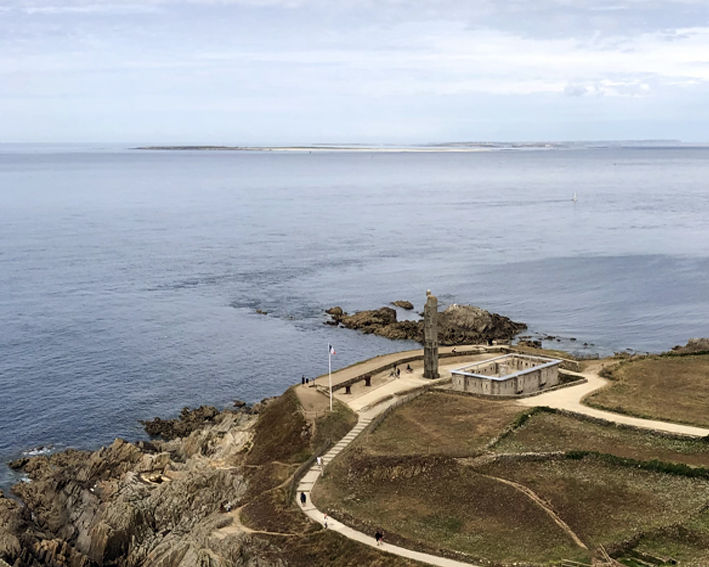 The battle of Pointe Saint-Mathieu (1293)
Even before the creation of the United Kingdom, English fleets had by far the better of nearly two dozen major sea-battles with France during five centuries when the two were seldom at peace, despite France’s far greater territory, population, and resources. One of the most striking demonstrations of English seamanship and martial spirit occurred in 1293. It all started when a Norman and a Bayonnais (then English) ship arrived simultaneously at a Breton spring. A dispute arose over priority of access, and a Frenchman was killed. The Normans and French conducted a series of such horrific reprisals on English merchant vessels that the semi-autonomous Cinque Ports, disregarding Edward I’s peace efforts, gathered a fleet of 100 vessels bent on vengeance. On May 15th, these ‘Portsmen’ engaged a 200-strong French fleet off Britanny, and sank or captured practically all of it. The French humiliation catalysed the nine-year Gascon War, eventually settled by royal marriages.
 The 2nd Siege of Leeds Castle (1321)
Whatever King Edward II’s other vices, the one that gave rise to the greatest antagonism was his indulgence of the gangster-like Despenser family. Kent-born Bartolomew de Badlesmere, who had been granted stewardship of Leeds Castle, joined the party of barons opposing them. While he was at Oxford attending a meeting of these ‘Contrariants’, the blue touchpaper was lit. The King got his wife Isabella to detour to Leeds and demand to be accommodated. This was a smart move, because Badlesmere’s wife Margaret was known to detest her. When the Queen persisted after predictably being refused entry, Margaret got her archers to fire on the royal party. Six were killed. The King mounted a major siege that the Contrariants opted not to interfere with. Margaret surrendered after a fortnight and became the first woman to be imprisoned in the Tower. Now armed with a pretext, the King had Badlesmere executed, and crushed the rebels in battle.
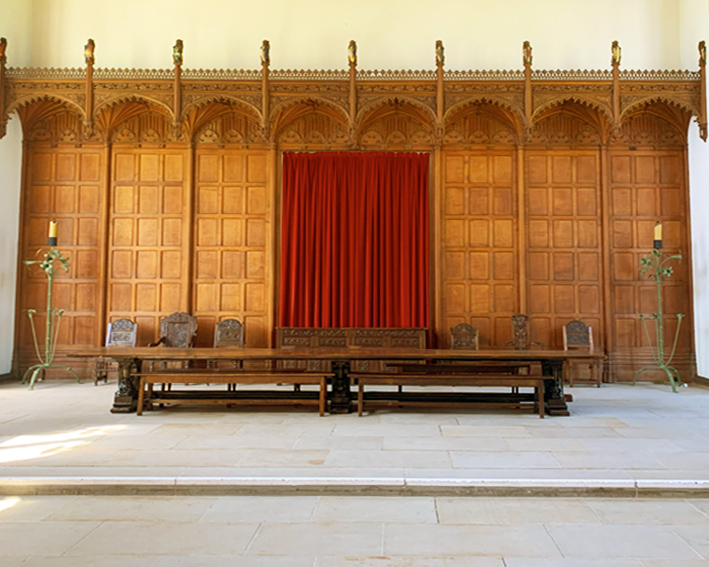 The Banquet of the Four Kings (1364)
The ‘Banquet of the Five Kings’ sounds a grand coming-together, especially when you are told it was organised by a former Lord Mayor of London and hosted by the Vintners’ Company, which had just received its Royal Charter. The snag is that it never happened. The host, Edward III, was around, as were the French king John II, a long-term hostage, and David II of Scotland, a former prisoner but also Edward’s recently widowed brother-in-law. A third guest, Valdemar IV of Denmark, turned up en route to France; but the last of the five, Peter I of Cyprus, had already left before Christmas. Edward did however entertain the others on the 12th day of Christmas, 1364 in the great hall at Eltham Palace. We know this because it is commemorated in a stained-glass window. Poignantly, although Edward was comfortably the oldest, he would outlive them all.
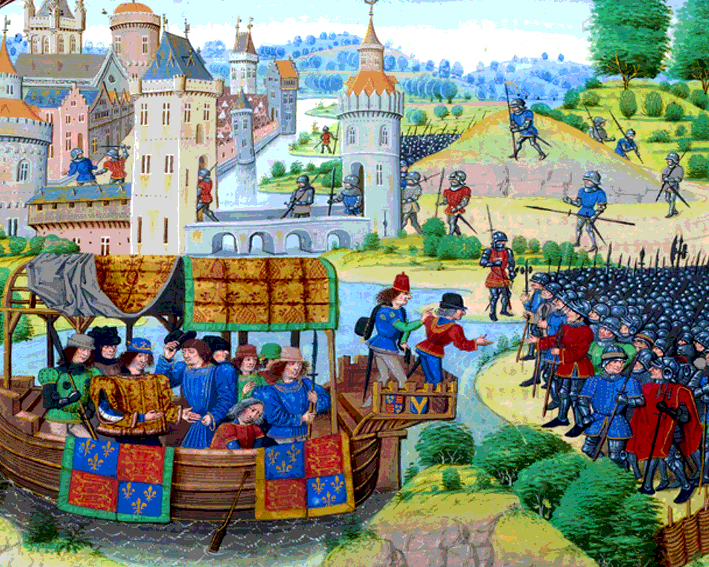 The Peasants’ Revolt (1381)
The Black Death of 1348 killed half the population of England. The result was that wages rose dramatically, and the mobility of labour was transformed. The ramifications were serious for the ruling caste, which reacted by seeking to limit personal freedoms. Coincidentally, the Hundred Years’ War was going badly, and a series of poll-taxes designed to raise funds exacerbated popular hostility. When the people of Brentwood in Essex refused to pay, there was open unrest, prompting a general insurgency across the South-East. The flashpoint was the imprisonment of Robert Belling, an escaped serf from Gravesend. Rebels released radical preacher John Ball from Maidstone Gaol and marched on Rochester Castle, successfully freeing Belling. Wat Tyler took control of the revolt, capturing Canterbury and assembling an army at Blackheath before causing mayhem in London. He overreached himself, however, and was killed at Smithfield. Without his leadership, the rebellion fizzled out. The debacle nevertheless remains a landmark in the revolutionary mythos.
 The Dover Straits earthquake (1382)
Although the North-West of Europe is not normally associated with newsworthy seismic activity, an area of instability does exist to the east of Kent. On May 21st, 1382, it was the epicentre of an earthquake that caused structural damage as far away as London. There is no record of a tsunami, but the quake is estimated to have been in the region of 6 to 6.5 on the Richter scale. The effects in Canterbury were considerable, including the partial collapse of St Augustine’s Abbey and the Cathedral. Even as far away as Hollingbourne, the church and manor suffered serious damage. Fortunately, no deaths were recorded. The earthquake occurred a year after the Kent-based Peasants’ Revolt, and was a sure sign of God’s displeasure with either the King or the rebels, according to perspective. Certainly it disturbed the ‘Earthquake Synod’ in Blackfriars, where the Archbishop of Canterbury construed it as a portent endorsing the persecution of supposed heretics.
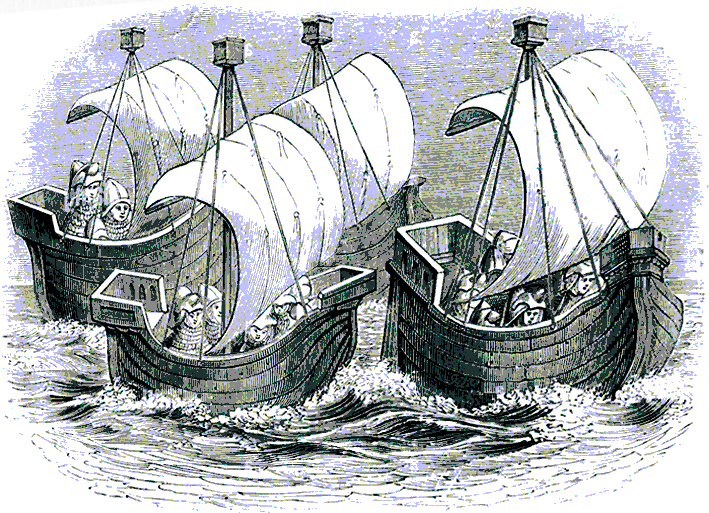 The battle of Margate (1387)
The Channel couldn’t stop the Norman invasion in 1066, but the new ruling caste’s bellicosity, combined with Anglo-Saxon hardiness, proved a tough nut to crack thereafter. Among the several would-be conquerors thrown up by Europe over the centuries, one of the earliest was the French protector Philip the Bold, who in 1386 assembled an invasion army of 30,000 in Flanders. After illness forestalled his plans, part of the vast fleet he had gathered was used to escort French, Dutch, and Spanish merchant shipping in the Channel. In March 1387, Richard Fitzalan, the Earl of Arundel, sailed from Sandwich with 51 ships and attacked a ~300-strong convoy off Margate. What enemy ships were not captured or scattered were driven into Sluis harbour. Fitzalan followed them in and, like a true-born Viking, burned and pillaged for a fortnight. The merchant ships he captured yielded 8,000 tons of wine that was sold off cheaply in London, sealing his popularity.
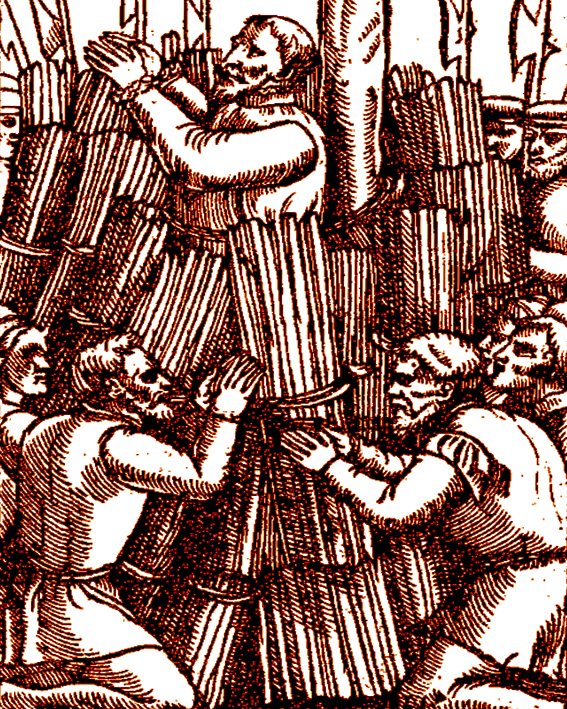 The martyrdom of William White (1428)
Since time immemorial, political tyranny has operated by propagating a rigid orthodoxy that all interested parties will unquestioningly parrot, no matter how irrational, but whose very unreasonableness invites overt rejection by opponents; the point being that they can then be identified, judged criminal, and eliminated. In the centuries following the Norman Conquest, the approved orthodoxy was religious. A typical casualty was William White, a supporter of Wycliffe‘s anti-establishment doctrine, who moved from Kent to Ludham, Norfolk to preach it. In 1428, he was arrested as a Lollard, tried at Norwich, found guilty of heresy, and burned alive at Lollard’s Pit outside the city walls, doubtless to the satisfaction of the complaisant masses. If a charge of heresy would not stick, there was always treason, while the relatively few female dissenters could be mopped up as witches. The Norwich Heresy Trials continued for three years, and saw 51 men and nine women brought to injustice.
 The Eleanor Cobham witch trial (1441)
El & Humph were the C15 supercouple. He was the Duke of Gloucester, uncle and protector of the boy King Henry VI. She, a lady-in-waiting to his wife Jacqueline d’Hainault, was his mistress. After divorcing Jacqueline, Humphrey settled with Eleanor at Placentia Palace in Greenwich, where they ran a celebrated court frequented by the artistic slebs of the day. She was known for beauty and wits, he for sophistication and hedonism. When he became heir presumptive to the throne, however, things turned nasty. Eleanor was accused of witchcraft after being told by three astrologers that the King would soon die. Convicted of treason, the three were executed, and she was made to do a harlot’s public penance before being jailed for life. An old woman who complained at Blackheath about the King’s treatment of her was rewarded with execution. ‘Good Duke Humphrey’ himself was forced to divorce Eleanor, and in 1447 died while under arrest for treason.
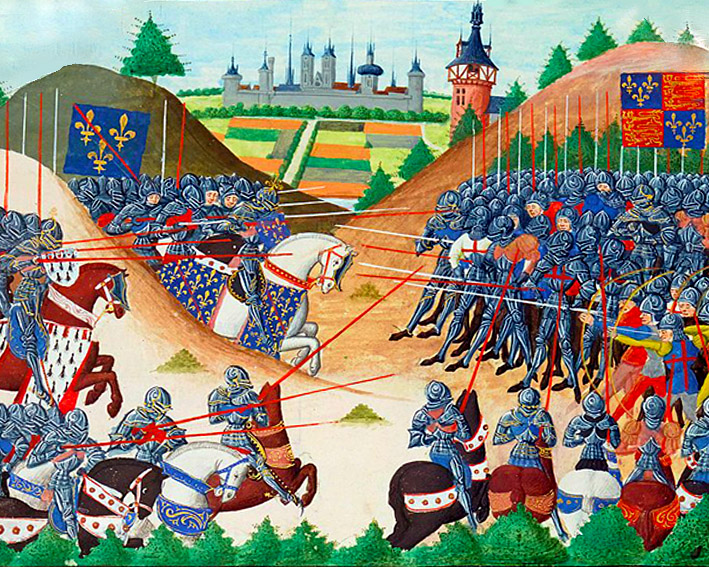 The Battle of Formigny (1450)
Nearly 400 years after the Norman Conquest, the Anglo-Normans finally lost their homeland to France. They had enjoyed glittering successes under Henry V, but his peace-loving son was unfit to rule. Spotting their opportunity, the French went on the offensive, winning immediate successes. An army despatched to Normandy to repel the threat engaged the French at Formigny, enjoying a small numerical supremacy that promised victory. The French, however, deployed cannon for the first time. As these were out of bow range, English soldiers went to capture them, but while dragging them back were attacked by French cavalry. Their formation broken, the English were picked off piecemeal, and 500 prisoners massacred. Three years later, the Hundred Years War ended, with Normandy permanently lost. Ironically, given Kent’s famous antipathy to Norman rule, the inexperienced commander at Formigny, Sir Thomas Kyriell of Westenhanger, was reputedly descended from an original companion of the Conqueror.
 Jack Cade’s Rebellion (1450)
Jack Cade was called the ‘Captain of Kent’ for good reason. By 1450, the rule of Henry VI and Margaret of Anjou was already known as much for ineptitude as for brutality. It was Jack Cade, said by Shakespeare to be from Ashford, who organised a distinctively Kentish uprising. He circulated a manifesto called ‘The Complaint of the Poor Commons of Kent’, airing the people’s grievances. Among them was being blamed for the death of the corrupt Duke of Suffolk, who had been washed up on the Kent coast. Ignored, Cade convened an army of 5,000 at Blackheath. What followed was something of a replay of 1381: a march on London, initial military successes, and revolutionary justice, followed however by a lack of self-restraint that alienated the locals. Badly beaten on London Bridge, the rebels withdrew; Cade was hunted down and slain. Though crushed, Kent’s rebellion paved the way for the Wars of the Roses five years later.
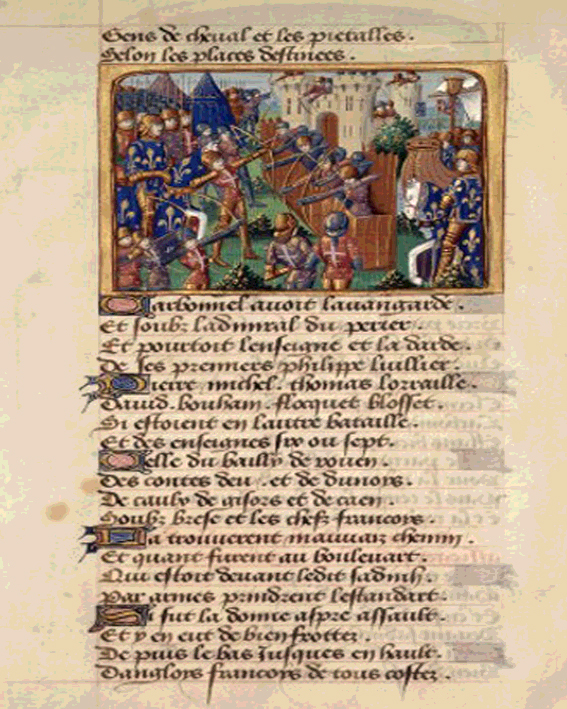 The Sack of Sandwich (1457)
No sooner than the Hundred Years’ War with France ended in 1453, the aristocracy got the Wars of the Roses started. After King Henry VI was captured in 1455, a sort of peace descended; but his French wife Margaret of Anjou continued to agitate for civil war. The supportive King of France sent a fleet from Honfleur under the command of Pierre de Brézé, a veteran antagonist of the English army. His 4,000 men put ashore at Sandwich on Sunday, August 28th, 1457. The unsuspecting townsfolk found themselves on the end of a Viking-style raid as the invaders ran amok. Apart from pillaging and burning down the town, they murdered John Drury, the mayor – a deed commemorated in the town mayor’s black robe today. Sandwich, which had been England’s biggest trading port outside London, never got over it. The motives of the French are unclear, though it could have been a pre-emptive strike in support of the baguette.
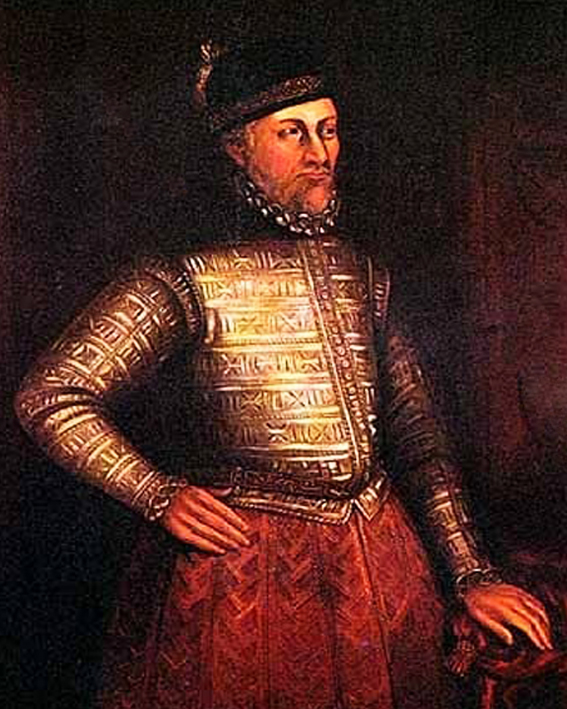 The 3rd Battle of Sandwich (1460)
The last and best remembered sea-battle off Sandwich occurred in 1460 during the Wars of the Roses. In October the previous year, Henry VI had won a walkover at Ludford Bridge, resulting in the flight of the Earl of Warwick and the future King Edward IV to Calais. By January, the royal Lancastrian fleet under the command of Maidstone-born Earl Rivers was at anchor off Sandwich. At dawn on January 15th, Sir John Dynham under Warwick’s command mounted an attack while the Lancastrian officers were still asleep. So total was the surprise that the King’s key ships were captured, along with their cannon, and Warwick was able to land his army at Sandwich. Having already made himself a hero in Kent by clearing the coast of pirates, he picked up many extra recruits on his way through Canterbury and Wickhambreaux. He marched his men to Northampton, where in July he won a major victory over the King.
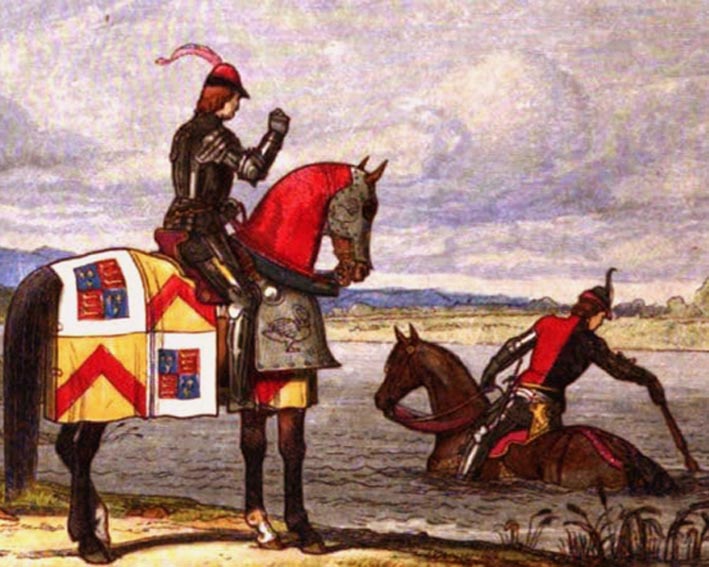
 The death of Sir Thomas Kyriell (1461)
An East-Kent counterpart to the de Clares of Tonbridge, the de Criol family of Westenhanger Castle was a significant force following the Norman Conquest. When the Wars of the Roses started, its paterfamilias was Sir Thomas Kyriell (b 1396) – the surname having been Anglicised – who had fought for Henry V in the Hundred Years’ War but been routed and surrendered at the decisive Battle of Formigny. Following his release, he became MP for Kent. Loath to support Henry’s clueless Lancastrian son, Henry VI, he joined the Yorkists at the 2nd Battle of St Albans. Being too old to fight, however, he was left to guard the King, who was then the Yorkists’ prisoner. When the battle was lost, the truculent Queen Margaret told her seven-year-old son to decide how Kyriell should die. Even though Kyriell had pledged to defend him, the King did not intervene. The unfortunate Kyriell was beheaded, and the family estate passed to his son-in-law, John Fogge.
 Buckingham’s Revolt (1483)
Although Richard III was killed at Bosworth, Leicestershire, the seeds of his demise were sown in Kent. The Yorkist king Edward IV’s wife Elizabeth was one of the powerful Woodvilles who owned The Mote, Maidstone. After Edward’s sudden death, Richard imprisoned her young sons Edward and Richard in the Tower and executed their guardian, her brother Lord Rivers. Appalled, Elizabeth’s brother-in-law Lord Buckingham organised a revolt in the South-East, to be supported by his invasion from Wales and his cousin Henry Tudor’s from Brittany. When news emerged of young Edward’s murder, however, Wealden supporters came out prematurely, alerting Richard to Buckingham’s defection. He intercepted 5,000 rebels led by Richard Guildford of Cranbrook from Penenden Heath to Gravesend via Rochester, and the invasions were prevented by floods and a storm respectively. Buckingham was executed, Guildford and his associates were attainted, and Henry Tudor had to bide his time. In 1485, however, with sentiment against Richard hardened, the tide would turn.
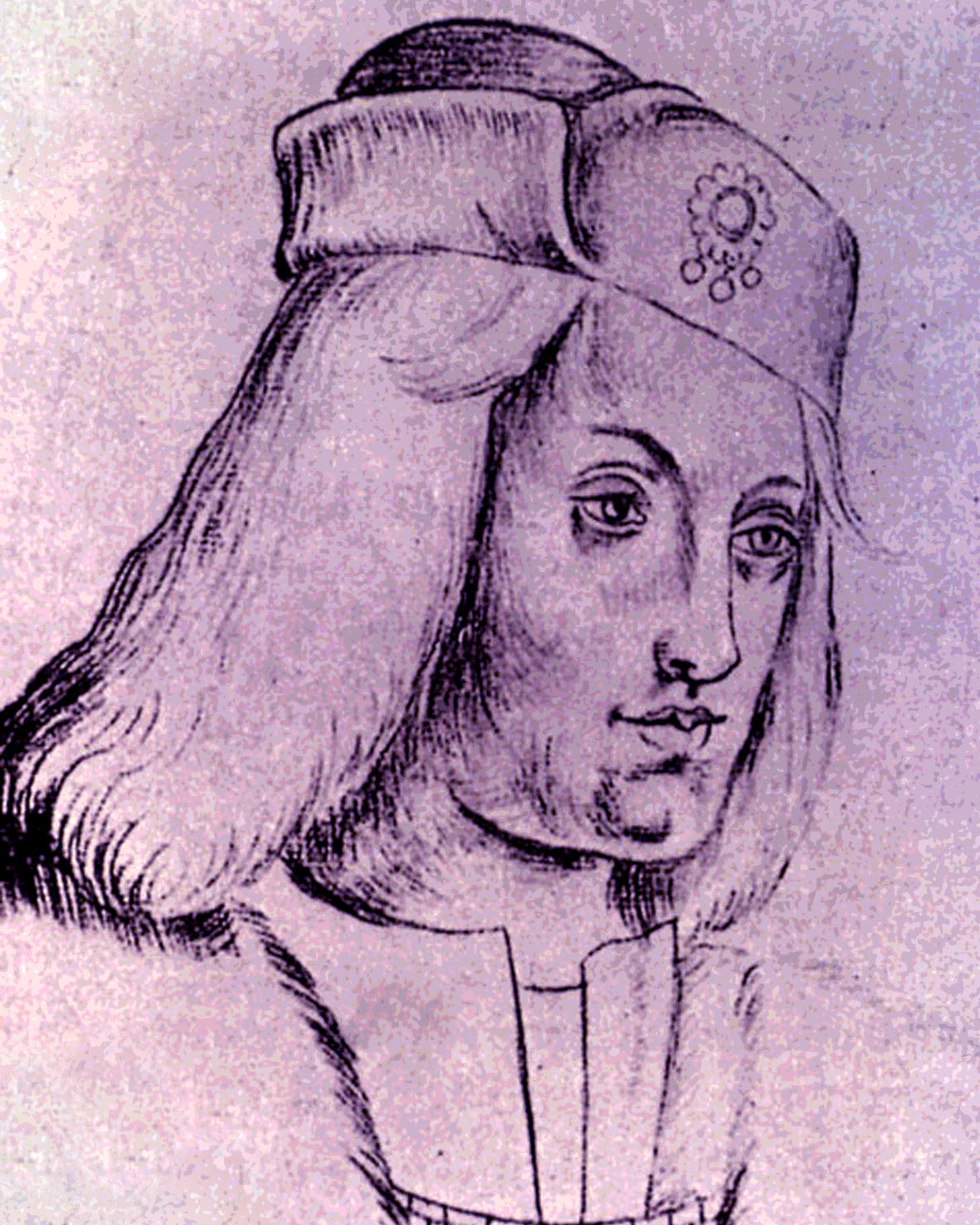 The Battle of Deal (1495)
The unknown fate of Edward IV’s two ill-fated sons, the unfortunate ‘Princes in the Tower’, presented a fine opportunity for fraud. The unlikely perpetrator, Perkin Warbeck (ca 1474-99), was from Wallonia and had learned his English in Ireland. Although his claim to be Richard, Duke of York was preposterous, he was promised support by several foreign parties hoping to see Henry VII deposed. With the King away in Lancashire, Warbeck set off for England with a shipload of mercenaries in the belief that the rebellious people of Kent would flock to his banner. By chance, he arrived at Deal, where the locals proved too canny for him. Discerning that his supporters were no loyal Englishmen, they lured them ashore, laid into them, and took 160 prisoner. Warbeck prudently stayed aboard and escaped. He tried his luck again four years later in Cornwall, and this time was captured. He escaped from the Tower, but was recaptured and hanged at Tyburn.
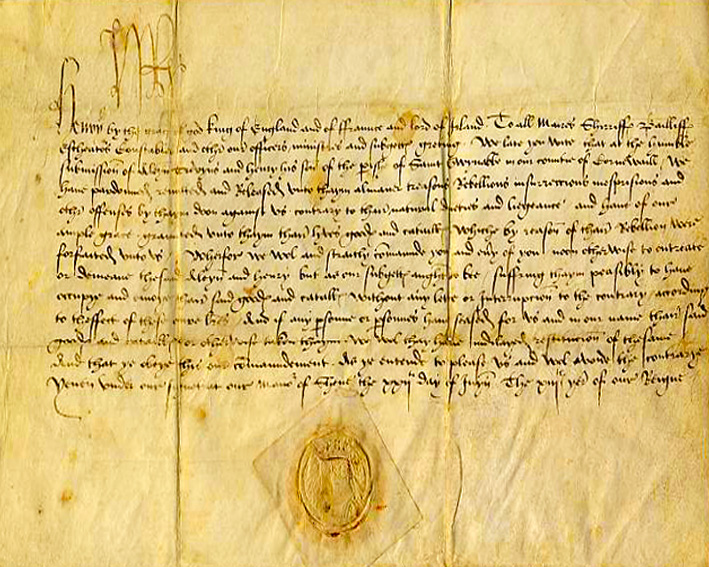 The Battle of Deptford Bridge (1497)
Although the Cornish Rebellion of 1497 is fashionably pitched as a Celtic nationalist revolt against the English monarch, it was in truth an armed protest against tax rises that was hijacked by a disgruntled minor aristocrat called James Tuchet, the 7th Baron Audley. When Henry VII sought to raise funding for England’s defences against threatened invasions by both the Scots and the pretender Perkin Warbeck, a 15,000-strong peasant army was raised in Cornwall, and marched on London. The rebels were met halfway by Audley, who took over command. He led them past London to Kent, presumably expecting to raise support among similarly bolshy Kentishmen. In fact, the reverse happened. On June 27th, he was met at Deptford by a vastly superior force, having also suffered many desertions on the way. The battle was lost, Audley was executed, and reparations were exacted. The king did eventually relent, whilst acknowledging Kentish loyalty by redeveloping the historic Placentia Palace at Greenwich.
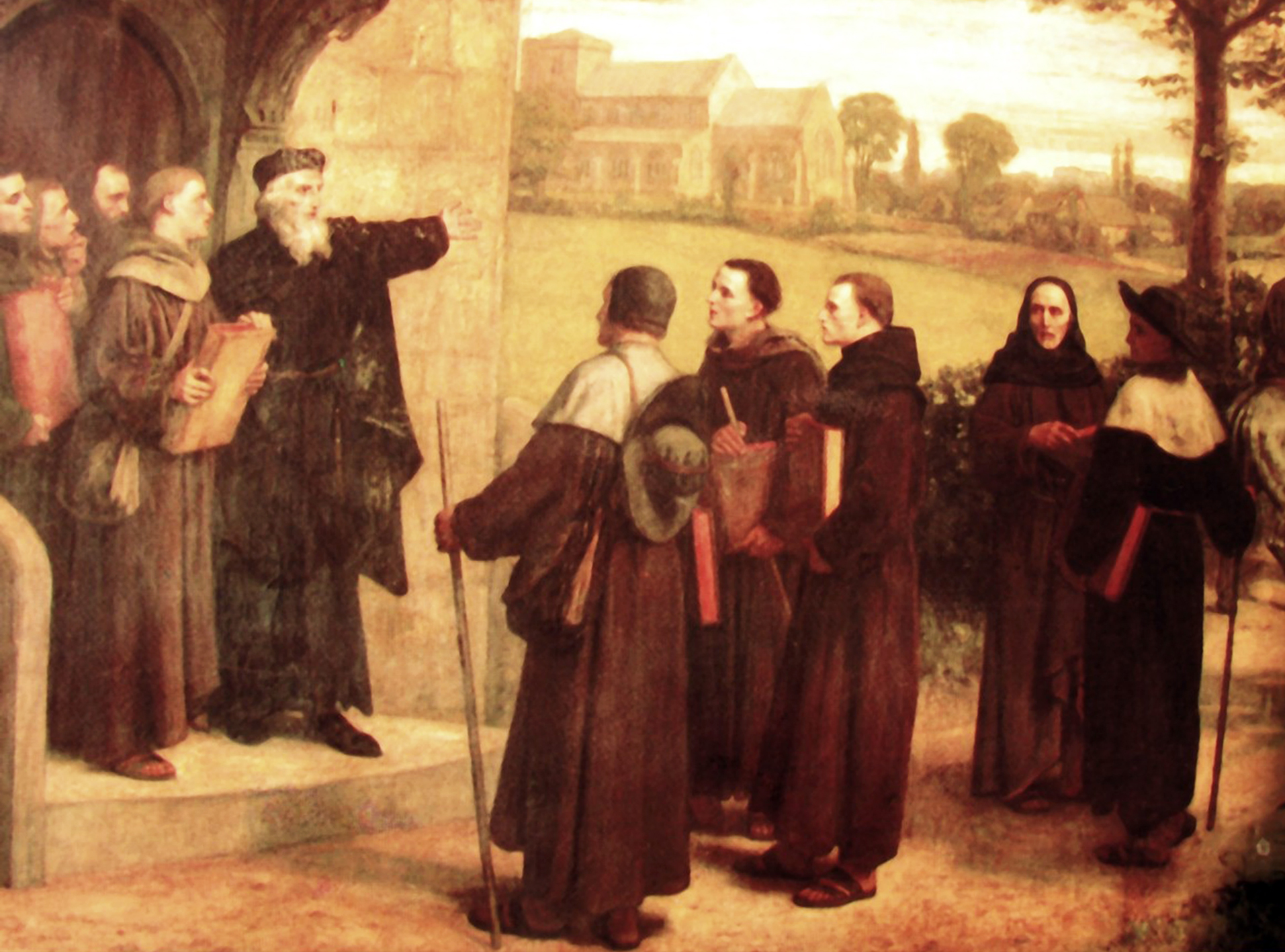 The Lollard heresy trials (1511-2)
In the C14, the Oxford priest John Wycliffe earned the opprobrium of the Roman Catholic Church by railing against many of the Church’s mainstream beliefs and practices, including the extravagant lifestyle of clergymen. He even translated the Bible into English so as to demystify it. He was in effect a harbinger of the English Reformation. The Church reacted in the normal manner of centralised authority, by declaring this challenger a devil and his followers idiots. They were in fact called ‘Lollards’, meaning something like ‘Mumblers’. But insults were not enough. In 1511, the Archbishop of Canterbury, William Warham, took a zero-tolerance stance. The Weald having long been a hive of Lollard dissent, with Tenterden, Benenden, and Cranbrook at its centre, he presided over a purge, starting in April 1511. 53 suspects were tried, of whom all bar five abjured their error and were made to do penance. The five, however, endured a single visit to the stake.
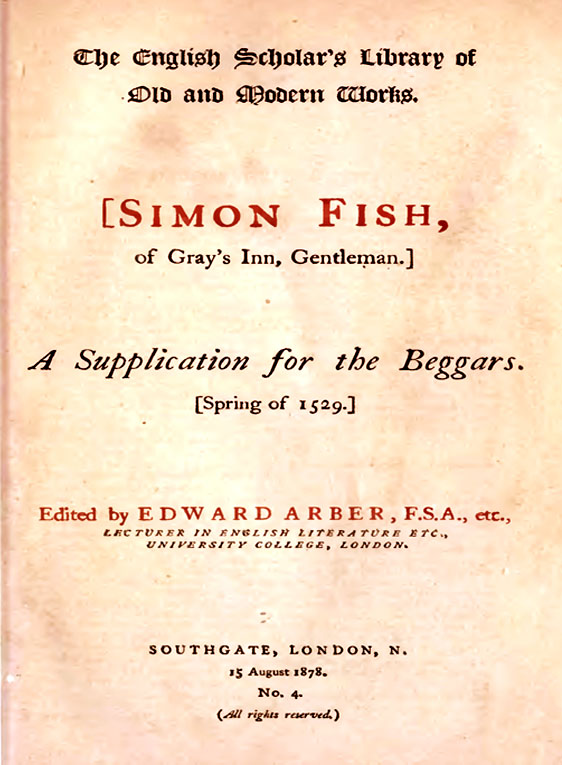 ‘A Supplication for the Beggars’ (1529)
Kent-born Simon Fish is known for one thing: his highly polemical 16-page diatribe against the Catholic Church known as ‘A Supplication for the Beggars’. Like all partisan proclamations today, it was coated in populist politics to garner mass support. In practice, it was another incendiary stimulus to Protestant revolt against Catholicism, twelve years after Luther’s ‘Ninety-Five Theses’. Entirely uncompromising, it inveighed against the tyranny of Rome in general, but specifically against the concept of purgatory, which had no basis in the Bible, and the practice of selling indulgences for financial benefit. Accused of unscrupulously enriching itself at the expense of the poor, the Church reflexively declared Fish a heretic, while Sir Thomas More wrote a verbose refutation. They never got the chance to fry Fish, however, because he died in 1531 of bubonic plague. Nevertheless, a year later they had the satisfaction of publicly burning James Bainham, another Protestant revolutionary who had married Fish’s widow.
 The burning of John Fryth (1533)
John Fryth was born at Westerham in 1503 and attended Sevenoaks Grammar School before going to Eton. At Cambridge, he encountered the new thinking that had ignited the Reformation, and probably first met William Tyndale, who greatly influenced him. These being intolerant times, he was one of ten arrested and confined in a fish cellar. After his release, he left for Antwerp, and in Germany took to writing patently heretical tracts. Their mocking tone provoked the vindictive Sir Thomas More into ordering his arrest on his arrival back in England. Challenged to confirm his faith in both purgatory and transubstantiation, Fryth refused on the grounds that neither was authenticated by the Scriptures. He was condemned even by his former tutor at Cambridge, the Bishop of Winchester, and burned at Smithfield with a young Faversham tailor, Andrew Hewet. St Mary the Virgin in Westerham still houses the font where he was baptised, a John Fryth Room, and the John Fryth Singers.
 The incorporation of Maidstone Grammar School (1549)
Maidstone, now Kent’s county town, had a school at the ecclesiastical College of All Saints as early as 1395. It endured for 151 years, until the Dissolution of the Monasteries rendered it unfit for purpose. In 1549, however, the town was incorporated under Henry VIII’s short-lived son and successor Edward VI, permitting the establishment of a new grammar school at the Corpus Christi Hall in Earl Street. It remained in this location until 1870, when a larger and quieter replacement was built off the Tonbridge Road west of the river; but this too was replaced just sixty years later by the more spacious building that forms the hub of the current school. MGS will therefore celebrate its quincentenary within 30 years. The first grammar school in Kent, it set a precedent for the likes of Dartford Grammar School (1576), Norton Knatchbull School (1630), and the Harvey Grammar School (1674), making Kent a grammar-school hotbed.
 The burning of Joan Boucher (1550)
Anabaptism is the credo that baptism is invalid for candidates who have not professed their belief. Being outside of mainstream Protestantism (the Amish sect being typical), C16 Anabaptists were as unpopular with the Church of England as with Roman Catholics. Joan Boucher, from Romney Marsh, may have been descended from Anabaptist refugees from persecution on the continent. She became an outspoken champion of her faith, and was briefly jailed for her critique of the Eucharist. Five years later she was convicted of heresy and sentenced to death. The following year saw numerous attempts by leading church figures to persuade her to recant, which would have made for good propaganda. She steadfastly refused. Royal chaplain John Rogers declared that beheading was too good for her, and she was burned at the stake. The ironic twist was that, with Mary I on the throne five years later, Rogers suffered the same fate: a case of the burner burnt.
 The murder of Arden of Faversham (1551)
North Kent was the scene of a C16 national sensation that was not so much a murder mystery as a murder farce. Alice Arden of Faversham decided with her low-born lover Thomas Mosby to murder her husband, former mayor Thomas Arden. After several failed attempts, she hired a couple of assassins called Black Will and Shakebag to do the job professionally. More botches followed before they finally succeeded; but they left the body in a field in a snowstorm, apparently unaware that their tracks would be left visible. The hitmen fled, but Arden and Mosby were tried and sentenced to death. Strangely, though he was hanged, she was burned at the stake, having been found guilty of ‘petty treason’ against a superior, namely a man. So dramatic were these events that they inspired an anonymous 1592 play, now thought to have been written mostly by William Shakespeare himself. The Bard, coincidentally, had an ancestor called Thomas Arden who’d died shortly before.
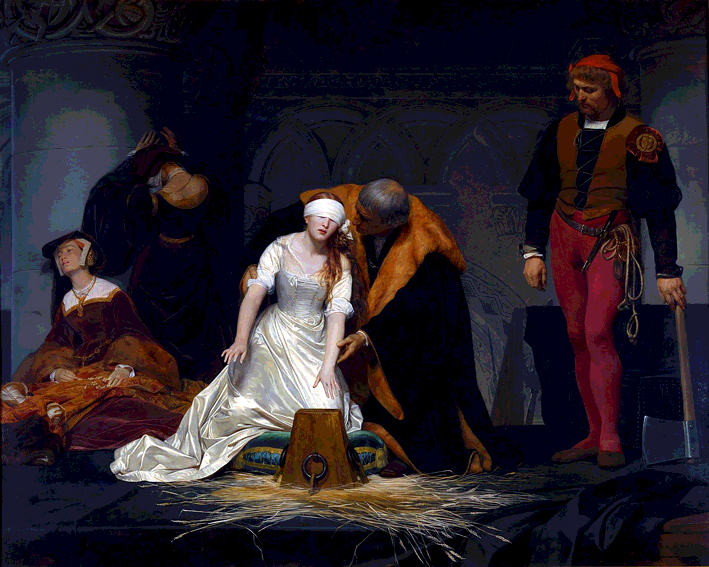 Wyatt’s Rebellion (1554)
When the Catholic Princess Mary usurped the throne from Lady Jane Grey in 1553, England was divided in a way not unlike Britain today. The flashpoint was her decision to marry the Catholic King of Spain, Philip II, prompting a conspiracy by Sir Thomas Wyatt the Younger, Sir Peter Carew, Sir James Croft, and Lady Jane’s father, the Duke of Suffolk. Their four armies were to converge on London from Kent, Devon, Herefordshire, and Leicestershire respectively. Wyatt was left isolated when the plot was exposed, but assembled an army of 1,500 men “of the best shire” at Rochester. Although 500 rebels were initially routed at Hartley Wood, many Royalist troops defected, as did militia sent from London. Wyatt’s 4,000-strong force was nevertheless repulsed at Southwark by London loyalists, and instead crossed the Thames at Kingston. They were again thwarted by Londoners at Ludgate, and disbanded. Like Lady Jane and 90 fellow rebels, Wyatt received no mercy.
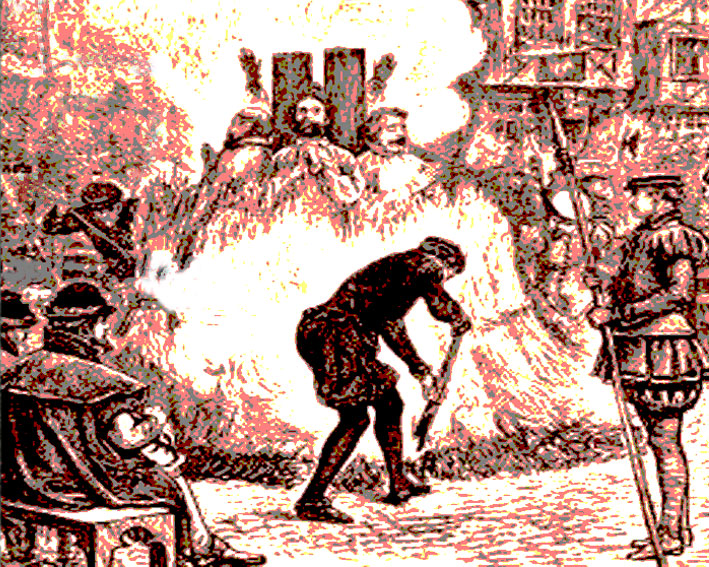 The executions of the Canterbury Martyrs (1555-8)
A big issue facing Christianity from the start was predestination. If all was pre-ordained by God, where did that leave free will? The consensus was that God’s will was supreme, but there was endless dispute about the detail. Reformation theologians generally went along with Catholicism on this; but a major challenge was presented by the Freewillers. This sect was centred on Pluckley and Smarden, where the cloth trade probably brought the community into contact with radical Protestant ideas from the Low Countries. It brought the first schism in Protestantism, exacerbated by the fact that it was able to run its own separate services. Its leader, Henry Hart, wrote passionate texts concerning free will, albeit not very articulately. Needless to say, Mary I took a very prejudicial point of view. Some members were burned in Canterbury; but, by the time the order for Hart’s arrest went out in 1557, he was already dead. The sect left no trace.
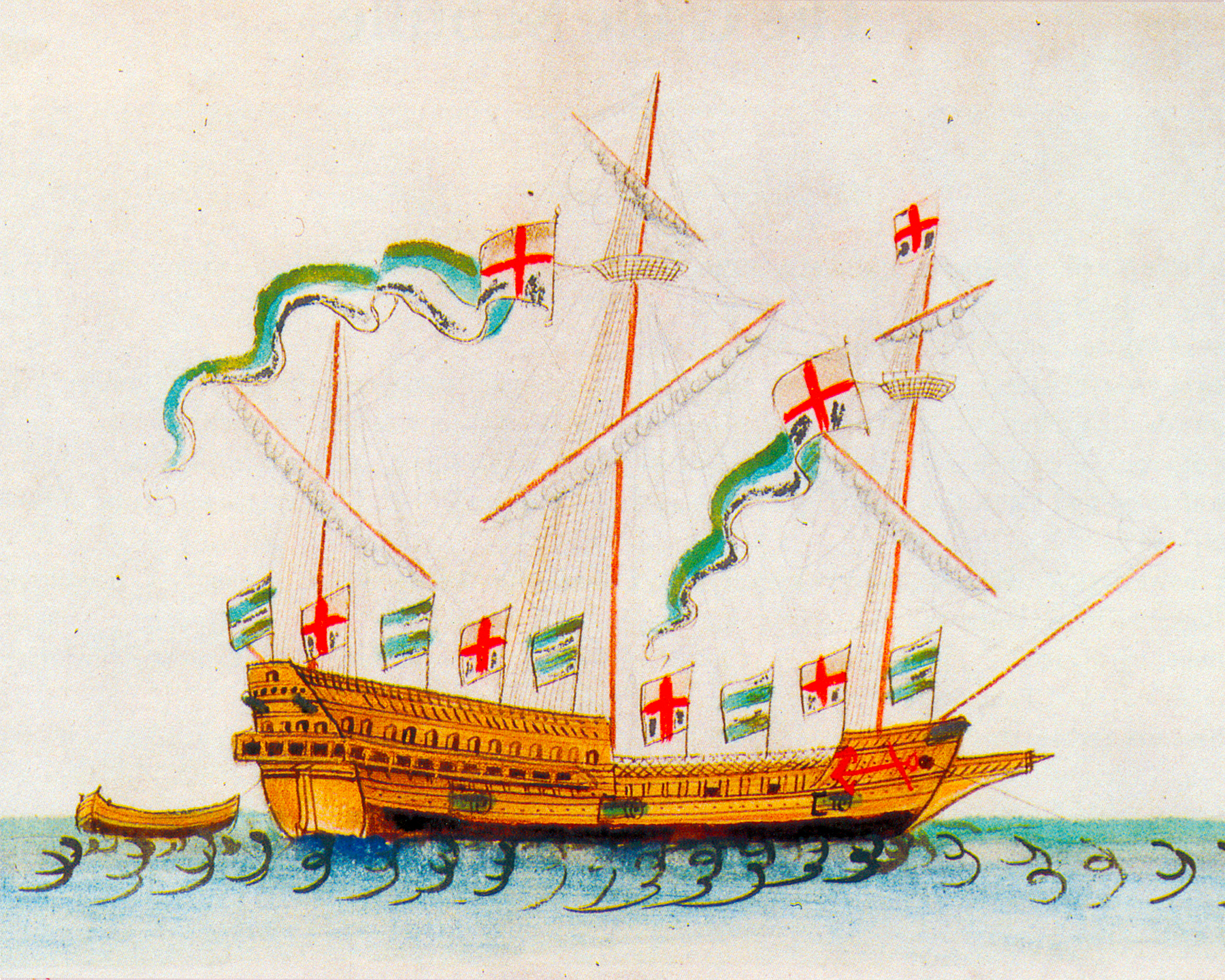 The wreck of the Greyhound (1563)
In 1553, Sir Thomas Finch from the Moat, Canterbury, helped put down Sir Thomas Wyatt the Younger’s revolt. Ten years later, he was sent as knight marshal to reinforce English fortifications erected in Le Havre in support of a Huguenot uprising. The 200 who embarked on the galleass Greyhound included other well-connected nobles. Driven back by adverse winds, they attempted to land at Rye, but were wrecked on a sandbar; all but seven men drowned. The loss of Finch, who was buried at Eastwell, was considered grievous. The disaster was lent added poignancy by the death of another on board, who was possibly related to the Brookes of Cobham Hall. A young poet called Arthur Brooke, he had written ‘The Tragical History of Romeus and Juliet’ – the main source for Shakespeare’s classic play – only the year before.
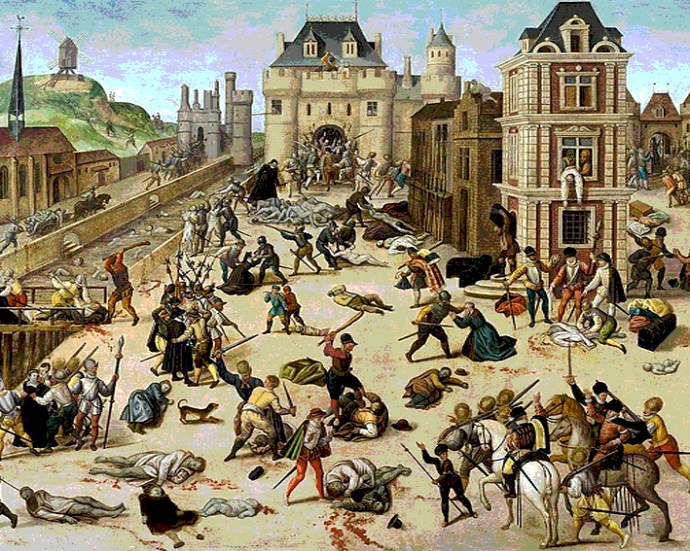 The Huguenot migrations (1572/1685)
‘Huguenot’ was another religious name coined as a term of derision. Its origins are obscure, but it described the French Calvinist Protestants who by the mid-C15 amounted to two million – roughly 10% of France’s population. Their growing strength provoked a Catholic backlash, culminating in 1572 with the St Bartholomew’s Day Massacre. Tens of thousands of Huguenots were slaughtered, prompting an exodus. A favoured destination was Elizabethan England, with its sympathetic Protestant work ethic. Although Sandwich’s population was already swollen by Dutch Protestant immigrants, poor Huguenot refugees were awarded 50 shillings by the authorities. More stayed in Dover, but most moved on to Canterbury, which acquired the largest foreign population outside London. This sudden influx brought unrest over overcrowding, crime, and preferential treatment for ‘strangers’, but the Government prized the immigrants’ commercial worth, especially as weavers. There would be a larger influx a century later, when Louis XIV revoked the Edict of Nantes that had halted the persecution.
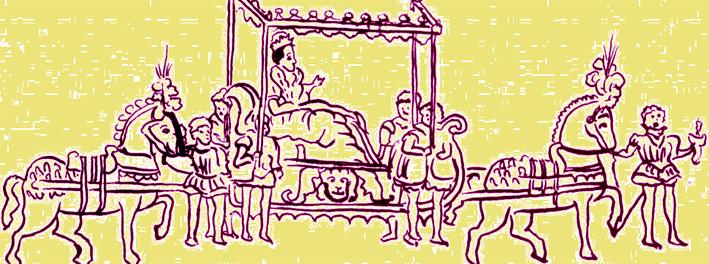 Queen Elizabeth’s Royal Progress into Kent (1573)
A favoured PR device in the late Middle Ages was the ‘royal entry’, when a monarch ostentatiously visited a domestic city or region, leaving a lasting impression. One exponent was Elizabeth I, anxious to encourage national unity in a land riven for centuries by factional interests, and presumably grateful for a summer vacation. Her main ‘Royal Progress’ for 1573 took her around Kent. Starting on July 21st, the outward itinerary ran first through Orpington, Knole, Otford, Birling, Oxenhoath, Kilndown, Bedgebury, Benenden, and Cranbrook. After a foray to Rye, there followed Sissinghurst, Boughton Malherbe, Smarden, Hothfield, Westenhanger, Smeeth, Sandgate, Hythe, and Folkestone, then a five-day break at Dover Castle. She proceeded via Sandwich, Wingham, and Littlebourne to Canterbury, where she remained for 13 days. After Faversham, Sittingbourne, Tunstall, Rochester, Gillingham, Cobham, Sutton-at-Hone, and Dartford, she finished on September 25th back at her birthplace, Greenwich Palace. It placed a financial strain on the hosts, but was immensely popular with her subjects.
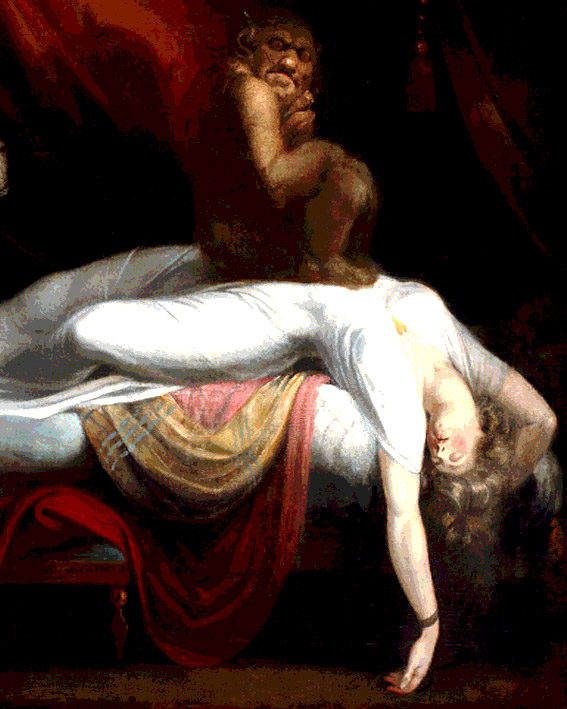 The Pythoness of Westwell (1574)
Mildred Norrington worked as a servant for William Sponer in Westwell. She obviously didn’t get on with her mistress, Alice, whom she accused of keeping the Devil captive in a bottle, then sending him to possess and destroy her. To prove Norrington’s point, the devil inside her put on a show of such diabolical intensity that it would surely have landed her a role in ‘The Exorcist’. Since a charge of witchcraft was then a matter of life and death, the girl was summoned to appear before Thomas Wotton of Boughton Malherbe and fellow justice George Darell of Little Chart. Faced by these two sage old patriarchs at Boughton Place, the girl admitted that she had made it all up with revenge aforethought, and put on a repeat performance to prove that she could do it at will. It cannot have done her employment prospects much good, but her colourful nickname has lived on through the centuries.
 The Dover Straits earthquake of 1580
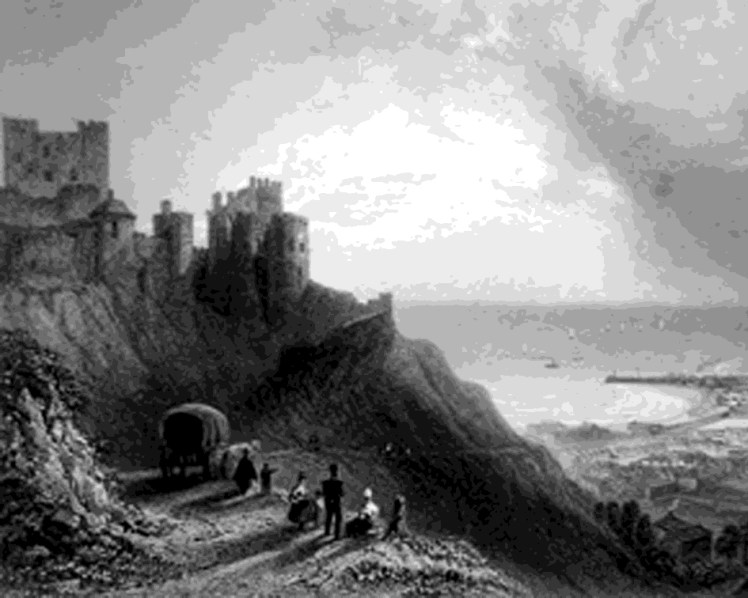
Although not as strong as the 1382 earthquake, the one that occurred at 6pm on April 6th, 1580 had equally dramatic if rather different effects. Its epicentre was not off the North Foreland but on the coast of France, near Calais. Its impact was spectacular in the English Channel, with freak waves that caused two dozen or more vessels to capsize; one passenger reported that his ship grounded five times on the seabed. The waves demolished a portion of the white cliffs at Dover, bringing down part of the Castle wall with it. Though earthquake damage was worst in Northern France and Flanders, the tremors rendered Saltwood Castle uninhabitable, while in London two children were killed by falling stones. Shakespeare even mentions the earthquake in ‘Romeo and Juliet’. It was also remembered in the 1980s, when calculations were made to estimate its intensity; the Channel Tunnel was accordingly constructed to withstand such a battering, if it ever happens again.
 The founding of the Globe Theatre (1599)
James Burbage (ca 1531-97) was probably born in Bromley. His trade was carpentry, which later served him well as a theatre-builder. First, however, he cut his teeth as an actor. Possessing all the charms of a top male thespian, he became leader of Leicester’s Men, the foremost troupe in Renaissance theatre. In his forties, he set about building arguably England’s first dedicated theatre since Roman times. ‘The Theatre’ opened in 1576 across the fields in Shoreditch. In the 1590s, Burbage’s legendary actor son Richard began appearing there with the Lord Chamberlain’s Men. Among young Burbage’s friends and colleagues was one William Shakespeare, several of whose early plays must have been performed there. By the time of James’s death, however, the Burbages got embroiled in a legal dispute over the Theatre’s lease. Richard and brother Cuthbert resolved the matter by secretly removing the theatre over Christmas 1598 and rebuilding it in Southwark as The Globe. The rest, as they say, is comedy.
 Royal grief at Greenwich (1606)
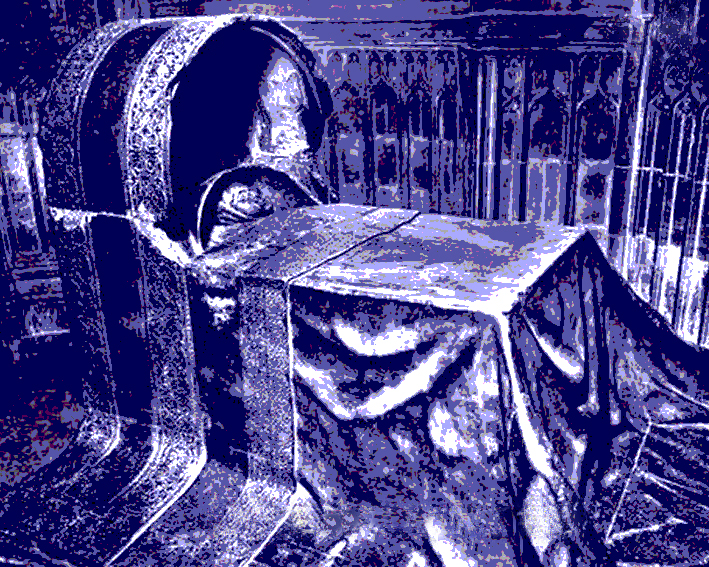
The occasion of the last royal birth at Greenwich Palace was also that of its last royal death. In October 1605, immediately before the Gunpowder Plot, it was announced that James I’s wife Anne was pregnant for the ninth time. No expense was spared on the preparations, and the team appointed to deliver the baby included Peter Chamberlen, whose claim to fame was inventing obstetrical forceps. Although the pregnancy went almost to term, the baby, born on June 22nd, struggled for life, and expired the next day after being baptised as Sophia Stuart. The body was buried at Westminster Abbey with a monument artfully designed to look like a crib; a grand tournament at Greenwich that had been organised to celebrate the new arrival was called off. Although still only 32, Queen Anne never had another child. Her brother, Christian IV of Denmark, came to console her a month later.
 The great gale of 1624
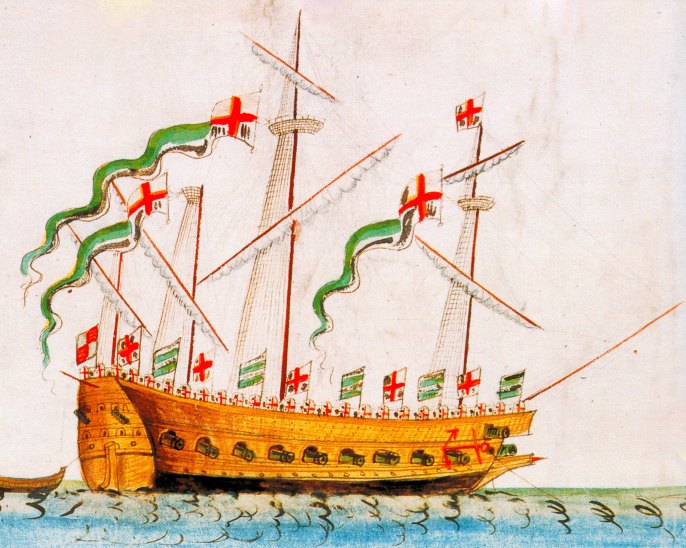
October 4th, 1624 brought a storm described as “a terrible gale, the like of which has never been seen” – which was really saying something among a nation of seafarers. About 120 vessels had taken shelter in the Downs, normally a safe haven. Ships were torn from their anchorages and tossed around like toys, crashing into each other with calamitous effect, and no hope of rescue. One warship, the Antelope, had her anchor cables severed by a merchant ship, the Dolphin, and was blown onto the Goodwin Sands. Despite losing her rudder and all her masts, she was finally brought to dock at Deptford, but only after the crew watched in horror as the Dolphin went down alongside with all hands. A French warship exploded with the loss of 200 lives, while Admiral Hendriksz’ Dutch flagship foundered. It was perhaps a portent: those two nations had just formed an alliance, and would both be at war with England that century.
 The launch of HMS Sovereign of the Seas (1637)
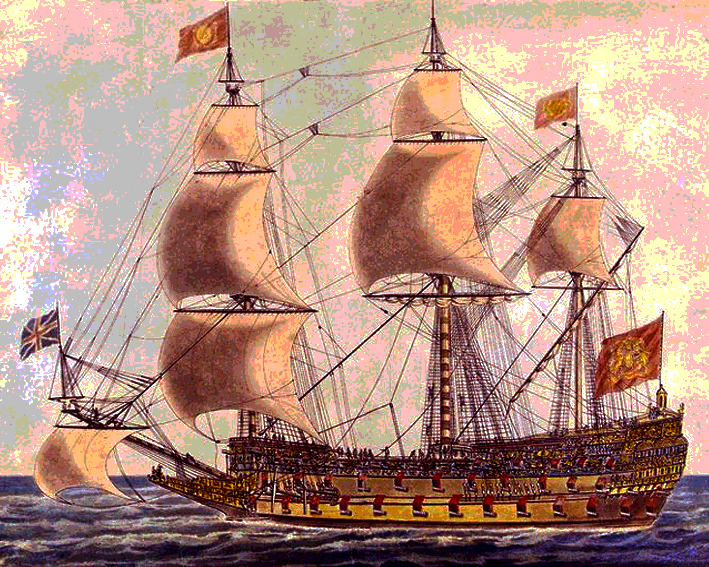
Built by Kentish Master Shipwright Peter Pett at Woolwich, the Sovereign of the Seas was more than just the biggest warship in the world; she was a political statement. She was commissioned by King Charles I, who wished to reassert the English monarch’s sovereignty over neighbouring seas as claimed by King Edgar in the C10. In 1609, a Dutch jurist, Grotius, had championed the principle of open seas allowing unfettered Dutch access to the English Channel. That demand was rebutted in 1635 by an English book, ‘Mare Clausum’ (‘Closed Sea’), to which Charles lent his weight by having this powerful ship built. He even had an excess of guns added at launch to emphasise the point. The ship – rebuilt in 1660 and renamed Royal Sovereign – fought in major battles both against and alongside the Dutch, but was destroyed by fire at Chatham in 1696. The careless bos’un who’d left a candle untended was flogged and jailed for life.
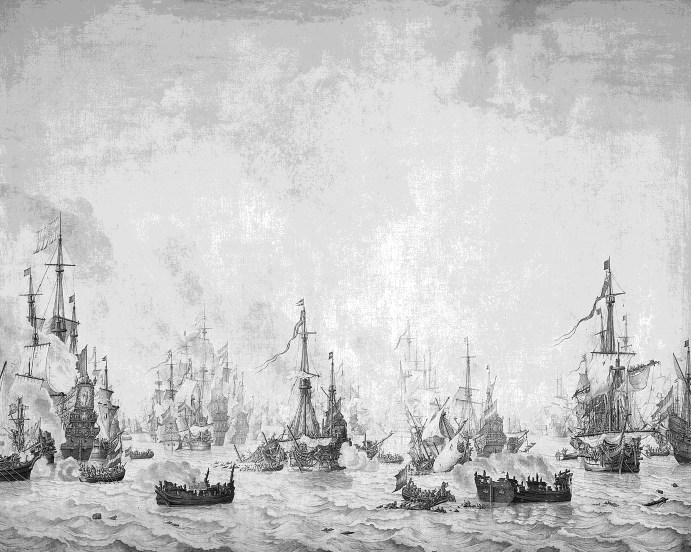 The Battle of the Downs (1639)
On October 21st, 1639, a sea-battle took place in Kentish waters between two alien powers. The antagonists were Spain and Holland, and the warzone the Downs, the safe anchorage off Deal. During the Eighty Years’ War between the Spanish Empire and the emerging Dutch nation, a fleet was sent from La Coruña to reinforce and resupply Spanish troops in Flanders. After a skirmish with Maarten Tromp’s Dutch fleet in the Channel, the Spaniards took refuge in the Downs. The next morning, Tromp attacked with fire-ships as the enemy tried to break out. It turned into a rout. Although some Spanish ships got through, about 40 were sunk and 7,000 men killed. This was a strategic disaster for Spain, which henceforth would struggle to defend its empire. Furthermore, England’s humiliating inability to prevent this blatant breach of its territorial integrity became a factor in the later Anglo-Dutch Wars. Not that the numerous Kentish spectators minded: they joyfully plundered grounded Spanish vessels.
 The Kentish Petition of March, 1642
The English Civil War was the outcome of unstoppable force meets immovable object. King Charles I obdurately refused to recognise Parliamentary resistance to his aims, and Parliament obdurately refused to raise taxes if he wouldn’t. There was no desire for regime change; but the nation spiralled downwards as the impasse continued. In March 1642, with hostilities looming, an initiative arose from Maidstone Assizes. Kent was Parliamentarian in outlook, like the rest of the South and East, but had Royalist landowners. The impartial gentry of Kent presented a petition asking the Long Parliament to compromise with the King, particularly by renouncing its claim to controlling the militia. Printed copies of the signed petition were distributed. The demands were moderate, but Parliament reacted with outrage. The Petition’s presenters to Parliament were arrested, its perpetrators were declared delinquents, it was publicly burned by hangmen, and Parliament concocted its own petition with more signatures. By August, the nation was at war with itself.
 The Faversham witch trial (1645)
Though witches are associated with the Middle Ages, settling scores with an allegation of witchcraft was still commonplace in the C17; and East Kent was a hotspot of indictments. When Thomas Gardiner hurt himself in a fall, Joan Walliford embarrassed him by laughing. He charged her with making it happen by witchcraft. Her friends Joan Cariden, Jane Hott, and Elizabeth Harris were named as accomplices. All either confessed to having had the devil appear to them in the form of a cat or, would you believe, a hedgehog. Their ready admission to such nonsense suggests a good deal of coercion, but it was enough to see them arraigned. Their trial consisted in being dunked in the river. Had they drowned, they would have been held innocent, but the devil helped them stay afloat. On September 29th, three were hanged at Faversham; Harris’s fate is unknown. Fortunately, the scientific revolution would soon be delineating the difference between truth and self-serving superstition.
 The Plum Pudding Riot (1647)
With the first Civil War over and King Charles safely in custody, the Puritan-dominated Parliament was free to throw its ideological weight around. The Puritans’ intolerance did not stop at restricting sports. They even banned Christmas. Popular reaction was predictably hostile, especially in Kent. The Mayor of Canterbury arrived at the marketplace on December 25th to find few traders observing the legal injunction to work normally. When he urged revellers to get to work, he got a surly reaction that turned to pushing and shoving. Someone produced an inflated pig’s bladder, the football of its day. It was a signal for the sort of competitive mass brawl that infuriated the authorities. Before long, it turned to a riot: a metaphorical bloody nose for Puritanism from the rebellious Men of Kent. It signalled an end to the phoney peace, and the start of further hostilities that, by the summer, would turn to mortal conflict.
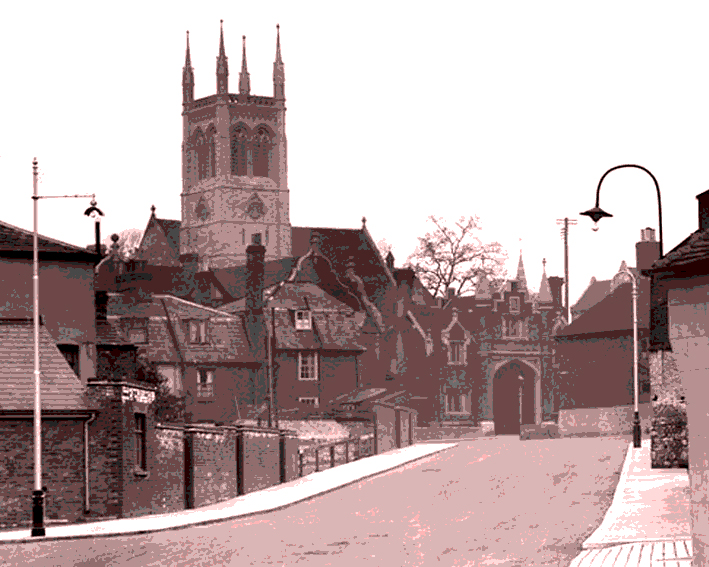 The Battle of Maidstone (1648)
The Kentish rebellion of Spring 1648 went further than football. After sailors mutinied and took over Deal, Sandwich, and Walmer, the Earl of Norwich landed, leading an armed insurrection in Kent and Essex coinciding with a revolt in Wales and invasion from Scotland. His force at Maidstone amounted to 10,000 volunteers; but he made the mistake of sending the majority to defend other towns. On June 1st, he was confronted by a force of 4,000 New Model Army veterans under Sir Thomas Fairfax. The initial combat took place on Penenden Heath, but Fairfax cunningly attacked the town from the south, eventually fighting his way up Gabriel’s Hill and through the town to St Faith’s Church. Havock Square, outside Maidstone Museum, now marks the point where the Royalists made their bloody last stand, although a thousand hid in the chapel before surrendering. Some diehards held out in Essex, but it was curtains for King Charles: he was beheaded in January.
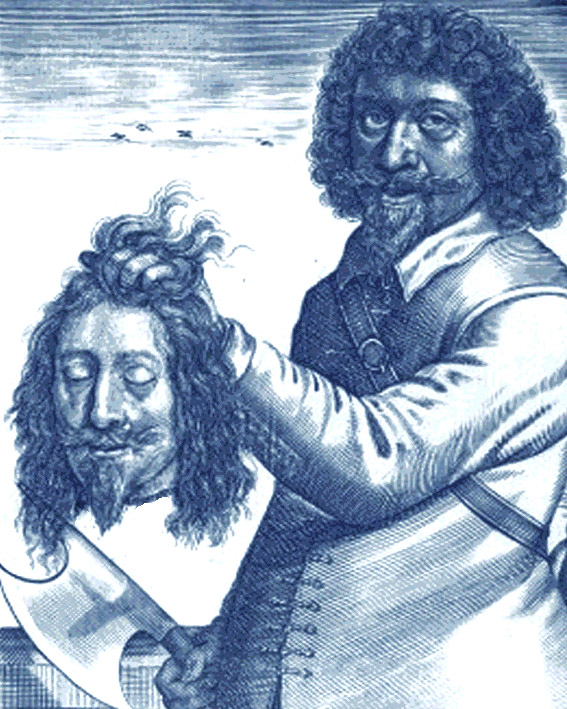 The recapitation of King Charles I (1649)
A Maidstonian by birth, Thomas Trapham played one of the most peculiar bit-parts in English history: as the man who sewed Charles I’s head back on. Having been licensed by Oxford University to practice as a physician in 1633, his services acquired special value when the bloody Civil War broke out. A Presbyterian, he nailed his colours to the Parliamentarian mast, and was party to the Earl of Essex’s debacle at the Battle of Lostwithiel in 1644. Appointed Cromwell’s surgeon-in-chief, however, he was also at Naseby in 1645, when the New Model Army first impressed itself on history, and the conclusive Battle of Worcester in 1651. After embalming the King’s decapitated body in preparation for burial, he amused some, but infuriated many, by quipping that he had “sewn on the goose’s head”. Somehow he survived the Restoration, plying his trade at Abingdon for two decades. His son Thomas wrote possibly the first manual of tropical diseases. He died in 1683.
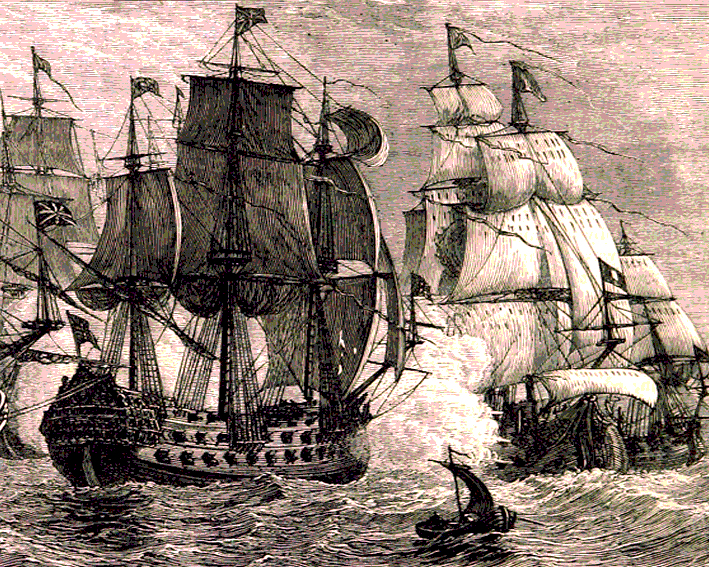 The Battle of the Goodwin Sands (1652)
One of the biggest challenges facing the English Commonwealth under Cromwell was the mercantile strength of the Dutch Republic. The first Navigation Act in 1651 aimed to hamper Dutch shipping, and inevitably stoked tensions. On May 29th, 1652, the great Dutch admiral Maarten Tromp was commanding 40 ships escorting a convoy. He defiantly ignored Cromwell’s decree that foreign ships must respectfully dip their flag when passing through the Channel. The ‘Father of the Royal Navy’ Robert Blake, who was policing the convoy with 25 English ships, fired three warning shots, one of which caused damage to Tromp’s flagship. Tromp returned fire, and a five-hour battle ensued. The Dutch withdrew with the loss of one ship, but the Commonwealth declared war two months later. This First Dutch War started well, when the Dutch fled the Battle of the Kentish Knock in September. However, the Government overconfidently sent warships elsewhere, allowing Tromp to win a major victory off Dungeness in November.
 The Maidstone witch trial (1652)
The Faversham witch trial of 1645 exposed the absurdity of charges brought as a means of silencing unwelcome women; but it was not exceptional. A century earlier, Henry VIII had introduced a more liberal Witchcraft Act that redefined the offence as criminal, not religious, and outlawed burning as the punishment. Elizabeth I went further, making hanging the penalty only for a second offence, provided that murder was not involved. Perversely, James I reversed the trend in 1604 by making even injury by witchcraft a capital offence. Witch hunters made a fortune drumming up business for the hangman. On July 30th, 1652, seven witches were tried by Sir Peter Warburton at Maidstone Assizes: Anne Ashby, Mary Browne, Anne Martyn, Anne Wilson, and Mildred Wright of Cranbrook, Mary Reade of Lenham, and Elizabeth Hynes. Ashby proved their collective guilt by reportedly going into ecstasy in court and expanding to a “vast bigness”. All were hanged at once at Penenden Heath, a record.
 The Sondes murder (1655)
Saturday, August 7th, 1655 did not start well for widower Sir George Sondes of Lees Court in Sheldwich. He woke at sunrise to find his younger son Freeman at his bedside. The bloodstained boy, 19, reported that he had just murdered his 22-year-old brother George in bed, having premeditatedly beaten his head in with the blunt edge of a meat cleaver and finished him off with a dagger. The dagger was still in his pocket, but he declared, “I have done enough!” and the old man survived. The boy’s motive became a national talking-point. If he hoped to succeed to the family fortune, it was a clumsy way to go about it. There was speculation about devilish possession, and fraternal rivalry over a girl named Anne Delaune. Because Freeman had confessed, however, it was an open-and-shut case at Maidstone Assizes. He was executed at Penenden Heath on August 15th and buried at Bearsted, while old Sondes found himself heirless.
 The Indemnity & Oblivion Act (1660)
Following the Royalists’ crucial defeat at Maidstone in 1648, the position of Clerk of the Court at the King’s trial months later was aptly filled by Andrew Broughton, the town’s Rutland-born mayor. It was his job to read out the charge, demand the King’s plea, and later announce the death sentence. Broughton went on to serve in two Parliaments; but, after Oliver Cromwell died and the monarchy was restored, there came a reckoning. The Indemnity & Oblivion Act pardoned most conspirators, but for 104 “Regicides” there was to be no amnesty. Broughton saw it coming, and fled to Switzerland for the rest of his life. Of the 59 signatories of the King’s death warrant, four others were Kent men: John Dixwell of Dover, Sir Michael Livesey of Eastchurch, James Temple from Rochester, and Sir Hardress Waller of Chartham. The first two likewise fled overseas, while the others’ death sentences were commuted to life imprisonment.
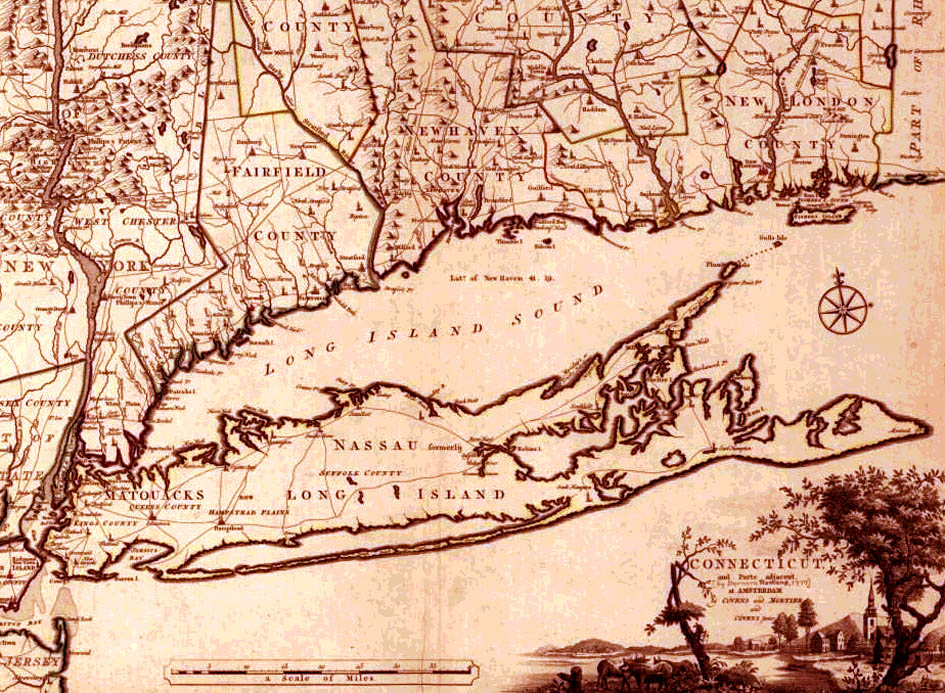 The Long Island land swindle (1661)
In 1650, Dorothea Scott (ca 1628-88) from Godmersham, a granddaughter of Sir Thomas Wyatt the Younger, inherited Eggarton Manor from her father and married future MP Major Daniel Gotherson. The couple became Quakers, and she wrote a tract called ‘To All that are Unregenerated’ (1661) while preaching to a group called Scott’s Congregation. A New England chancer called Captain Scott approached her, claiming to be a relation, and persuaded her to expend £2,000 (over £200,000 today) on land in Long Island for a new Quaker community. After renaming the area Ashford, he erected three houses there called Scott’s Hall, Egerton (sic), and Braebourne (sic). It was all a swindle: the land was not his to sell. Her husband died, heavily in debt, in 1666. After appealing fruitlessly to Charles II for redress, she remarried locally, sold up, and went to live on a small plot in Long Island. The unregenerated Scott lived out his days in Barbados.
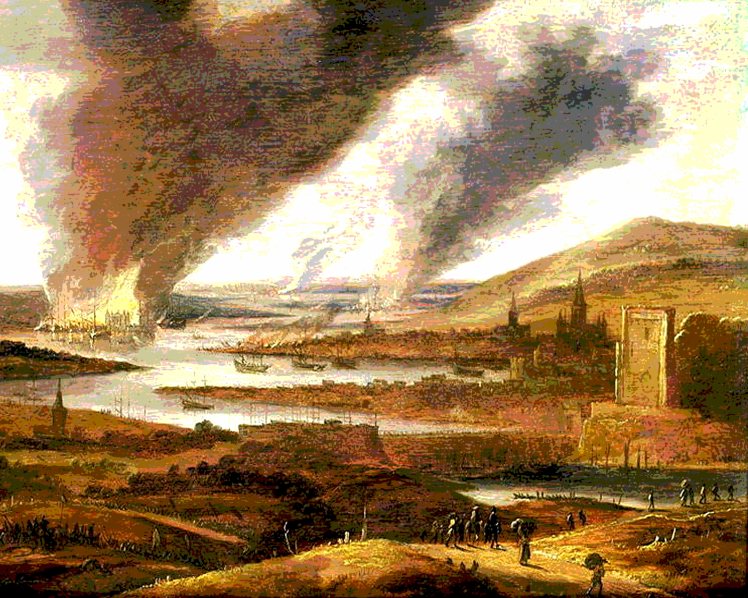 The Raid on the Medway (1667)
The Dutch attack on the Royal Navy in the Medway in June 1667 was so expertly executed that it counts as Britain’s own Pearl Harbor. It did not start a war, however, but ended one. The Second Dutch War had been going badly for Britain, which was teetering after suffering the Black Death and the Great Fire of London within the last two years. The Dutch admiral Michiel de Ruyter led a daring mission up the Medway, first capturing the unsuspecting defences at Sheerness and then jumping the ‘Gillingham Chain’ that was supposed to bar entry to Chatham Dockyard. Thirteen major English ships were destroyed at anchor, and the flagship HMS Royal Charles was towed back to Holland as a prize. A month later, Britain sued for peace. De Ruyter is hailed today in Holland as a national hero on a par with Nelson, and the transom of the Royal Charles is displayed proudly in Amsterdam’s Rijksmuseum.
 The Secret Treaty of Dover (1670)
King Charles II was most fortunate that his Treaty of Dover remained secret for a hundred years. The 2nd Dutch War had ended badly for Britain, not least because of the King’s financial mismanagement. Parliament responded prudently by striking an alliance with the Dutch and Sweden to counter French aggression. Charles, meanwhile, ploughed his own furrow. Through his sister Henrietta, he initiated secret talks with her brother-in-law, King Louis XIV – the despotic Sun King. After considerable wrangling, they concluded a dramatic agreement. Charles would personally receive a monumental bribe from France, plus the help of French troops in case of rebellion. In return he agreed, unbelievably, to convert to Catholicism and join the French in waging war on Britain’s allies, the Dutch. The compact was signed in secret at Dover. War was duly declared, and the 3rd Dutch War proved another calamity. Had the truth come out, the traitorous king might well have suffered the same fate as his father.
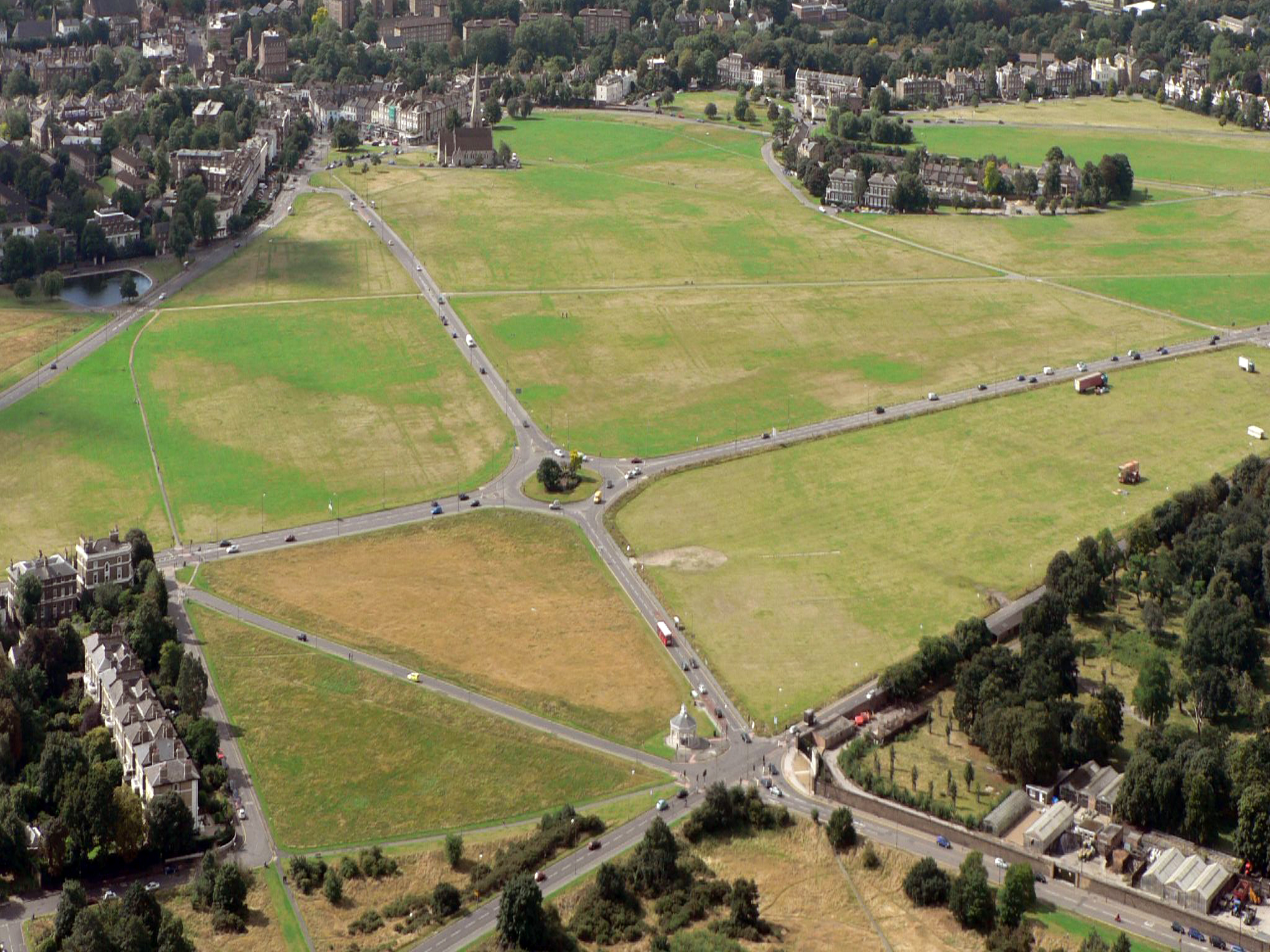 The Blackheath Army (1673)
As a wide open space about an hour’s march from London, Blackheath was naturally a perennial choice of venue for rallying troops. It took on a new significance in 1673, when Charles II assembled a 13,000-strong army there under the command of Huguenot general Frederick Schomberg. This ‘Blackheath Army’ was intended to form an invasion force in the 3rd Dutch War, but the plan was scuppered when a Dutch fleet defeated general-turned-admiral Prince Rupert at the Battle of Texel, so denying the Army safe passage across the sea. Anxious to prevent the King from using it instead to meddle in domestic affairs, Parliament insisted on its disbandment. Ironically, Charles’s illegitimate son the Duke of Monmouth, who had been denied the opportunity to lead the Army himself against William of Orange in Holland, was to lead a failed rebellion against Charles’s successor James II in 1685, while William himself invaded England in 1688 to depose James.
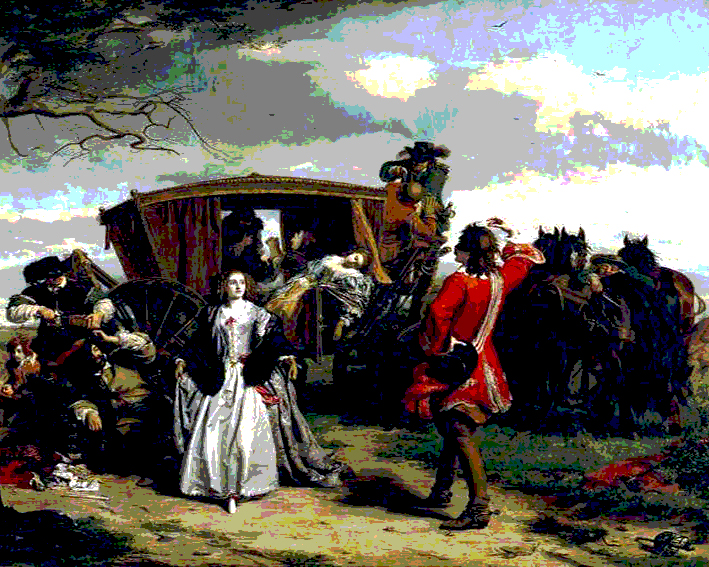 Nevison’s horse ride (1676)
John (alias William) Nevison is barely remembered today, but was a scourge in his time and certainly did not lack ingenuity. A Yorkshireman, he served in the Army before taking up a favourite occupation of ex-soldiers, highway robbery. Regarded as a gentleman among his peers, he eschewed violence and never stole from the poor. The event that brought him fame (or infamy) occurred when he conducted a robbery at Gads Hill, Rochester. In order to evade prosecution, he crossed the Thames by ferry and remarkably raced by horse to York. That evening, he went to see the Lord Mayor and struck a wager with him. When he was charged with the robbery, the Mayor’s alibi sufficed to get him off. It only brought him a temporary reprieve. After further close shaves, including a pardon that spared him transportation, he was arrested on a charge of murdering a constable. In view of his past record, he was hanged.
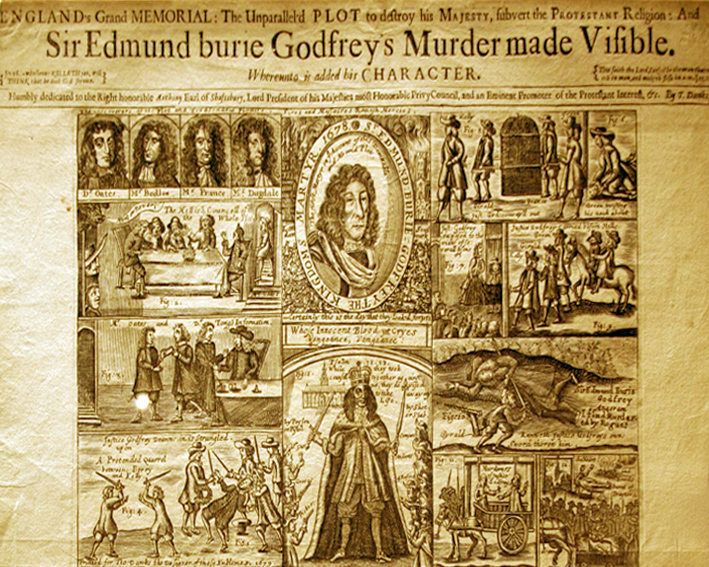 The strange case of Sir Edmund Godfrey (1678)
In October 1678, the corpse of a middle-aged man was found in a London ditch. Though impaled on a sword, suggesting suicide, it had not bled; the victim had evidently been strangled days earlier. He turned out to be Sir Edmund Berrie Godfrey, a well-respected magistrate and fuel merchant from Sellindge. The mystery took on a political hue because Godfrey, son of the MP for New Romney, was a member of the Peyton Gang, a republican society alarmed by rumours of the Secret Treaty of Dover. Godfrey had recently taken a deposition from Titus Oates alleging a ‘Popish Plot’, and his murder now stoked religious hysteria; the perjury of one Catholic suspect, Miles Prance, caused three men to be wrongfully hanged. The case, still unsolved, has been addressed by literally dozens of writers, including historians, novelists, and dramatists. The most likely culprit is the 7th Earl of Pembroke, a notorious rogue whom Godfrey had previously indicted for murder.
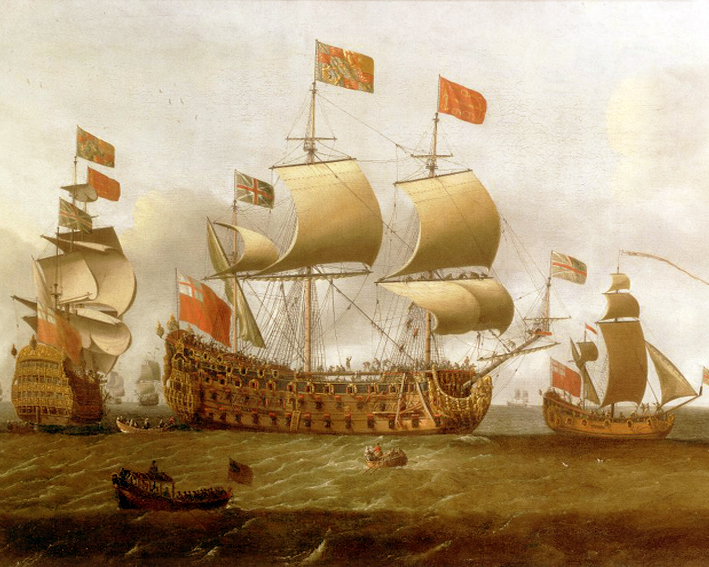 The HMS Britannia fiasco (1682)
After the disastrous Raid on the Medway (1667), the Navy Board’s Samuel Pepys pressed for 30 new warships to balance Dutch strength. Of these, the largest was the first-rate Britannia, designed by commissioner Sir Phineas Pett (1635-94) and built at Chatham dockyard. As a raised main battery was demanded, Pett added 16 inches to the girth for stability; but the Admiralty rejected the extra cost while insisting on the extra height. When the ship was completed in 1682, she was found to be too top-heavy to fight. She therefore went back into dry dock to have the 16 inches added – evidence that bureaucratic incompetence is nothing new. Bristling with 100 guns, she nevertheless made a formidable flagship in Admiral Russell’s fleet, and at the battle of Barfleur (1692) badly damaged her French counterpart Soleil Royal, which was destroyed soon afterwards. In 1715, she was thoroughly overhauled at Woolwich, but in 1749, now outmoded, was broken up.
 The King’s forced landing near Broadstairs (1683)
On June 30th, 1683, King Charles II and his brother the Duke of York, the future James II, were sailing around Foreness Point en route to Dover when they ran into bad weather. Fearing a shipwreck, they made an unplanned disembarkation at Bartholomew Gate, a gap in the cliff they could scramble up. Also on board that day was the Canterbury-born basso profundo John Gostling, who persuaded Henry Purcell to mark the King’s survival by setting to music some verses he had adapted from ‘Psalms’; the result was the celebratory song ‘They That Go Down To The Sea In Ships’, showcasing Gostling’s extraordinary range. Around 1750, Henry Fox, 1st Baron Holland, erected a commemorative arch whose inscription decreed that Bartholomew’s Gate was now King’s Gate. After being wrecked by a storm in 1819, it was rebuilt in the grounds of an intended convent nearby, which Fox had given the cod Latin name ‘Port Regis’.
 A white-haired wedding (1685)
Brides of retirement age are not unheard of today, but were few and far between in the C17, when lifespans were much shorter. One bride, Margaret Thomas of Charlton-next-Woolwich, must have stunned relatives in 1685 on revealing that she was to marry at 80. That, however, was nothing compared with her other news: she was not marrying a toy-boy, but a pauper old enough to be her father. We know the marriage really happened, because it was licensed by the Bishop of Rochester. Her husband to be, John Cooper, gave his age as 108, so that their aggregate age was 188. It is nigh on impossible to prove their ages, because dates of birth back then are hard to establish dependably; but, if the facts are true, he and they beat Guinness’s supposed world records. Unfortunately, having such a youthful wife was too much for the groom: he expired within a year.
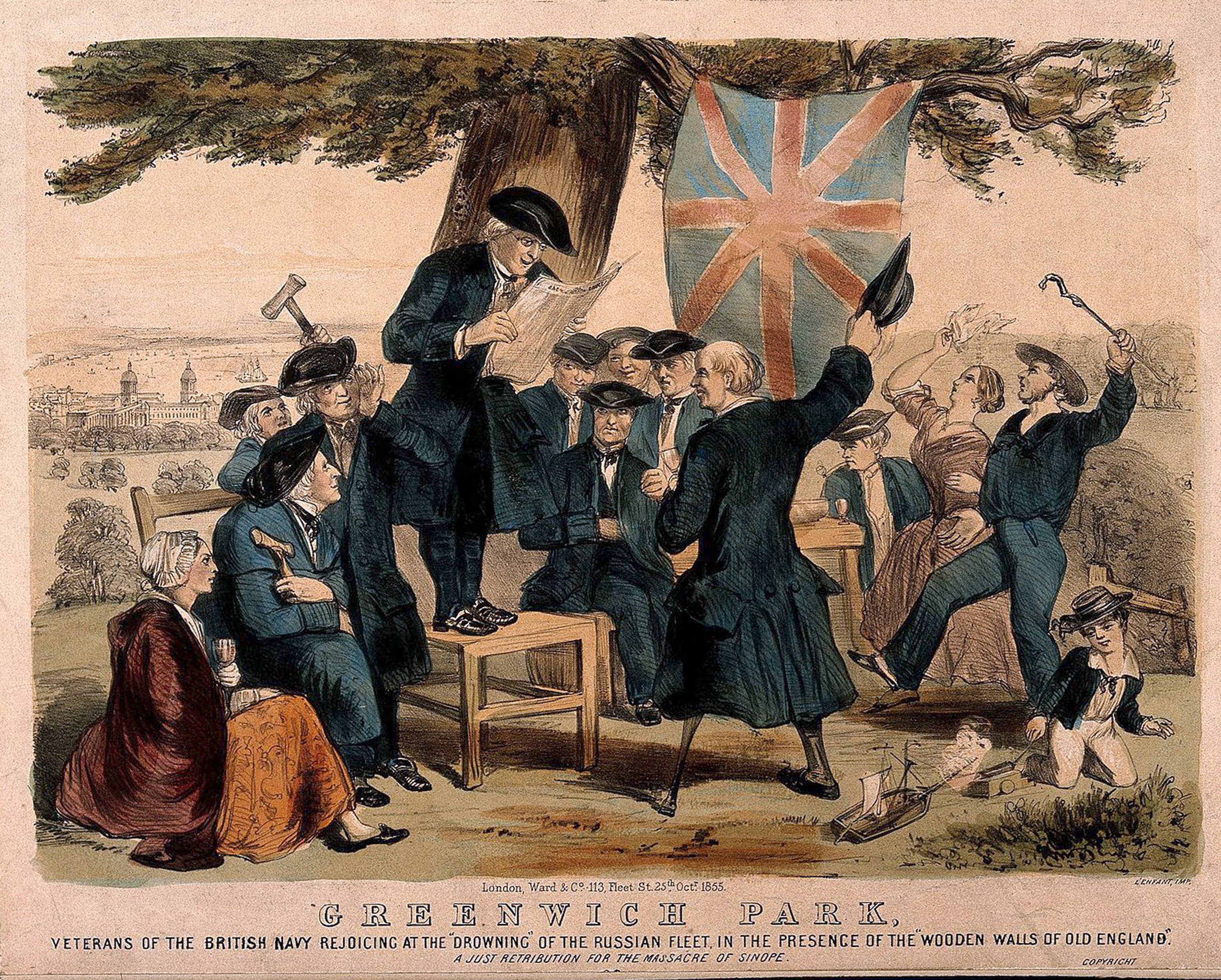 The opening of Greenwich Hospital (1692)
The Royal Hospital for Seamen, like the Eastbridge Hospital in Canterbury, was never actually a hospital, but had that name in the sense of an institution offering hospitality to the needy. It was opened in 1692 at the behest of Mary II, who liked the idea of a naval equivalent of the Chelsea Hospital for soldiers. The obvious location was the site of the former Placentia Palace, close to Greenwich Park and beside the Thames not far from London. It was to be a large affair, housing over 2,000 retired sailors; so a problem arose when it was realised that it would block the view of the Thames from the Queen’s House. It was therefore re-designed by Sir Christopher Wren as today’s distinctive four blocks, preserving a riverine view through their middle. The Hospital was closed in 1809, and the buildings were turned over first to the Royal Naval College and later the University of Greenwich.
 The Verviers earthquake (1692)
On the afternoon of September 18th, 1692, there occurred the most powerful earthquake ever recorded on the mainland of north-west Europe. Measuring around 6.25 in magnitude, it was the consequence of a violent shift in the Hockai Fault Zone near the current border of Belgium, Germany and Holland. The local disturbance was so strong that entire buildings fell down, including churches. The tremors were felt right across southern England; so the effects of the two-minute quake were considerable across Kent, particularly in Canterbury, Dover, and Sheerness. Deal Castle shook so violently that it seemed in danger of collapse. With pewter falling off shelves in homes all over, there was widespread terror. The incident did have a funny side. A story went round afterwards concerning anatomy students at the University of Leiden. When the quake started, the skeletons hanging in their laboratory suddenly sprang to life, causing them to run for their lives.
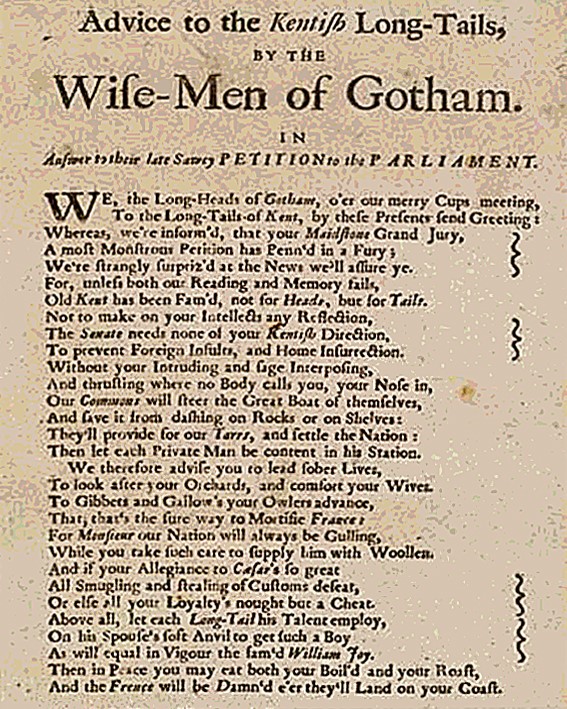 The Kentish Petition of 1701
Conscious of its status as the nation’s senior county, Kent was never backwards in putting forward its opinion on national matters, never mind how unpopular they might be. Kent’s Petition of 1642 had only goaded Parliament into civil war. Now, with William of Orange on the throne, it was another story. Five Kent men went to petition the Tory-dominated Commons to pass a bill of supply so that the King could build Britain’s defences against the French. Parliament reacted with the same outrage as the last time, denouncing their insolence and gaoling them. Kentish folk were lampooned as a race of Long-Tails, i.e. rats. Redemption came two weeks later from an unexpected quarter. With a 16-man guard for protection, Daniel Defoe came to Parliament and, in the name of 200,000 loyal subjects, reminded MPs of their democratic duty. The bill was passed. On their release, the Kent five were banqueted in London, and hailed as heroes back in Maidstone.
 The Great Storm of 1703
December 1703 saw the most destructive storm in English history. A gale had been brewing for days, and exploded on the 7th. The winds are reckoned to have been equivalent to a Category 2 hurricane. Damage to shipping was particularly grievous. HMS Vanguard sank at anchor in Chatham dockyard, but at least no one was harmed. It was another matter on the Goodwin Sands, which became a seamen’s graveyard. Numerous ships were wrecked, mostly with all hands: HMS Restoration (387 lost), HMS Northumberland (220), HMS Stirling Castle (206) and HMS Mary (268) among many others. There was, however, one incredible good-luck story. Seaman Thomas Atkins was swept from the sinking Mary onto the deck of the Stirling Castle, which itself was about to capsize. Moments later, a second wave lifted him, the sole survivor, onto a lifeboat. The Government attributed the storm to God’s anger with the nation, and ordered a day of fasting as penance.
 The Palatines on Black Heath (1709)
The Palatinate (‘Pfalz’) was the land in the west of the Holy Roman Empire under the Pope’s direct control, its name surviving today within that of the German province Rheinland-Pfalz. Like most of Germany, the region suffered horribly during the 30 Years’ War, but then had more to endure from the eastward expansionism of France’s Louis XIV. The last straw was the freezing winter of 1708-9. Opportunistic traffickers lured ‘Poor Palatines’ with the prospect of a new life in America, but dumped them in Kent. Within months, 13,000 of them were encamped on Blackheath. Following two earlier influxes of Huguenots to the county, the presence of these unskilled, uneducated Franconian-speaking ‘strangers’ caused considerable unrest. The Tories complained that their upkeep was insupportable, while the Whigs battled to drum up sympathy. Most of them either were dispersed or went home, but a minority were taken at public cost to build Palatine colonies in New York and Pennsylvania.
 The Dering vendetta (1711)
The first duel in London between men armed with pistols, not swords, took place in May 1711. At a dinner in the Toy tavern at Hampton, Middlesex, matters got out of hand when 32-year-old Cholmeley Dering, heir to the Dering baronetcy at Pluckley and current MP for Kent, got into a drunken brawl with Colonel Richard Thornhill. They fought so fiercely that they smashed the wainscoting, and Dering stamped on Thornhill’s face, knocking out several teeth. His apology afterwards was rejected, and he felt obligated to respond to Thornhill’s challenge. The next morning, they faced one other alone at Tothill Fields, Westminster. Each fired at point-blank range, and Dering was killed. Duels being considered barbaric, Thornhill was tried for murder at the Old Bailey, but convicted only of manslaughter on account of Dering’s aggression. Thornhill was sentenced to be branded; but, three months later at Turnham Green, Middlesex, he was murdered by two assailants, plainly in revenge.
 The launch of the Kentish Post (1717)
Newspapers started showing up around Europe in the C17. The first in Kent was the ‘Kentish Post’. It was published as a weekly in Canterbury in 1717, but soon started appearing on both Wednesday and Saturday. Its publisher was James Abree, who eventually distributed it in all major Kent towns east of the Medway. Abree took on a successor, George Kirkby, and retired in 1768, at which point James Simmons launched the rival ‘Kentish Gazette’. Before long, Kirkby was obliged to merge the ‘Post’ into the new title, which has continued to serve Canterbury as a weekly until the present day. Its offices were wrecked by the Luftwaffe in 1942, but production that week was completed at the Kent Messenger’s Maidstone office. The ‘Gazette’ took over several Kent County Newspapers titles. Meanwhile, however, the Kent Messenger Group – which started with the ‘Maidstone Telegraph’ in 1859 – had been growing steadily stronger, and acquired KCN in 1980.
 The Luxborough Galley disaster (1727)
In June 1727, the South Sea Company ship Luxborough Galley was sailing back to England with a cargo of rum and sugar when she caught fire below decks. By the time the crew became aware of the danger, there was a blaze, and the presence on board of gunpowder made the captain decide that the best course of action was to kneel and pray. The main lifeboat could not be launched, for some reason, so the crew of 38 was left with only a 16-foot yawl. Only 22 squeezed aboard, and the rest were left to die. Some wanted to throw overboard the two “black boys” thought to have started then concealed the fire, but the captain forbade it. Adrift for two weeks, the crew resorted to eating the hearts and drinking the blood of the first to die. One of the dozen survivors was 27-year-old second mate William Boys of Deal, whose son William published an account in 1787.
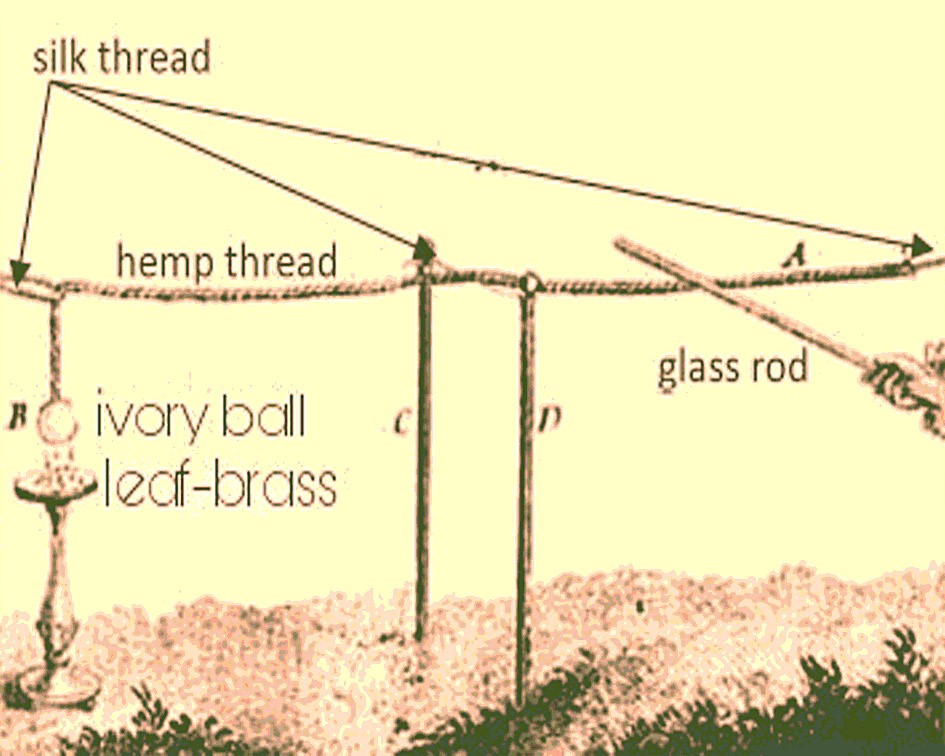 The discovery of electrical current (1729)
Until Stephen Gray from Canterbury came along, electricity was thought to be static. It was while teaching at Charterhouse School that he discovered he could make a charge migrate along a stick. Wishing to experiment further, he involved his friend the Reverend Granville Wheler while visiting Otterden Place in June 1729. To begin with, the tests they conducted were within the house. They replicated one that Gray had already done with thread but on a larger scale, along a whole gallery. Realising that they needed to suspend the thread with silk to avoid contact with the ground, they also discovered the principle of insulation. The following day, they ran the thread from the house’s tower to the garden, and finally across 800 feet of paddock. Wheler reported the ground-breaking results to the Royal Society, which awarded Gray its first Copley Medal. Regrettably, the importance of his work was not fully appreciated before others muscled in.
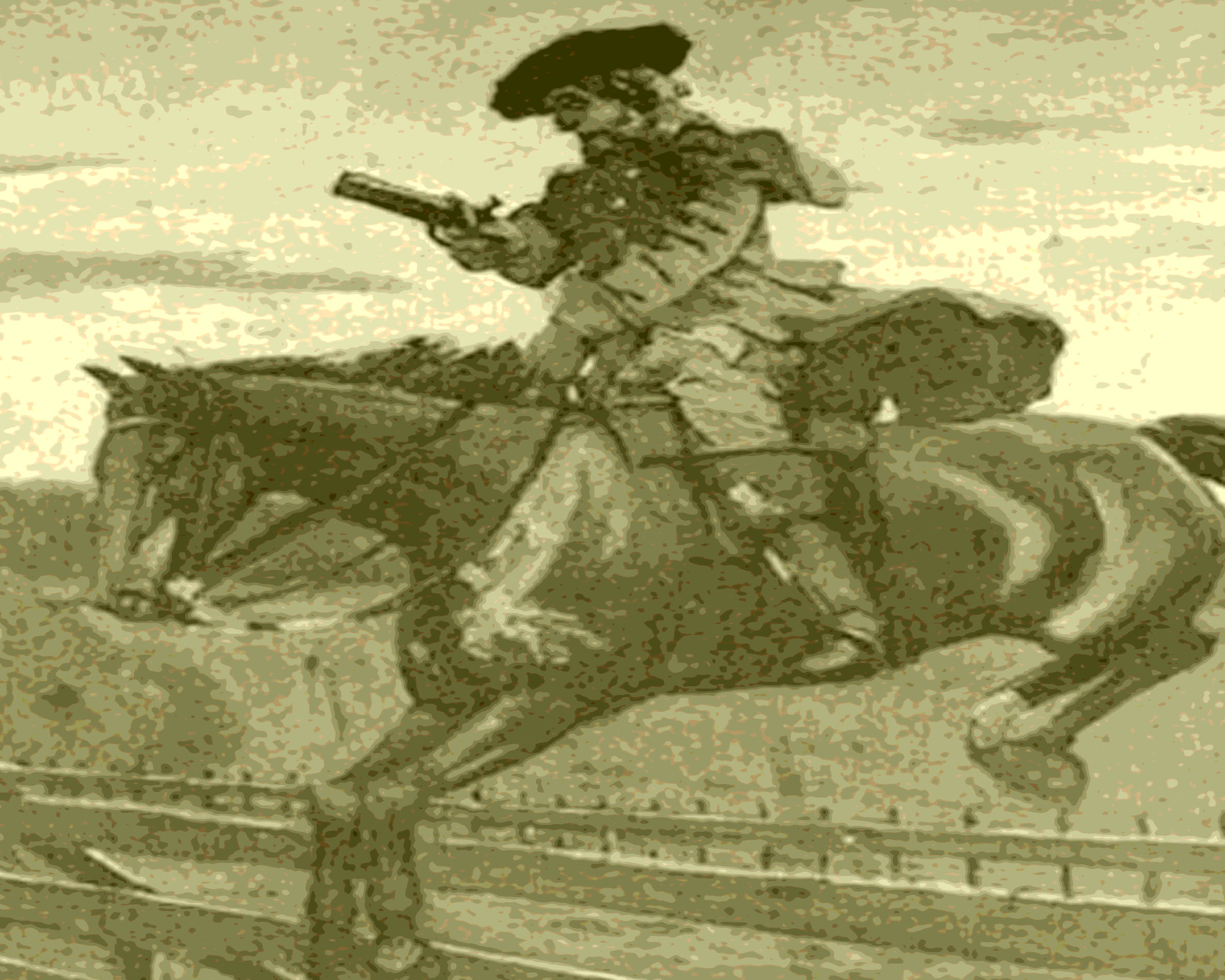 The Kentish raids of Dick Turpin (1735)
Today’s public image of Dick Turpin is as far from reality as can be imagined. He was born in Essex, and started life as a butcher. A gang of deer thieves used him as a fence, but he decided he could make a better living by joining them. This ‘Gregory Gang’ became a notorious band of robbers. They ravaged the countryside, their favourite tactic being raids on remote households where they would torture householders into handing over their life savings; murder and rape were later added to their charge sheet. Their activities were mostly north of the Thames, but extended to Gravesend and Charlton in Kent in 1735. After the gang was brought to justice, the pock-marked Turpin turned to highway robbery. In 1737, he murdered a gamekeeper, and was later hanged at York for horse theft. He owes his reputation as a gentleman robber to William Ainsworth’s 1834 novel ‘Rookwood’, which chose to depict him as a heroic figure.
 The Battle of Goudhurst (1747)
In the mid-C18, the lawlessness of Wealden smugglers took on hues of the Wild West. By 1747, the notorious Hawkhurst Gang was so terrorising Goudhurst that a recently returned corporal, William Sturt, formed a posse to take them on. New gang-leader Thomas Kingsmill, 27, demanded a showdown, threatening townsfolk with deadly reprisals. With fifty bare-chested men, he rode into town, expecting a slaughter; but he was in for a surprise. ‘General’ Sturt’s surprisingly well-drilled men, entrenched in St Mary’s graveyard, responded to their approach with volleys of musket fire. Three gangsters were shot dead, including Kingsmill’s brother, and the rest fled. The chastened Kingsmill overreached himself months later, when his gang raided a custom house in Dorset, stealing £500 of tea (= £50,000 today). A bounty was put on their heads, and 75 were brought to justice. Kingsmill was hanged at Tyburn, and his corpse sent back to Goudhurst to rot on a gibbet.
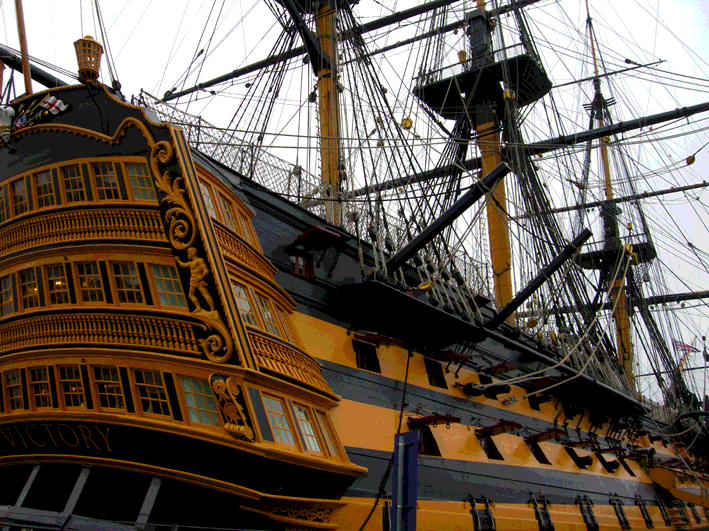 The launch of HMS Victory (1765)
In the era of sail, it was customary for warships to form a line that fired on the enemy passing in the opposite direction. Such ‘ships of the line’ were divided into four ratings, according to their number of guns and crew. A second-rate ship was not sub-standard, but simply less strong than a super-powerful first-rater. So, when the Government ordered a new first-rater in 1758, it was a big deal. That ship would be HMS Victory, and she would be built at Chatham. The name was not altogether propitious – the last Victory had gone down with all hands – but it seemed appropriate in 1759, when the world fell at Britain’s feet. 150 workmen built the frame using 6,000 trees, mostly oak, at a cost equating to around £9 million. She was launched in 1765, featured prominently in the Battle of Cape St Vincent in 1797, and won fame as Nelson’s flagship at Trafalgar. Officially still in commission, she is now displayed at Portsmouth.
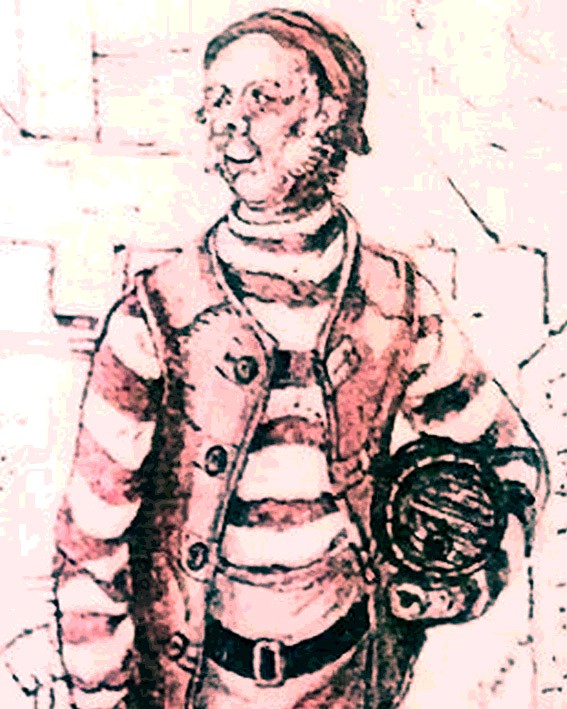 The Battle of Botany Bay (1769)
The Callis Court gang was a notorious band of smugglers. Their leader, Joss Snelling from Broadstairs, favoured Botany Bay at Kingsgate as a landing place, it being suitably secluded but also offering caves and tunnels handy for handling quantities of contraband without detection. In March 1769, however, he was in for a surprise. Lying in wait was a squad of armed excisemen ready to make arrests and confiscate loot. When the ‘owlers’ resisted arrest, mortal hand-to-hand combat ensued on the shore and in the sea. Five of the gang who escaped the beach were met at the top by a mounted officer, whom they shot dead. A search of nearby houses yielded a dead smuggler in a cottage, alongside a dying one. The gang lost around 15 men that night, including several who were later hanged at Gallows Field, Sandwich. Snelling himself got off scot-free; and, as an old man, he would even be introduced to Princess Victoria.
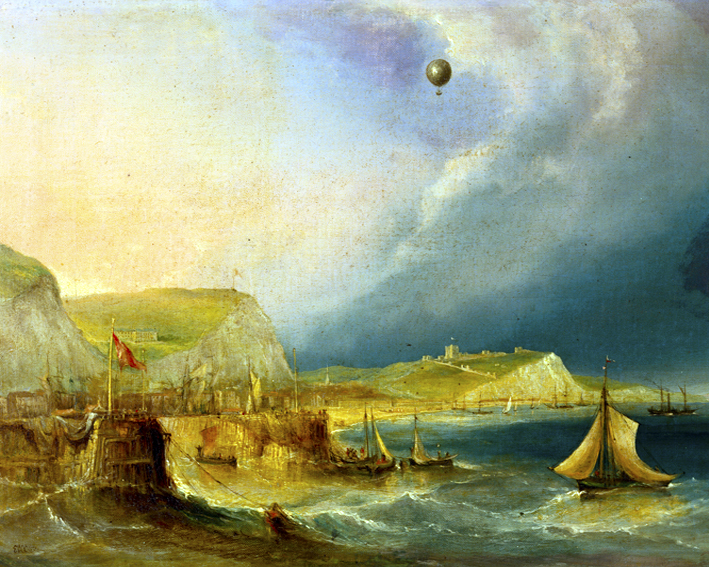 The first Channel crossing by air (1785)
No sooner had the Montgolfier Brothers made history with their first-ever manned flight than two more adventurers felt the need to upstage them. John Jeffries and Jean-Pierre Blanchard, an American and a Frenchman, came to Dover Castle to attempt a crossing of the English Channel by hydrogen balloon. They set off at 9 am on January 7th, 1785 in the expectation of arriving safely in Calais 150 minutes later. It wasn’t quite so simple. Although they had a following wind, the basket was so heavily laden that they nearly ditched in the sea several times. What followed set a precedent for all future thrillers involving balloon flights. They ejected their ballast, anchors, food and drink, and finally even their clothes. They then overshot Calais and landed in a forest, where their achievement has a memorial. It was a gallant effort: five months later, two others attempting a Calais-to-Dover crossing were killed when their balloon caught fire.
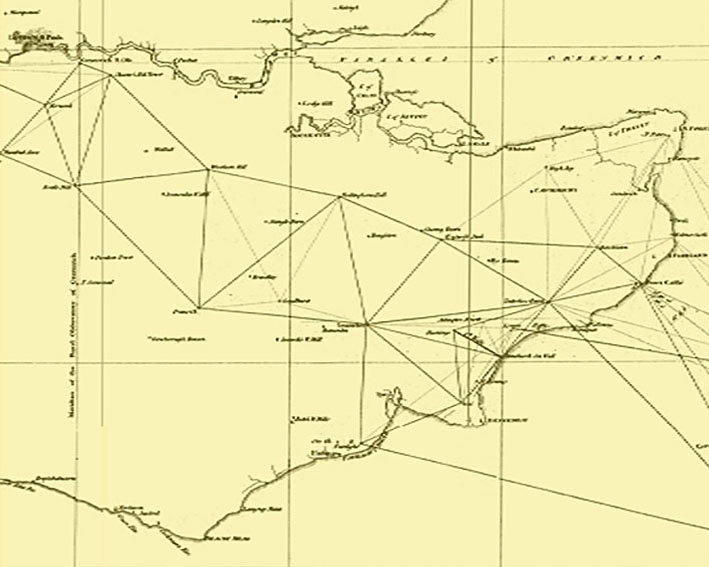 The Anglo-French Survey (1790)
The Astronomer Royal Nevil Maskelyne was unimpressed when the director of the Paris Observatory commented that measurements of latitude and longitude provided by the Royal Observatory at Greenwich were inaccurate. Sensing an opportunity, however, he proposed that the gifted Scottish surveyor William Roy conduct a world-beating project to establish the precise distance between the Greenwich and Paris observatories by geodetic means. This would first mean measuring a five-mile baseline on flat land in Middlesex with extreme accuracy. By means of trigonometric surveying techniques, a network of imaginary triangles would then be constructed, progressing from Greenwich through Romney Marsh to France, with Dover Castle providing a particularly important cross-Channel landmark. The canny Roy secured funding by grossly underestimating the cost, but pulled it off in 1790 after six years’ work. Although he did not outlive its publication, the project served as a foundation for the Ordnance Survey a year later.
 The Nore Mutiny (1797)
The Nore is an anchorage off Sheerness that gave its name to an infamous mutiny. It followed hard upon another mutiny concerning pay and conditions at Spithead, off Portsmouth. With Britain embroiled in war with the French Revolutionists, the Nore mutiny was a more sinister affair. It started when the crew of the Sandwich seized control of their ship, and 27 others followed suit. Richard Parker from Exeter was elected their leader. His plan was to hold the Admiralty to ransom by blockading the Thames. Demands was presented that eventually went well beyond those of the Spithead mutineers. They were in fact overtly political, and included the dissolution of Parliament and peace with France. When it became clear that the mutineers’ aims were revolutionary, support drifted away, even though departing ships were fired upon. Eventually the Sandwich found herself isolated, and capitulated. Nine men were flogged, 29 imprisoned, and 29 hanged, among them Parker.
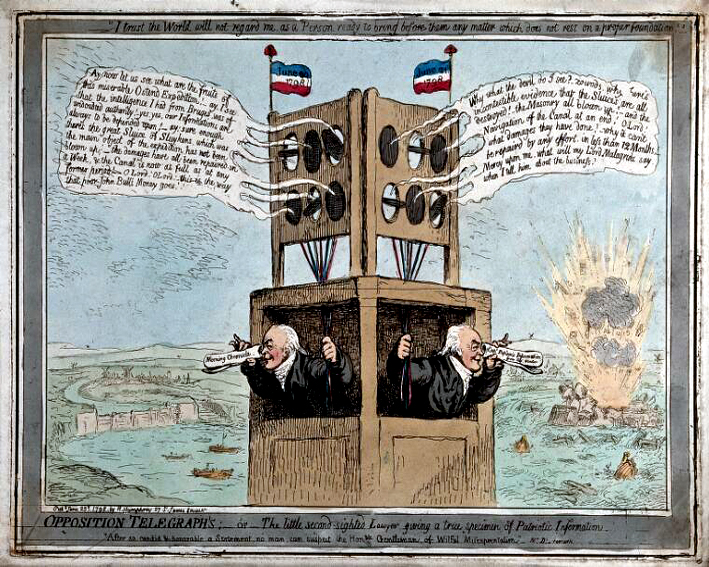 The Ostend Expedition (1798)
The military operation in Flanders devised by Captain Home Popham during the Revolutionary War with France was an eerie forerunner of the disastrous Zeebrugge Raid of 1917. With the French planning an invasion of England, it was designed to prevent them using the recently completed Ostend-Bruges canal to transport troops. Major-General Eyre Coote, commander of Dover’s army garrison, was to lead a force of 1,300 to destroy the locks and sluices, obliging French vessels to take to the sea, where the Royal Navy could engage them. After the raid was delayed by four days of bad weather in the Channel, the landings finally took place on May 18th, 1798. All was proceeding well until an adverse wind blew up, and British transports were unable to take the troops off. 115 of Coote’s men were killed in frantic fighting, and 1,134 taken prisoner. Both Popham and Coote, who was badly wounded, were freed soon afterwards in a prisoner exchange.
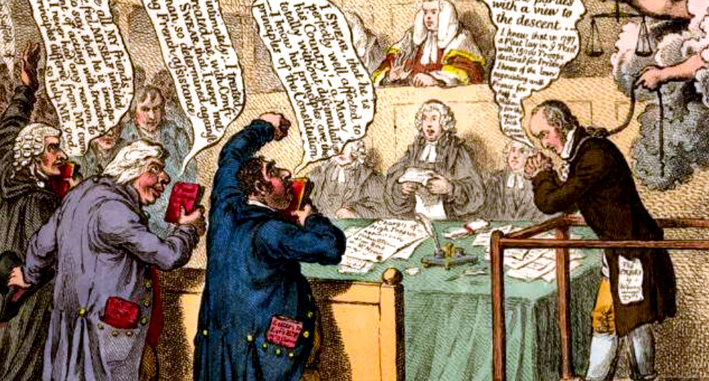 The Maidstone Trial for High Treason (1798)
During the French Revolutionary War, the Society of United Irishmen attempted to emulate the American Revolution while Britain’s attention was elsewhere. The original perpetrators were Presbyterians angry at playing second fiddle to the Anglican Church, but they were joined by many Catholics. Their revolt was suppressed by the British Army after nearly five months. A comparative sideshow, but a focus of national attention, was the trial at Maidstone of Father James O’Coigley and four others who were apprehended at Margate on their way to solicit a French invasion. The authorities put on a great show of justice, a list of 207 Kentish jurors being drawn up and 41 Kentish witnesses produced. The jury took 40 minutes to find O’Coigley guilty of treason and acquit the others; he was publicly hanged, drawn, and quartered at Penenden Heath. A century later, the Irish Parliamentary Party made a pilgrimage to Maidstone’s St Francis’ church and installed three stained-glass windows in his memory.
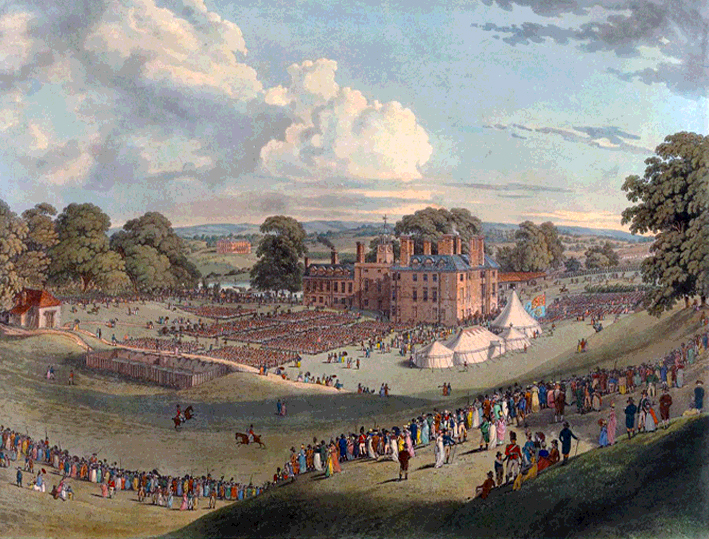 The Grand Review at Maidstone (1799)
In the days when local militias were an integral part of the nation’s defence against the persistent threat of invasion, parades were not infrequent in Kent, and the wide open spaces of Blackheath provided a popular venue. Perhaps the best remembered, however, took place on August 1st, 1799 at The Mote in Maidstone, which was then owned by Lord Romney. Since the guests included George III and Queen Charlotte, the Prince of Wales, and prime minister William Pitt the Younger, the host naturally pulled out all the stops, laying on a full military parade of his 5,228 volunteers. Afterwards, all sat down to a vast banquet outside the house, though what provision was made against the possibility of rain is unclear. It went sufficiently well that it was commemorated by an expensive Doric pavilion that still stands, albeit somewhat forlornly, in Mote Park. The occasion was recorded in watercolours by Maidstone-born artist William Alexander.
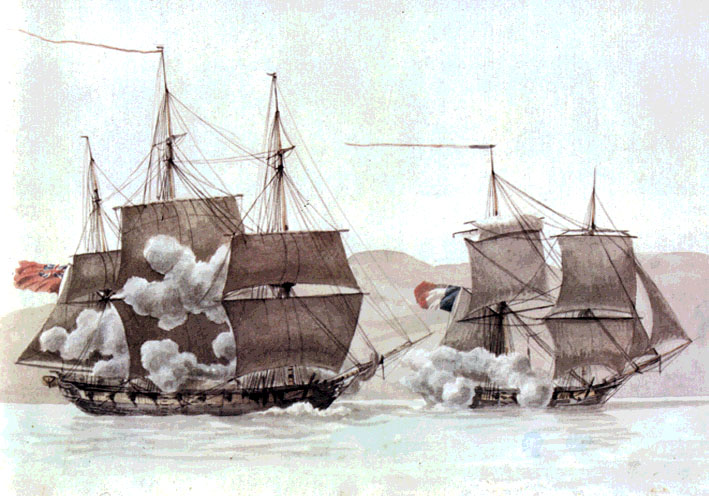 The capture of Ligurienne (1800)
Lacking the requisite minimum of 20 guns, HMS Peterel was not rated, and so was termed a sloop. She nevertheless had a more distinguished career than many larger ships. She was built in 1794 at Frindsbury, and fitted out and copper-bottomed at Chatham. Her 16 guns and >100 crew were put to good use by numerous captains, the foremost being Jane Austen’s brother Francis, a future admiral of the fleet; and her crew included the intrepid seaman Staines, whose adventures alone would make an exciting ‘Master and Commander’ movie. Launched during the French Revolutionary Wars, she was already serving in Nelson’s fleet by 1796, and under Commander Austen captured about 40 enemy ships. Most famously, after seizing two merchant vessels off Marseilles, she was attacked by three French escorts. Austen forced two of them to beach, and captured the largest, Ligurienne. Peterel was converted to a receiving ship for new recruits in 1811, and sold 16 years later.
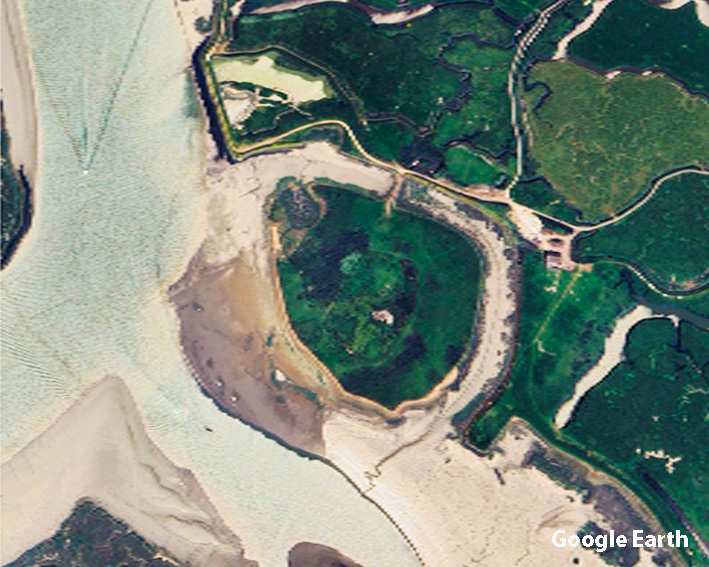 The Chetney Hill fiasco (1800-15)
During the Napoleonic Wars, the government encountered political pressure to emulate European best practice and build a lazarette, or isolation unit, for sufferers from exotic diseases arriving in England. The HM Board of Works’ surveyor James Wyatt prepared plans for one on Chetney Hill, a deserted 30-acre island in the backwaters of the Medway estuary north-west of Iwade. These were approved by Parliament in 1800. A vast amount of money was pumped into the project, but it proceeded slowly even after Wyatt’s budget was ironed out and engineer John Rennie the Elder was hired to complete it. It became evident meanwhile that a much cheaper solution for providing quarantine might be available, in the form of hulks. The death blow was dealt when it transpired that the land was far too marshy to support buildings. The construction materials were sold off at a huge loss, and a veil expediently drawn over this white elephant.
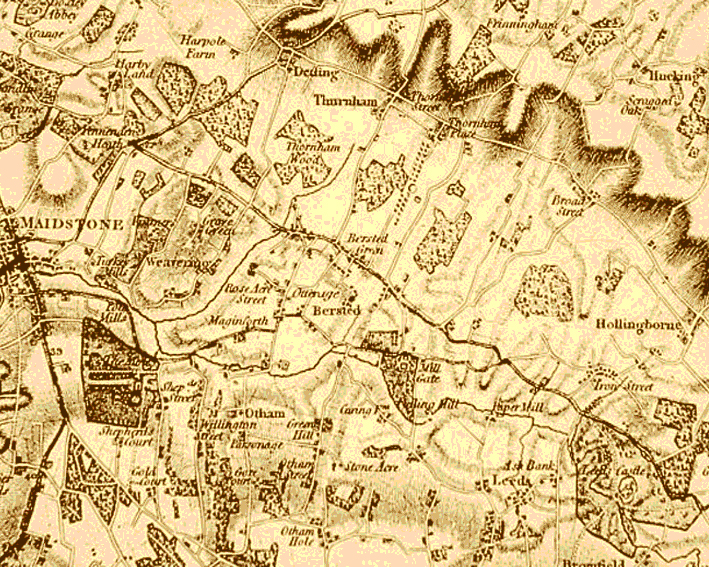 The first Ordnance Survey map (1801)
Although the Ordnance Survey is now most commonly associated with hiking and the like, its original purpose was military. The name itself exposes its purpose, ordnance being the traditional name not only for munitions but also military logistics. The idea of creating detailed maps for British Army use was suggested after the Battle of Culloden in 1745, when a map of the Highlands was needed for tracking down Jacobite rebels. The task turned into a lifetime project for William Roy, later a Royal Engineers major-general. By 1790, the threat from Napoleonic invasion suggested the need for a detailed survey of the likely theatre of war, which in practice meant Kent. That first map was published privately in 1801. Though the next, featuring Essex, was produced by the Ordnance Survey soon afterwards, the set of British maps was not completed for decades. A commemorative set of UK postage stamps published in 1991 featured Kent’s Hamstreet.
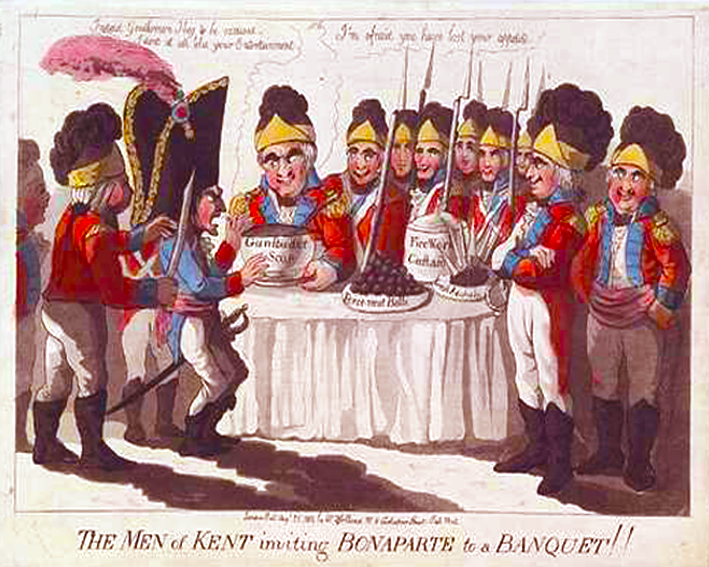 Napoleon’s invasion plan (1803)
In April 1803, Napoleon sold Louisiana to fund his imperial ambitions, and Britain declared war. Vowing to fly his Imperial Eagle over the Tower of London, ‘Boney’ terrifyingly amassed an army of 100,000 at Boulogne. Wordsworth summed up British sentiment: “Vanguard of Liberty, ye men of Kent, Ye children of a Soil that doth advance Her haughty brow against the coast of France, Now is the time to prove your hardiment! To France be words of invitation sent! They from their fields can see the countenance Of your fierce war, may ken the glittering lance And hear you shouting forth your brave intent. Left single, in bold parley, ye, of yore, Did from the Norman win a gallant wreath; Confirmed the charters that were yours before;— No parleying now! In Britain is one breath; We all are with you now from shore to shore:— Ye men of Kent, ’tis victory or death!” Perhaps wisely, Napoleon called the invasion off.
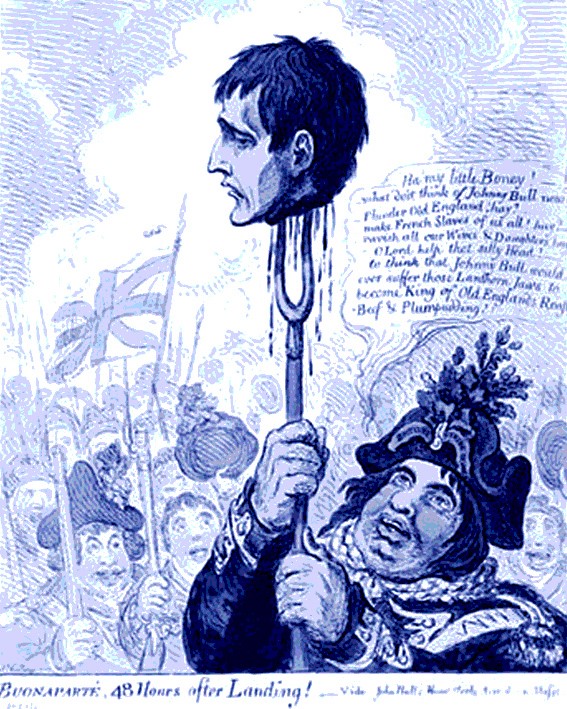 The Kentish call to arms (1803)
The West Kent Militia, founded in 1758, was an auxiliary unit in the British Army that fed the West Kent Regiment with reinforcements during WW1, while the East Kent Militia founded two years later performed the same role for the Buffs. In 1798, with the 2nd French Revolutionary War preoccupying Britain, Irish insurgents had mounted a revolt, and invited French troops to land in County Sligo in support. Though that insurrection was put down, dealing with it left the South of England largely undefended, so temporary “volunteer associations” were formed. They had to be reformed urgently in 1803, with Napoleon threatening to invade. The whole country got behind the effort, the popular entertainer Charles Dibdin expressing the hope that Kent would send the French “hopping”. The government set quotas for each county, Kent’s being 4,633. As usual, the frontline county was not slow to heed the call, raising 18,996 men in the first six months.
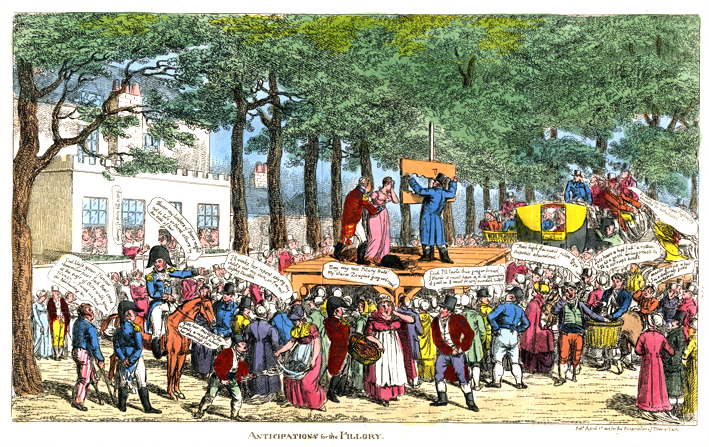 The Delicate Investigation (1806)
Blackheath was once the focal point of a national scandal. Lord and Lady Douglas complained about the behaviour of their neighbour at Montagu House, the Prince of Wales’s estranged wife Caroline. They reported licentious goings-on, and claimed she had sent them abusive and lurid correspondence. Caroline’s status as queen-in-waiting prompted a secret inquiry, known as the Delicate Investigation, conducted by the Prime Minister, Home Secretary, Lord Chancellor, and Lord Chief Justice. Lady Douglas, who had previously been the Princess’s friend, told them tales of high-profile gentleman visitors, and asserted that Caroline had an illegitimate child. The princess’s domestic staff were reticent about the visitors, but maintained she had not given birth. Perhaps swayed by Caroline’s popularity, the commission decided she had done no wrong legally speaking, though she was permitted to see her true daughter Princess Charlotte only weekly thereafter. When the findings were leaked to the press, the Douglases were metaphorically pilloried.
 The John Grant case (1808)
Few today are aware that there is still a street in Kolkata named in honour of a Man of Kent. In 1808, a cadet called John Grant was found guilty of arson. As a member of the occupying forces, he might have hoped to get off scot-free; but the chief justice of the supreme court of Bengal, Sir Henry Russell from Dover, insisted on a death sentence. His reasoning was that Indians must enjoy the same standard of justice as Britons, failing which their “affection and allegiance” could not be expected. His stance contrasted strikingly with that of India’s previous overlords, the Moghul Empire, whose founder Mīrzā Zahīr ud-Dīn Muhammad avowedly detested India, and tolerated Indians only as a source of riches. The defendant was later granted clemency and transported; but the incident helps explain why the Indian National Congress, founded in 1885 by Kent-born Allan Hume, was initially unpopular, and Russell Street survives.
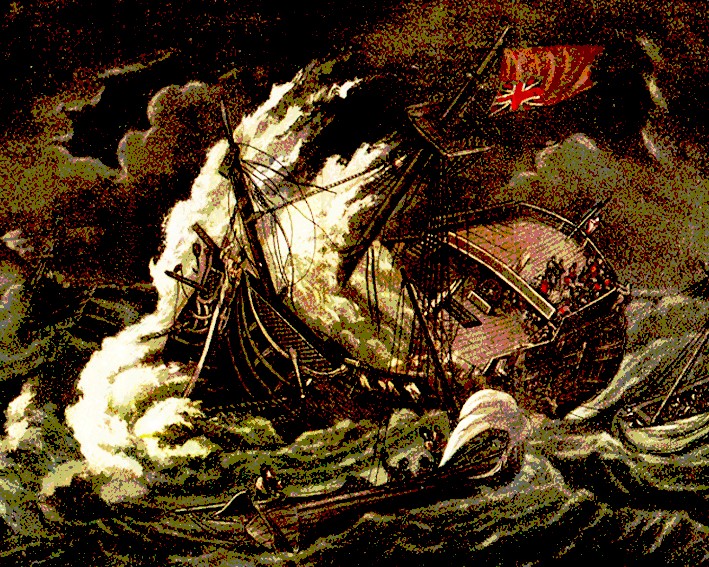 The wreck of the East Indiamen (1809)
The Admiral Gardner and the Britannia had three things in common: both were built in Blackwell, owned by the British East India Company, and doomed to the same watery end. Admiral Gardner, launched in 1797, made five trips to India, once surviving an attack by a privateer. Britannia, built in 1806, made just one voyage to China and India. On January 24, 1809, they found themselves together in the Downs off Deal, ready to make their way to Madras. A severe gale blew up that tore both from their moorings and onto the Goodwin Sands. Fortunately, local boatmen were able to save all but seven of Britannia‘s crew, and most of Admiral Gardner’s. The losses from the storm were largely financial. Apart from the two valuable ships, Britannia’s lost cargo was worth £2.5 million today, while Admiral Gardner was carrying nearly £1 million in copper coins belonging to manufacturer Matthew Boulton. This wind really was an ill one.
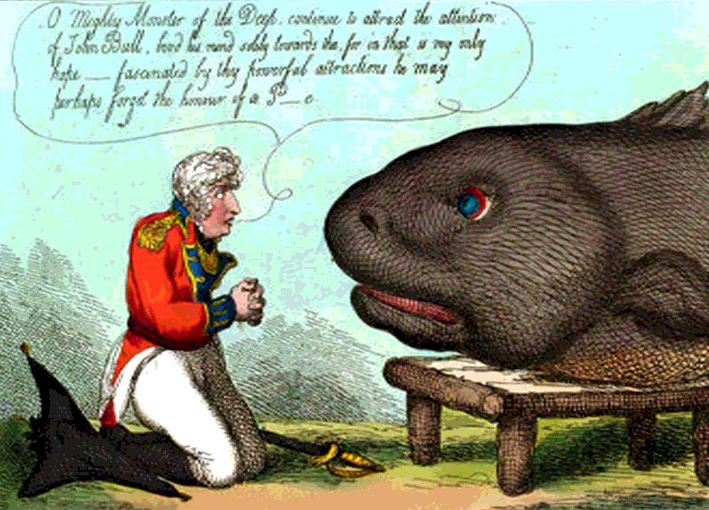 The Prince of Whales (1809)
Among the whales that occasionally stray up the Thames, one of the most noteworthy was the 75-feet long specimen with a 25-feet girth, probably a fin whale, that was driven ashore at Gravesend in 1809 by a river pilot called Barnes. In those days before television, such a spectacle was bound to attract much curiosity, and the Lord Mayor of London, who controlled that stretch of coast, cashed in by barging it upstream past London Bridge and charging one shilling a look. Eventually the Admiralty muscled in on the action, removing the 30-ton carcase by force and making £150 out of the blubber, worth £7,000 today. The story coincided exactly with another involving Prince Frederick, the ‘Grand Old Duke of York’ of nursery-rhyme fame, whose mistress Mary Anne Clarke had been exposed in a cash-for-commissions scandal. The whale might have afforded him a brief respite from public attention, but he was forced to resign as Commander-in-Chief anyway.
 ‘The shipwreck of the Minotaur’ (1810)
Built by William Rule at Woolwich, HMS Minotaur was launched in 1793 soon after he was appointed surveyor of the navy. A 74-gun warship, she was tailor-made for the French Wars and saw considerable action, participating at the Battles of the Nile (1798), Trafalgar (1805), and Copenhagen (1807). Disaster struck just before Christmas 1810, when she ran aground off Holland after dark. The ship toppled over, but survived until the morning after the crew cut off her masts. Then, at 8am, her hull split open. 117 crewmen made it to shore in two boats, only to be handed over to France as prisoners of war. Because the hostile Dutch made desultory efforts to mount a rescue, up to 570 men drowned. The case caused an outcry in Britain, and JMW Turner capitalised on the interest by suitably renaming one of his paintings depicting a shipwreck.
 The Coast Blockade (1817)
We are so accustomed to the idea of smuggling as the pastime of romantic rogues that we overlook the savage reality. It was more like Prohibition Era gangsterism: as costly to society as it was to the Treasury. Customs & Excise always struggled to cope, not only because it was ill-equipped and outnumbered, but also because of corrupt officials and collusive communities. Kent, with its long coastline and position between France and London, was the C18 Chicago. What changed things was the Battle of Waterloo. With the Napoleonic Wars over, the Royal Navy had unused resource. In 1817, its guns were turned on smuggling. Patrols from HMS Ganymede and HMS Ramillies regularly rowed ashore from the Downs to guard the coastline. Their efforts were soon supplemented with the use of redundant Martello towers, and new stations were built every three miles from Sheppey to Lydd. This ‘Coast Blockade’ continued till 1831, when a fully-fledged Coast Guard service was introduced.
 The first internal combustion road vehicle (1826)
In 1826, a landmark event in the history of locomotion took place in Kent. Samuel Brown (1799-1849), then living at Brompton, Middlesex, was a cooper by trade, but took an active interest in propulsion. He converted an old Newcomen atmospheric steam engine so that, instead of creating a vacuum in the cylinder with steam, it used a hydrogen flame. This ‘gas vacuum’ engine was a direct ancestor of the internal combustion engine. Not content with theory, Brown mounted his 8.8-litre, 4-hp engine on a vehicle that successfully drove up Shooters Hill on May 27th. Although the Swiss Isaac de Rivaz had propelled a comparable vehicle a few yards in 1807, this was the first ever road test. Brown’s engine achieved 7 mph in a repeat demonstration on Hammersmith Road, London with several men on board, then propelled a boat along the Thames. A version of the idea was eventually exploited commercially by Crossley Brothers of Manchester, though not Brown.
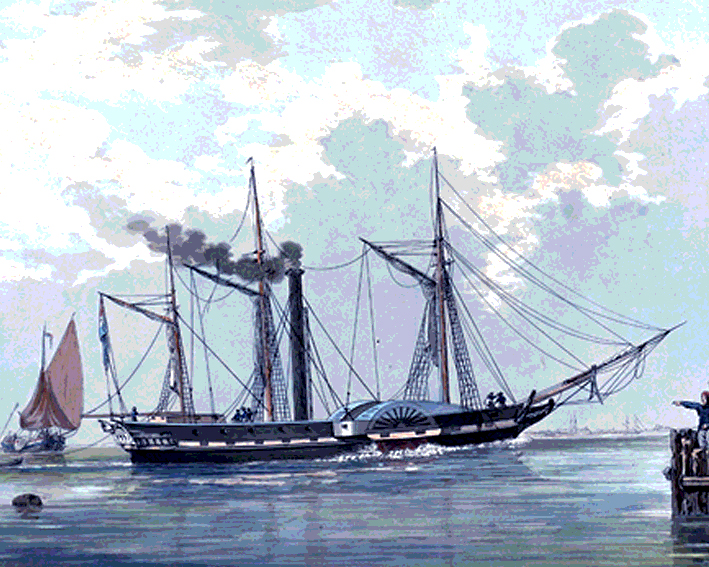 The first transatlantic crossings by steamship (1827)
So dominant were North Kent’s shipbuilding yards, and for so long, that Dover’s once thriving industry is usually overlooked. Its most famous production was Calpe, a 438-ton wooden paddle-driven steamship ordered by the American & Colonial Steam Navigation Company in 1825. By the time she had been built by JH and J Duke on Shakespeare Beach, the order had been cancelled; so she was sold to the Dutch government for a transatlantic mail service from Rotterdam to its South American colonies. Renamed Curaçao, she first crossed the Atlantic in April/May 1827, reaching Suriname in 28 days at a stately eight knots. Though slow, this still cut 12 days off the journey by sail. The American hybrid SS Savannah had already made the crossing in 1819, but that was largely under sail, whereas Curaçao’s engines were used for at least 11 days, and at least 22 on the return journey. Being unreliable, however, she was eventually converted to a man-of-war.
 The last Penenden Heath hangings (1830)
By the C19, Penenden Heath had been a place of execution for around a millennium. Things were set to change in 1830, however, with Maidstone Prison being built; it was to be used as a new town-centre venue for this salutary public entertainment. The authorities laid on a grand finale, hoping for a big Christmas crowd. On December 24th, three farm-workers were hanged together: Henry and William Packman, and John Field, alias Dyke. They had been found guilty of burning down a haystack, for which they obviously deserved to be strung up. The man with the noose was William Calcraft. This great showman used a short rope to ensure a slow death by strangulation, giving him the pretext to pull theatrically on the guilty parties’ legs, or even climb onto their shoulders, to break their necks. As a plaque records in Bearsted churchyard, however, it was a miscarriage. Someone else subsequently admitted to the offence on his deathbed.
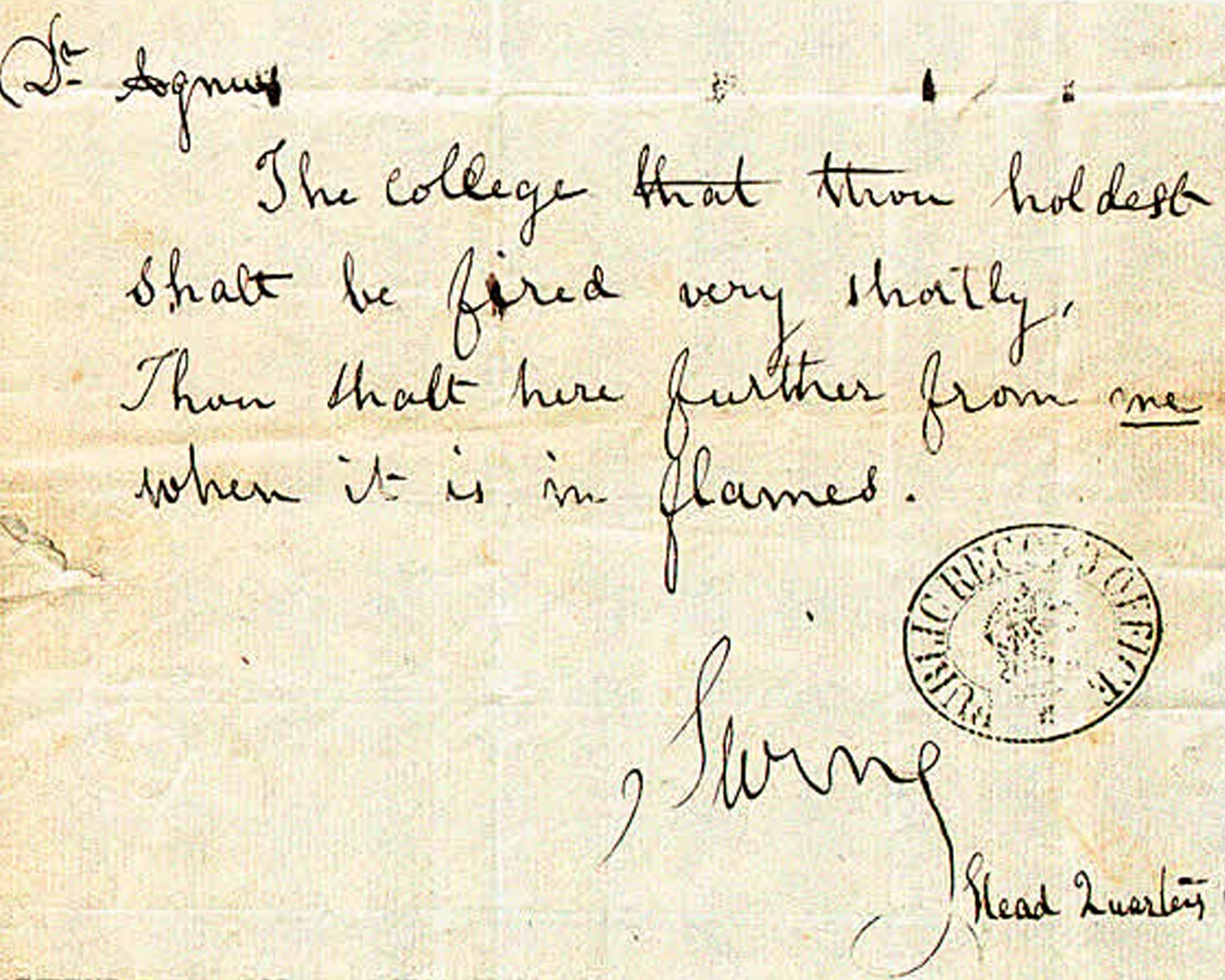 The Swing Riots (1830)
The Swing Riots were a typically Kentish revolt. Though technological efficiency was a boon to employers, it brought with it mass unemployment. After decades of low wages and high taxes, the spread of threshing-machines was the last straw for farmworkers. Reaction began in the Elham area, when a machine was wrecked one Saturday night in August, 1830. It started a copycat pattern of Luddism that resulted in over 100 machines being destroyed in East Kent within eight weeks. Action broadened to attacks on barns, haystacks, and even farm animals. The riots took their name from a mythical ‘Captain Swing’ whose name was routinely appended to threatening notes sent to opponents. During November, the revolt spread to neighbouring counties. The Duke of Wellington’s government fell, and the new Whig regime introduced the 1832 Reform Act as well as the 1834 Poor Law Amendment Act. By then, 19 protesters had been hanged, 644 imprisoned, and 481 transported.
 The execution of John Any Bird Bell (1831)
With Maidstone Prison having opened by 1831, it was hoped that public hangings there would attract big town-centre crowds. The first looked a good draw, the convicted felon being a boy. This was John Any Bird Bell, 14, from a Rochester poor-house. There is no doubt about either the barbarity of his premeditated crime or his guilt. Knowing that 13-year-old Richard Taylor regularly walked from Aylesford to Strood with his father’s 9-shillings sick benefit, he plotted with his brother to rob him. When the boy resisted, Bird gruesomely cut his throat. His execution on August 1st did indeed draw a good crowd, estimated at over 8,000; and he gave the reporters something to enthuse about by struggling for two minutes before expiring. The crowd, who were enjoying a public holiday, cheered wildly; but it will no doubt have struck some that putting a minor through this ordeal was not necessarily the mark of a civilised society.
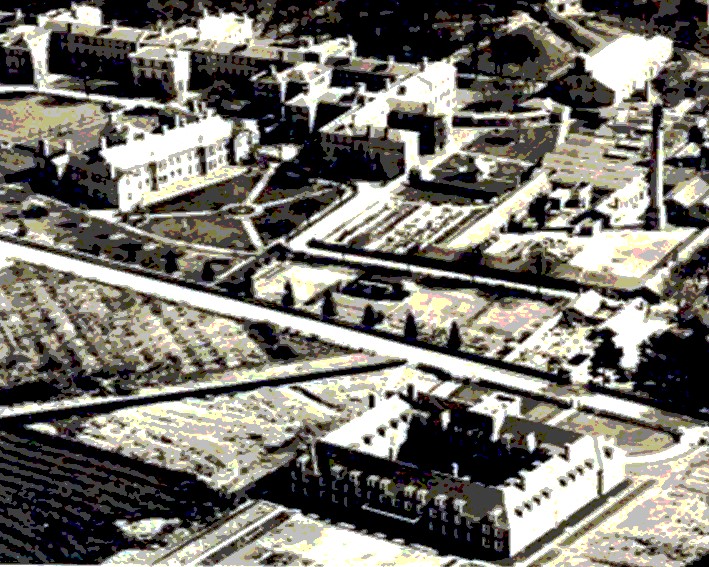 The opening of Kent County Lunatic Asylum (1833)
The Kent County Lunatic Asylum was built on Barming Heath to cater for the entire area of historical Kent as far as Deptford. It soon filled up, and St Andrew’s House was supplemented with first the Queen’s House and then the Hermitage Block. By the 1940s, it was tending to 2,000 patients. It even had its own cemetery containing 7,000 burials, with poignant memorials to nurses who had died at suspiciously young ages. Apart from four pointless name changes, ultimately to Oakwood Hospital, it served its purpose efficiently until 1957, when there was a fatal fire. In 1994, however, fashionable theory colluded with financial expediency to bring about its closure under the auspices of ‘Care in the Community’. Though Maidstone Hospital shouldered some of the load, the burden of care and supervision of the mentally ill fell mostly on families and GPs, who continue to bear it today. Oakwood Hospital is now the St Andrew’s residential estate.
 The winter of 1836-7
Among the atrocious winter weather that used to afflict Kent before the present century, one of the worst episodes was the winter of 1836-7. On Christmas Day, exceptionally heavy snowfall was accompanied by high winds. With the surrounding area covered in drifts up to 40 feet deep, Dover was effectively cut off, and closed down. A Maidstone solicitor, Peter Hussey, who had travelled there on December 23rd, left a first-hand account of his efforts to get home. After failed attempts to escape by sea and on foot, he paid a hefty £2 fare on New Year’s Eve to be taken by an improvised horse-drawn sledge to Canterbury, an onerous 16-mile journey that took three hours. He then continued by stagecoach to Rochester and by omnibus to Maidstone, the total journey taking ten hours. Incredibly, the severe winter weather had hardly begun; and the following year, it was little different, Beckenham recording a low of -14° Fahrenheit (-26° Centigrade).
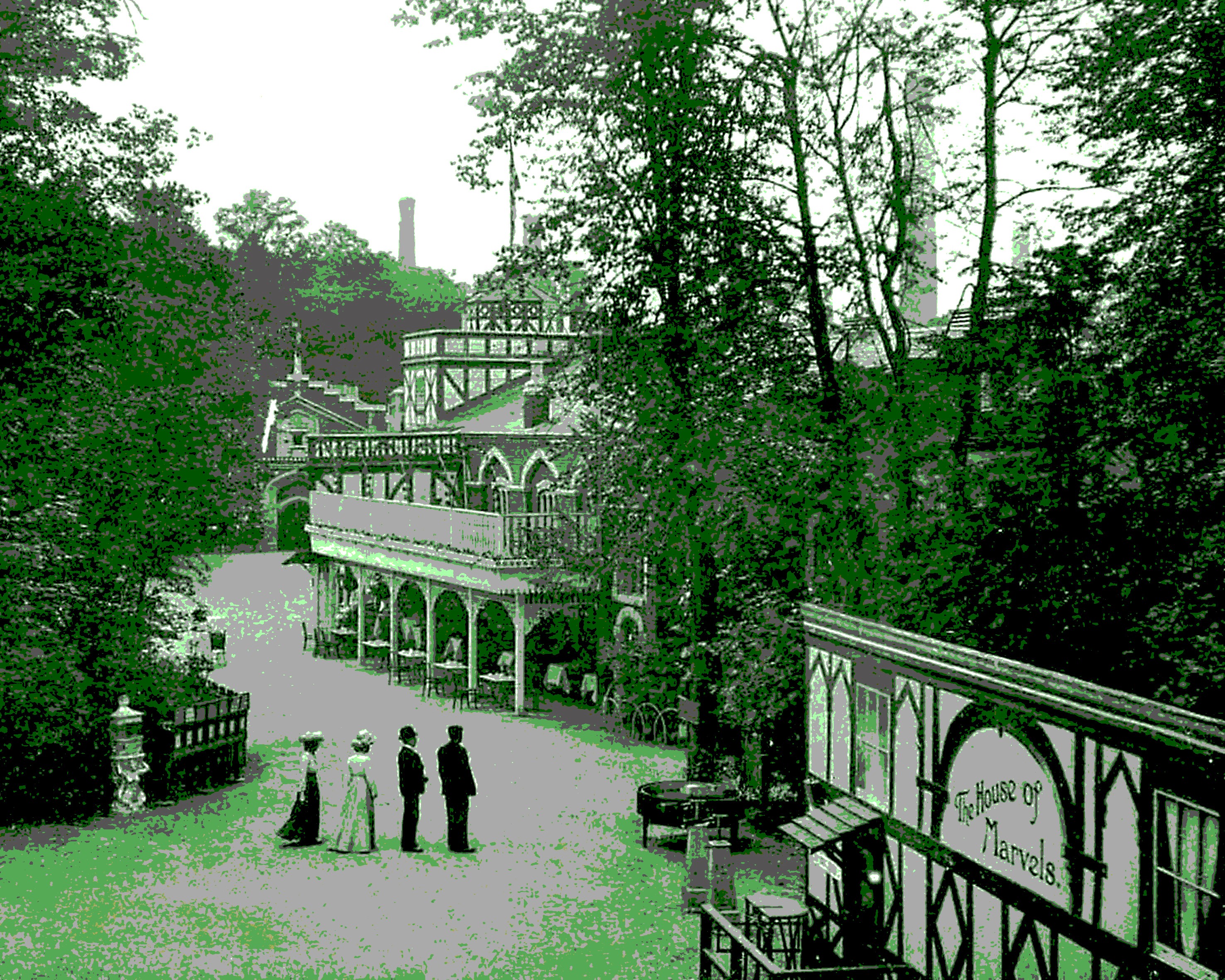 The opening of Rosherville Gardens (1837)
In 1830, the entrepreneurial Islingtonian Jeremiah Rosher had the idea of creating a leisure resort for Londoners at a former chalk-pit he owned, where Northfleet now lies. He engaged a businessman named George Jones to realise it. Seven years later, it opened as Rosherville Gardens. The beautiful 17-acre site amounted to a Victorian theme park, offering a top leisure experience even without the benefit of technology. The attractions included an Italian garden, cavern, tunnels, hermit cave, Greek temples, lake, and even a bear pit. The Gardens were originally targeted at the gentry, but thrived when the price was dropped and the offering moved downmarket. Many entertainments were staged there, including dances, live performances, and firework displays. Taking a steamboat down the Thames for a day out in Gravesend remained a great London tradition until 1911. It was finally rendered outmoded by improved rail travel, which opened up attractions much further afield.
![]()
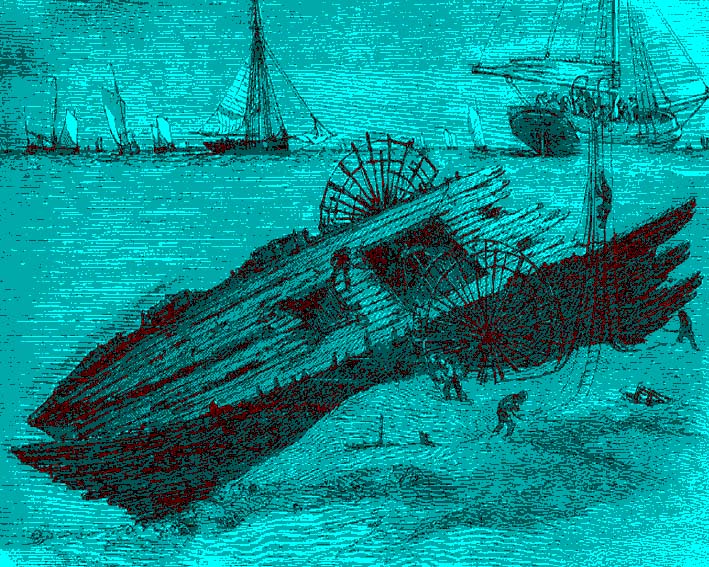 The wreck of RMS Royal Adelaide (1838)
The RMS Adelaide was an Irish paddle-steamer that chiefly operated between Cork and London. In 1850, just as the potato famine was easing, at least 150 Irish passengers boarded the ship heading first for Plymouth, where 14 further passengers joined. She set off for London at 3.30am on Friday, March 29th. The Adelaide was last seen late on the Saturday evening from a lightship 15 miles north of Margate. Two miles further on, she ran into trouble. Though distress flares were seen, there were only three or four, so that observers assumed the crew had solved the problem. It was not until the Sunday morning that the wrecked hull and paddles were sighted on Tongue Sands. Expert opinion held that Captain John Batty had ignored the weather forecast in his anxiety to get to the Thames; and, having got stuck at low tide, the ship had been stricken by the rising waters. All on board were lost.
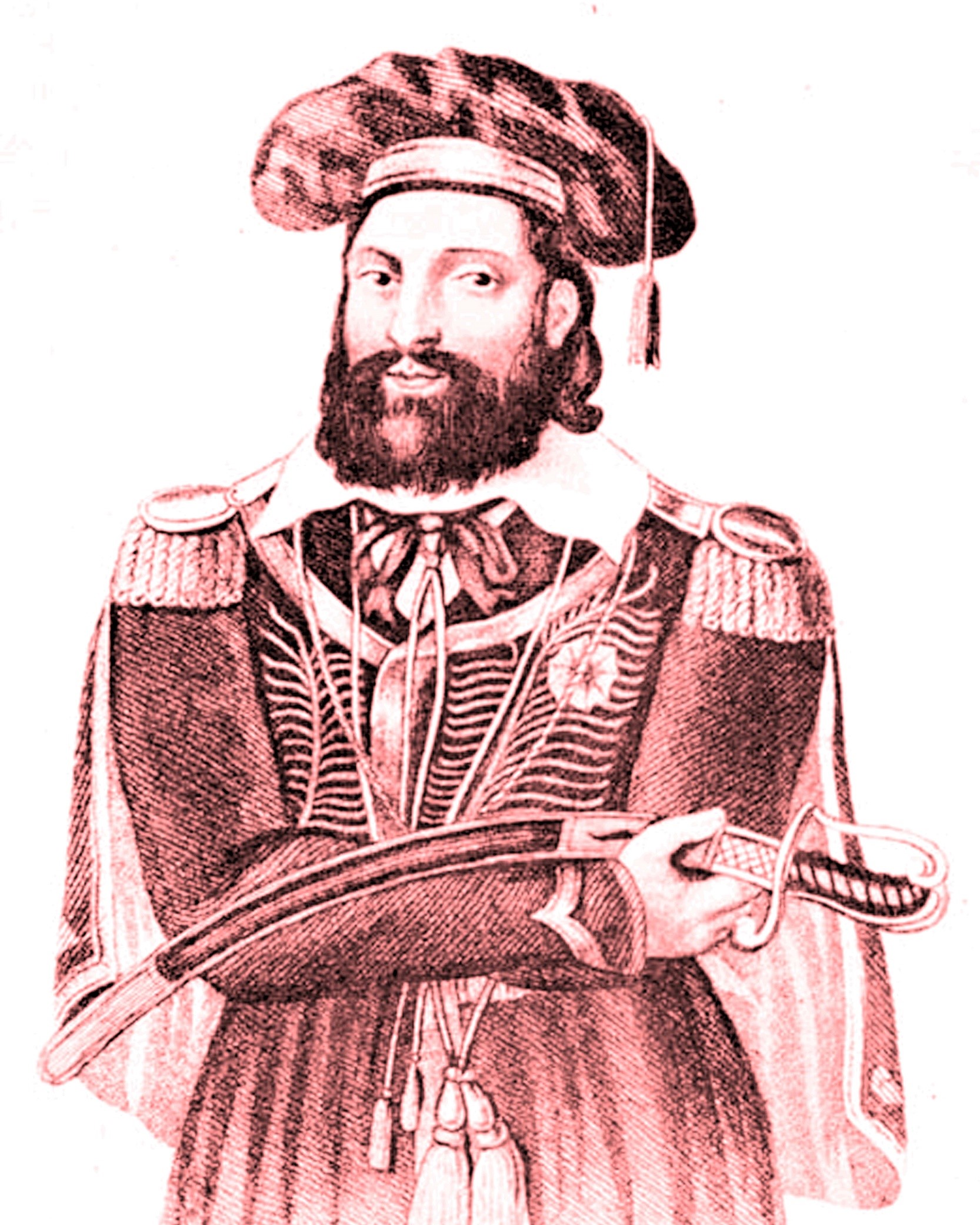 The Battle of Bossenden Wood (1838)
A battle on May 31st, 1838 in Bossenden Wood near Boughton-under-Blean is generally recognised as the last on British soil. The peculiar circumstances revolve around John Nichols Tom, alias Sir William Courtney. This Cornishman was a maltster who had spent four years in Barming Heath Asylum. Towards the end of May, he started riding around the area west of Canterbury pontificating about the New Poor Law. His incendiary rhetoric drew a gang of supporters who followed him on foot. When a constable was sent to arrest him, Tom shot him dead. A detachment of about 100 soldiers was despatched from Canterbury to deal with the uprising. Some of Tom‘s followers fled, but he was left with about 40 men armed with sticks. When a detachment of soldiers approached the rebels in a clearing, Tom shot their lieutenant. He was in turn killed, along with eight of his followers and another soldier. Several rebels subsequently found guilty of murder were reprieved.
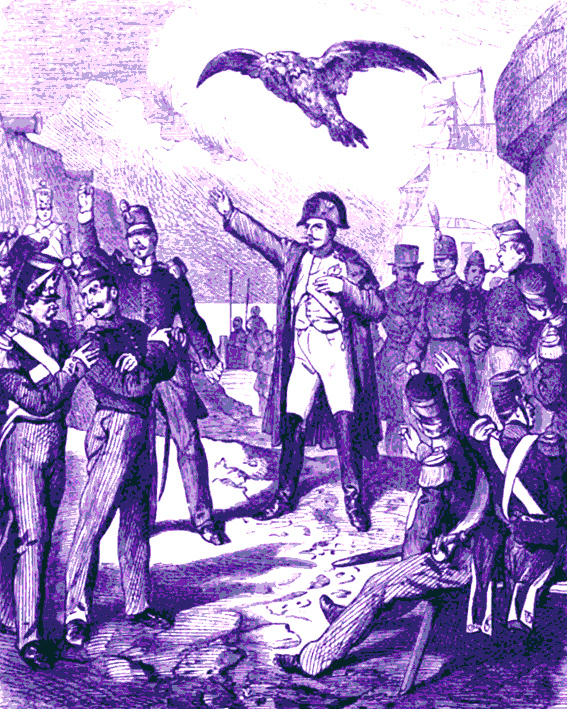 The penultimate invasion of France from England (1840)
Exiled in Chislehurst, Louis-Napoleon III decided he only needed to show his face in France, and the people would flock to the imperial banner, as they had in 1815. Even more theatrically, a trained eagle was to land symbolically on his shoulder as he addressed the revolutionary throng. On August 2nd 1840, with 60 armed men, he set off on the Edinburgh Castle in high hopes, but arrived in France to find only a gaggle of loyalists on the beach. They marched nevertheless to Boulogne, where Napoleon tried in vain to win the garrison over. Fiasco followed farce when he foolishly shot a grenadier, prompting a fusillade of musket fire that drove the invasion force literally into the sea. The dinghy Napoleon was loaded into capsized. Wounded and captured, he spent six years in jail. The skipper was eventually allowed to return to Dover, and the eagle seized its chance for freedom.
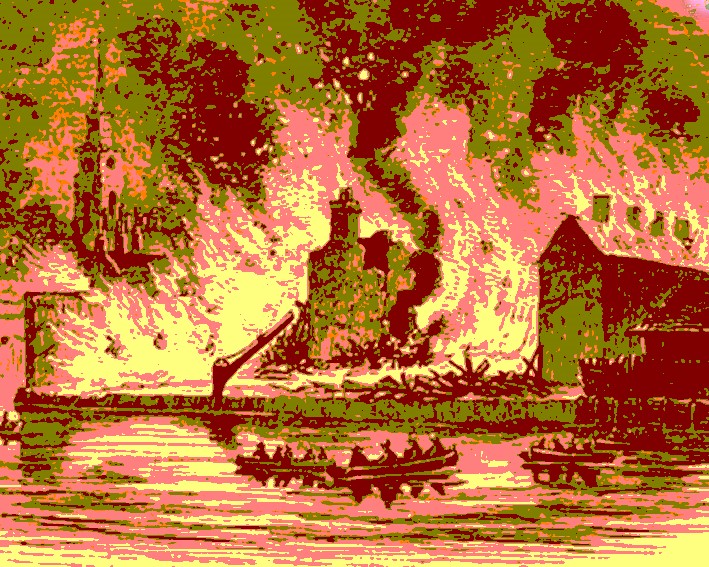 The great fire of Gravesend (1844)
At 10.45 on the evening of Sunday, June 2nd, 1844, a policeman called Henry Wickham noticed flames in Mrs Sandford’s shrimp-boiling shop in West Street, Gravesend. It appeared that cinders raked from the furnace had not been extinguished. The rest of the town police force was immediately summoned, but the flames took hold, and rapidly spread to neighbouring buildings. Before long, the whole locality was aflame. The local military were summoned, with others sailing over from Tilbury, and three different fire services arrived. They all served little use. The conflagration reached Mr Saddington’s salt warehouse, where barrels of gunpowder and sulphur were stored. In desperation, two were thrown into the river, but it was too late to remove them all, and three or four exploded, to dramatic effect. With the whole area ablaze, it could be seen from miles around. Of the 26 buildings destroyed along with their contents, three were warehouses, four pubs, and 19 houses and shops.
 The Elham Murders (1846)
Early on Wednesday, September 30th, 1846, at a cottage in Elham, there occurred one of those grisly events that filled the Victorian penny dreadfuls. Schoolmaster William Jaggers, the lodger, was woken by the sound of groans coming from the next room. Downstairs, he noticed something at first surprising, then horrific: blood was dripping through the ceiling. It turned out that there had been murder above – bloody murder. Mrs Quested, a neighbour, went in to investigate. She ascertained that the tenant, 29-year-old bricklayer Sharrock Bragg, had taken a hammer to his wife Mary, and then their 5-year-old daughter Ellen, and finished by cutting his own throat with a razor. Somehow or other, baby Mary had survived. An inquest suggested that Rudd was subject to depression, and not of sound mind. It caused quite a stir thereabouts. After all, this was not the East End of London. This was the Elham Valley, deep in the Garden of England.
 The world’s first undersea telegraph cable (1851)
In 1843, an East India Company surgeon, William Montgomerie, realised the industrial potential of gutta-percha, a rubber-like emission from a tree indigenous to Singapore. It possessed the highly unusual property of being malleable when heated but solid when cold, well before plastics. English inventor Charles Hancock quickly created numerous commercial uses for it, including bottle stoppers; but its most important application would be insulating underwater cables, an idea originally suggested by Michael Faraday. In 1848, at his Gutta Percha Company’s Middlesex factory, Hancock produced an insulated cable through which a ship two miles off Folkestone sent a test message to London. Three years later, he manufactured the world’s first undersea telegraph cable, laid from Dover to Cap Gris-Nez. In 1864, the company merged with Glass, Elliot of Enderby’s Wharf in Greenwich to form the Telegraph Construction & Maintenance Company, capable of producing a complete armoured transatlantic cable. The business eventually merged into Callender’s Cables of Belvedere in 1959.
 The opening of the Hythe School of Musketry (1853)
For well over 100 years, the standard-issue firearm for British soldiers was the Brown Bess flintlock musket. In 1849, the French captain Claude-Étienne Minié invented a muzzle-loading rifle that enjoyed considerable advantages in operability and accuracy. Consequently, muskets began to be replaced with Minié rifles in 1851. It was decided that expert tuition was needed to ensure their ballistic capabilities were exploited to a consistent standard, and Wrotham-born Lord Hardinge, the Commander-in-Chief, was given a budget of £1,000 to set up a college. Confusingly named the School of Musketry, it opened at Hythe in 1853, and a Corps of Instructors of Musketry followed two years later. After machine-guns – first the Maxim, then the Vickers – became central to warfare in WW1, its name changed to the Small Arms School. In 1969, it removed to Warminster in Wiltshire. A monument marks its former location in Military Road, Hythe, facing the Royal Military Canal.
 The Hartlake disaster (1853)
Hartlake Bridge at Golden Green near Hadlow is a spot more likely to be associated with romantic poetry than a disaster. On the evening of October 20th, 1853, a party of 37 Irish and Romany hop-pickers were returning to their camp on the back of a horse-drawn waggon. The weather had been poor, and the River Medway was in full spate. On the narrow bridge, one of the horses spooked, causing a wheel to crash through the balustrade. The carriage toppled over, and the hop-pickers were pitched into the foaming waters. Thirty were drowned. The inquest found that the bridge had been dangerously designed and maintained, but returned a verdict of accidental death. The incident was marked with an oast-house shaped memorial at Hadlow church. It was also commemorated in a 1975 folk song, and a plaque was unveiled in 2013 bearing the names of the dead.
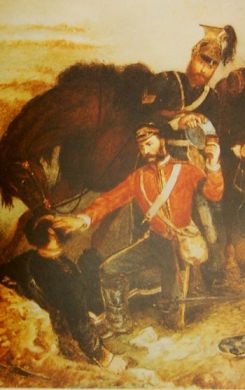 The Charge of the Light Brigade (1854)
James Mouat (1815-99), born in Chatham two months before Waterloo, took part in Britain’s next major conflict, the Crimean War. Having entered the Army as a medic, he rose to the rank of surgeon. He was at the Battle of Balaclava when, on October 26th, 1854, an order was badly misunderstood and the Light Brigade – whose real job was mopping up after the Heavy Brigade – attacked the Russian guns. The charge was led by Lt Col William Morris in the centre of the front rank. After losing his sword running through a Russian officer, he was struck twice on the head by sabres and impaled by a lance. Having lost his horse, he mounted another that was shot. He ran off, but fainted. Mouat raced to his rescue and, under heavy fire, saved him from bleeding to death. For this, Mouat was awarded the Victoria Cross, and eventually promoted to surgeon general. Morris died from the effects four years later.
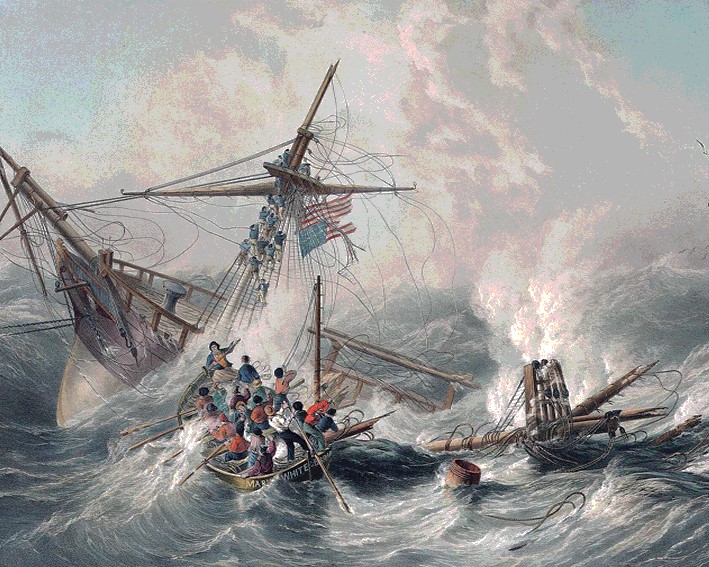 The wreck of the Northern Belle (1857)
The Northern Belle was a trading vessel operating out of New Orleans. Early on January 5th, 1857, while heading for London from New York with a cargo of wheat and flour, she anchored off Kingsgate Bay in a storm. The ship was soon in such straits that the crew cut off two masts. As crowds watched from the clifftops, three rescue boats put out. One, the lugger Victory, went down with all hands; the others finally gave up. The Northern Belle’s crew lashed themselves to the remaining mast and sat out the night in blizzard conditions. The next morning, men from Broadstairs and Margate dragged another lifeboat two miles through the snow to Foreness Point, where the ship was now on the rocks. They managed to take off the whole crew of 23 before she foundered. This story of outstanding heroism travelled around the world. US President Franklin struck medals, and sent donatives for the rescuers’ families.
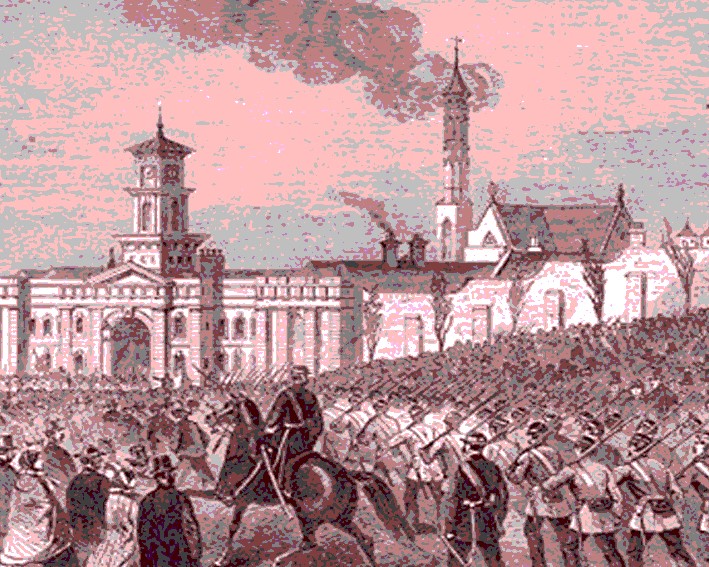 The Chatham prison riot (1861)
In January 1861, a minor incident led within days to a major insurrection at St Mary‘s Island Prison in Chatham. Early one morning, a trustee prisoner called Peters absconded during a regular medical examination and used a skeleton key to try and release a hardened criminal called Bennett. When he was apprehended, the prison population expressed its disapproval with a barrage of noise. The governor sent in a posse of 150 officers to restore order and place the ringleaders in punishment cells. This led only to a further escalation. A few days later, about 50 prisoners went on the rampage, releasing all the other thousand convicts and causing serious damage. With matters running out of control, the Home Secretary sent in the military: 400 Royal Marines marched in under arms to bring the situation under control. The blame was placed on slack man-management by warders who, having worked only on prison hulks, were unused to conventional prison methods.
 The coming of a queen in waiting (1863)
With Prince Christian of Schleswig-Holstein-Sonderburg-Glücksburg in line to succeed his second cousin Frederick VII as Danish king, his daughter Alexandra (1844-1925) was in contention for a prestigious marriage, the deluxe possibility being the heir to the British throne. Victoria, who had once rejected Christian as a suitor, would have preferred a German daughter-in-law; but Alexandra proved the only viable candidate. At 18, she landed at Gravesend on the yacht Victoria & Albert to great excitement. Her arrival was painted by Henry O’Neil, and greeted with tailor-made music by Arthur Sullivan and Tennyson’s excitable sentiment that We’re All Danes Now. Although destined to be a fashion icon, popular benefactor, and future queen mother, Alexandra was unlucky to win the contest. Her playboy husband Prince Edward had enjoyed an affair with an actress between their first meeting and their wedding at Windsor, and subsequently conducted countless others. Alexandra, who did not become queen consort until 1901, outlived him by 15 years.
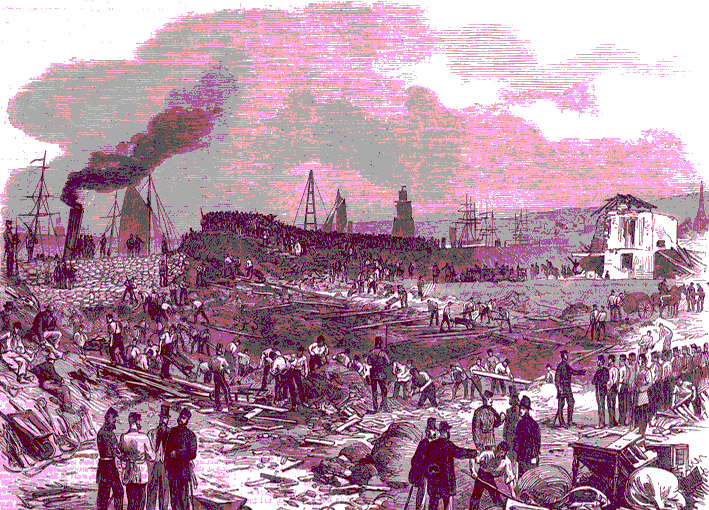 The Erith gunpowder disaster (1864)
At 6.42am on Saturday, October 1st, 1864, a boat laden with explosives blew up on the Thames near Erith, igniting two land-based gunpowder stores nearby. The three explosions were heard 100 miles away. A total of nearly 50 tons of gunpowder went up, blasting a 35 yard-long gap in the river defences. Surprisingly, the death toll was only in single figures, but a much more pressing concern was immediately recognised by local engineer Lewis Moore: with high tide approaching at 1pm, there would be catastrophic flooding of the surrounding area, which was below sea level. He got 350 navvies sent from Crossness Pumping Station, soon reinforced by 1,500 men from the Royal Arsenal, who set about plugging the gap with puddle clay and sandbags. Working with efficiency that would be unthinkable today, they completed the task with under an hour to spare, so saving at least six square miles of the most densely populated part of Kent from devastation.
 The Staplehurst rail crash (1865)
Rail travel was never the safest in the Victorian era, and accidents were commonplace. One that took place at Staplehurst on June 9th, 1865 took on a particular significance because of one noteworthy passenger on board: Charles Dickens. He was in fact travelling with his supposed mistress Ellen Ternan and her mother. The accident happened because a stretch of rail had been removed during engineering works on a 10-feet high viaduct. A man carrying a red warning-flag was positioned only 554 yards up the track, barely half the regulation distance, which was insufficient to allow the train to stop in time. It was derailed, and 50 people were injured, 10 of them fatally. Dickens actually tended the victims, some of whom died in his presence. It affected him terribly. He could not speak for two weeks, and his son said he never got over it. He died five years to the day after the accident.
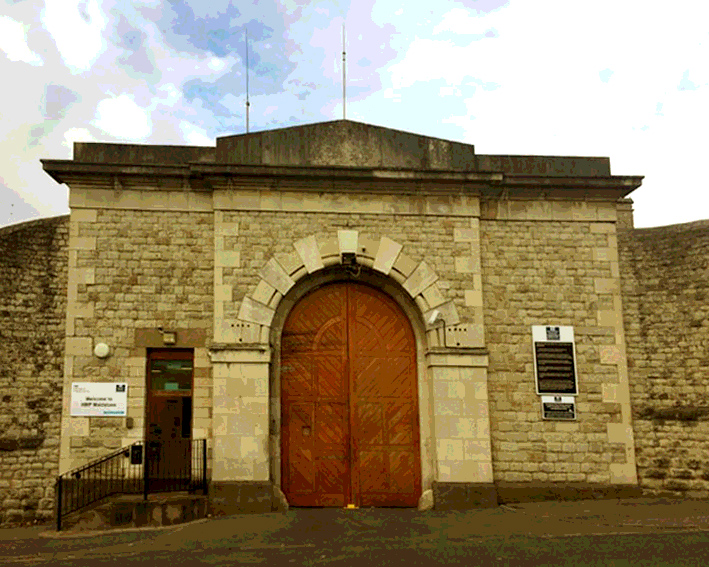 The last woman publicly hanged (1868)
The last time a woman was hanged in public in England, it was a largely Kentish affair. In 1865, Frances Turner married William Kidder from Hothfield, whose child she had borne illegitimately. He already had an illegitimate 11-year-old daughter from a relationship in Hythe, named Louisa Staples, to whom she took a severe dislike. On a visit to her parents at New Romney in August 1867, Kidder returned alone from a walk, saying Louisa had fallen into a ditch. After the girl was found drowned, Kidder was arrested. At the next Kent assize the following March, even her own family testified that she’d been heard beating the hated child. Pronounced guilty after just twelve minutes’ consideration, she was sentenced to death. Three weeks later, a 2,000-strong crowd gathered outside Maidstone Prison to see the wicked step-mother hanged at noon by the notoriously inhumane William Calcraft, who let her choke to death on a short rope.
 The ‘record’ heatwave (1868)
For a hundred million years, early mammals sweltered in average world temperatures between 21 and 31°C. Since the meteor strike around 65 million years ago that wiped the dinosaurs out, that average has plummeted to around 16°C today, even after recovering by 1°C during the industrial age. Our Kentish ancestors got an aftertaste of the Cretaceous world back in 1868. When a heatwave struck in late July, the temperature remained above 30°C for over a week, peaking on the 22nd. Eye-catching headlines were made by a reading in Tonbridge of 100.5°F, which was long considered the British record; it was eventually downgraded, however, because the manner of measurement was technically questionable. Nevertheless, 96.6°F (or 35.9°C) was accurately reported at Greenwich that day; and at Linton Park, water was said to be growing scarce on account of the exceedingly hot, dry month. Not until 1976 did the county encounter anything so persistently tropical again.
 The great fire of Whitstable (1869)
Late on the evening of Wednesday, November 16th, 1869, a fire broke out in Whitstable that turned into a major conflagration. It started at the yard of Charles Hoult, a mast and block maker, and spread rapidly. As at Gravesend 25 years earlier, conditions were perfect for a blaze, most buildings being close together, wooden, and coated with asphalt. Fanned by the wind, the fire passed from The Wall along Harbour Street and Marine Street, and soon formed such a firestorm that distant features could be seen as though it were daylight. So spectacular was it that a crowd estimated at 10,000 came to watch, even though Whitstable’s population was only about a fifth of that number. The fire service was unable to make much difference because the tide was out and there was no other water source. 71 buildings were destroyed, including 25 habitations. Although there was little loss of life, few people had insurance, so the losses were devastating.
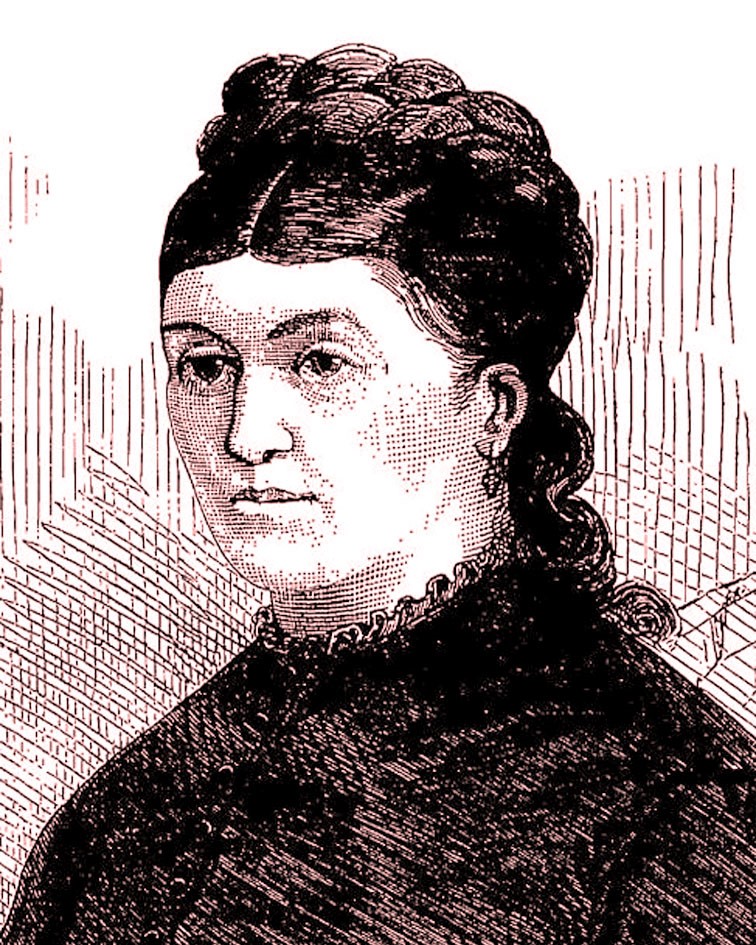 The Chocolate Cream Poisoner (1872)
Christiana Edmunds was born in Margate in 1828, the daughter of the architect of the local lighthouse. She had a comfortable upbringing, though mental illness on both sides of her family perhaps accounted for her diagnosis of hysteria around 1850. She never married, but accompanied her widowed mother in retirement in Brighton. Around the age of 40, she took a shine to her doctor, whose wife she secretly poisoned, though not fatally, with a chocolate cream. She then began obtaining chocolate creams from a local confectioner, John Maynard, and returning them after adding her own ingredient: strychnine. Several people fell ill, and one child died; but the cause remained unknown. Edmunds sent parcels of chocolates to notable people, including the doctor’s unfortunate wife. As police suspicion grew, she sent herself parcels in the hope of incriminating Maynard. Eventually the doctor reported his suspicions, and she was tried for murder. Her death sentence was commuted to life in Broadmoor.
 The sinking of the Northfleet (1873)
The Northfleet was a frigate, actually built in Northfleet, that on January 13th, 1873 set sail from Gravesend for Hobart in Tasmania with 34 crew, 342 emigrants and four others on board. Because of foul weather, by the 22nd she had still only reached Dungeness, where she was at anchor. Around 10.30 in the evening, a steamer ran into her. Incredibly, the steamer silently backed away and disappeared into the night. Being heavily laden – there were 340 tons of iron rails and 240 tons of other equipment on board – the Northfleet sank within 30 minutes, before any nearby ships were even aware she had a problem. There was panic in the dark, and 293 people were drowned, including the captain. Investigations revealed that the offending steamer was the Murillo, a Spanish ship. Eight months after the collision, she was stopped off Dover and confiscated. The Admiralty censured her officers and ordered her to be sold.
 The first cross-Channel swim (1875)
Captain Matthew Webb from Shropshire was a natural born swimmer. At 15, he saved his brother from drowning in the Severn, and after joining the Merchant Navy was celebrated for leaping into the Atlantic to try and save a man overboard. In 1873 he read of JB Johnson’s failed attempt to swim the English Channel, and decided to try for himself. He practised intensively at Lambeth Baths, in the Thames, and in the Channel itself. Following a failed attempt, he departed from Dover’s Admiralty Pier on August 24th, 1875, covered in porpoise oil and accompanied by three boats. Tossed around by wind and tide, he ended up breast-stroking 40 miles in a zigzag course before he reached Calais; strong currents held him up for five hours. He became a national hero, and his 21-hour 40-minute swim was commemorated with a statue at Dover. Sadly, his attempt ten years later to swim across Niagara Falls proved one feat too many.
 The wreck of the SS Deutschland (1875)
A maritime incident off Margate on December 6th, 1875 could have had major international repercussions. The SS Deutschland with her crew of 90 was carrying 123 German emigrants to New York via Southampton. In the pre-dawn dark and a blizzard, Captain Eduard Brickenstein sailed 30 miles off course, and got stranded on the Kentish Knock sandbank. A lightship three miles away saw his distress signals, yet no help was sent until the following day. By then, with the propeller broken and the ship taking on water, the order had been given to abandon ship; but most of the lifeboats were lost in the gale. 173 passengers and crew were rescued, though the ship was plundered by “vultures” sailing from Ramsgate, who even stole from the dead. The Captain appealed to Bismarck to take it up, but he fortunately was busy planning war on Austria. Gerard Manley Hopkins recorded the wreck in a poem dedicated to five nuns who drowned.
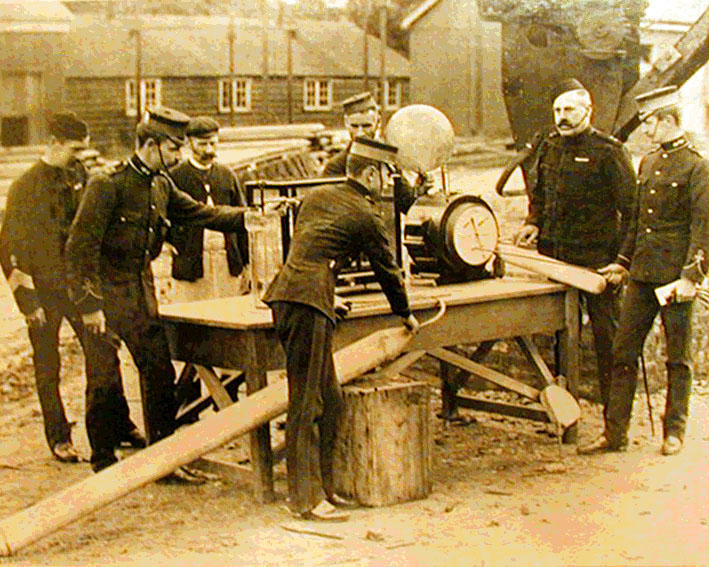 The birth of British military aviation (1878)
After efforts to use balloons for military reconnaissance proved ineffectual in the US Civil War, the British Army embarked in 1862 on a concerted programme to develop viable military balloons. Initial experiments were undertaken with a balloon hired from the great Wouldham-born balloonist Henry Coxwell. In 1878, Captain James Templer from Greenwich established and then commanded a new School of Ballooning at the Royal Arsenal, Woolwich. Crucially, this incorporated a research & development programme called the Balloon Factory, which in 1882 moved to Chatham. Experiments at Lydd in 1886 evaluated the use of balloons to observe artillery fire, and land was hired at Lidsing for training camps. Owing to lack of space, the Balloon Factory moved in 1890 to Aldershot, Hampshire; and from 1904 it relocated to nearby Farnborough, which had space to build the first British airship, Nulli Secundus, launched in 1907. Five years later, the Balloon Factory became the Royal Aircraft Factory.
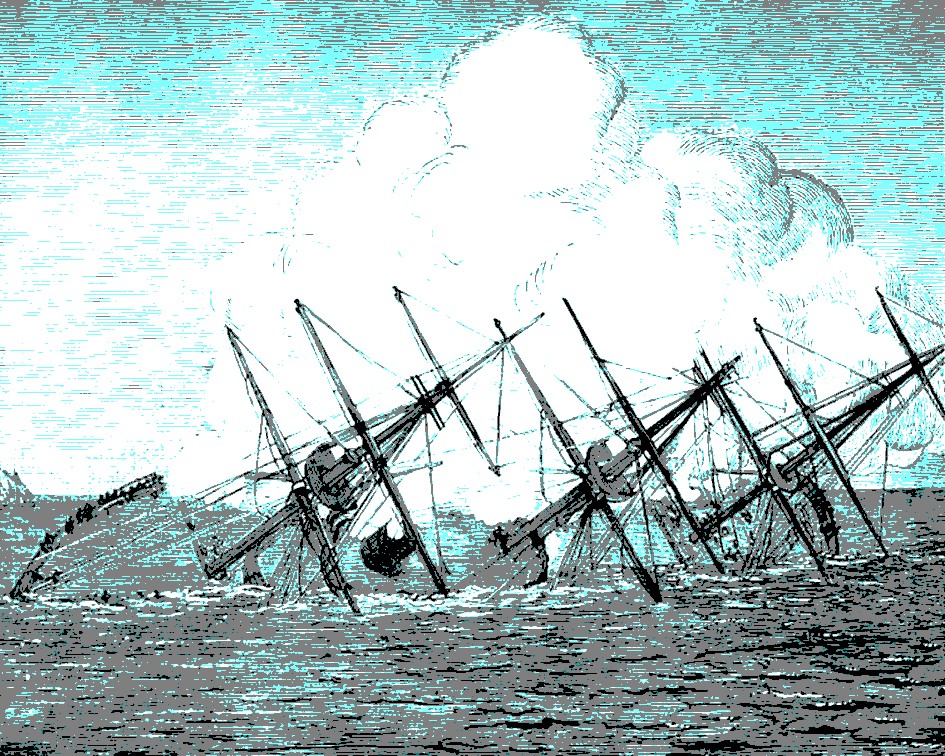 The sinking of the SMS Grosser Kurfürst (1878)
Less than a month after being commissioned in May 1878, the SMS Grosser Kurfürst of the German Imperial Navy was sailing past Folkestone with two other German ironclads when two local boats were spotted crossing their path. The Grosser Kurfürst turned to starboard and then straightened her course, whereupon the König Wilhelm alongside initiated the same manoeuvre. She somehow ended up ramming the Grosser Kurfürst, which sank in eight minutes. Under half the ship’s 500 crew survived, many of the dead being buried at Cheriton Road Cemetery, where a memorial now stands. The accident led to an embarrassing series of German courts martial that were intended to pin blame, and even embroiled the Kaiser. It prompted the German government’s prolonged reluctance to invest in new warships. It is possible that the incident – which happened to be witnessed from another ship by the librettist Arthur Sullivan – inspired the blackly comic collision caused by Admiral Horatio D’Ascoyne in ‘Kind Hearts and Coronets’.
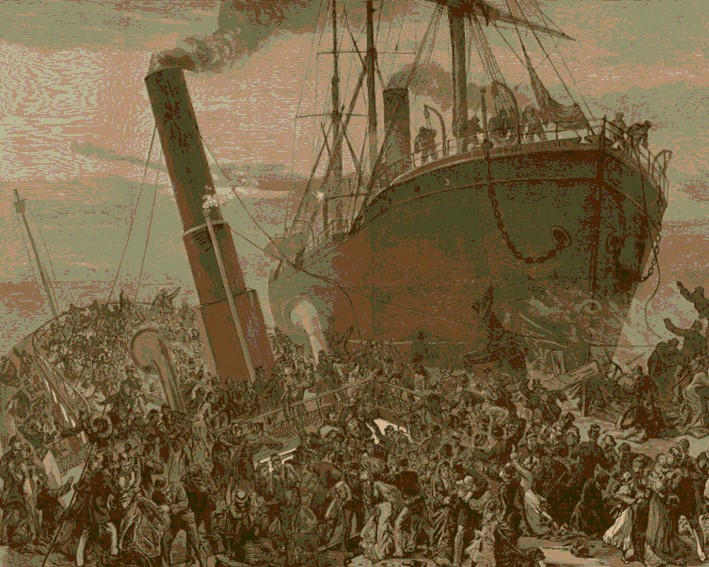 The SS Princess Alice disaster (1878)
At twilight on September 3rd, 1878, on the Thames north-east of Woolwich, there occurred one of those accidents that warrant the description ‘horrific’. SS Princess Alice was known locally as the ‘Shah’s Boat’ because she had carried the Persian king five years earlier. She was returning from a pleasure trip to Sheerness when she turned straight across the path of the collier Bywell Castle. She broke into two, and sank in four minutes. What made matters worse was that the Metropolitan Board of Works had just pumped 75 million gallons of raw sewage into the river at that point. Of the 130 who were rescued, many died later from poisoning. As there was no register, the exact tally of fatalities is unknown, but it exceeded 600, making it Britain’s worst ever inland water disaster. The coroner found the skipper of Bywell Castle at fault, while the Board of Trade blamed it on the skipper of Princess Alice.
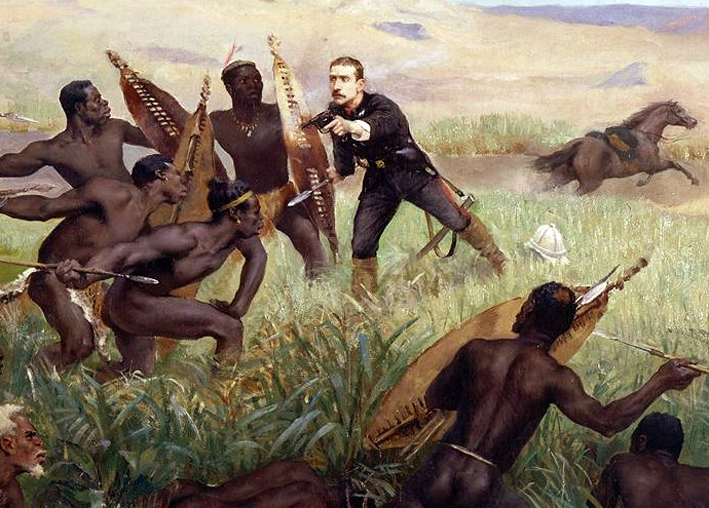 The slaying of the Prince Imperial (1879)
When Emperor Napoleon III fled France at the outbreak of the Third Republic in 1870, he brought his son Louis-Napoleon, Prince Imperial (1856-79) to live at Camden Place in Chislehurst. The prince, a popular candidate to marry Queen Victoria’s daughter Princess Beatrice, graduated from the Royal Military Academy at Woolwich, finishing top in riding and fencing. A headstrong sort, he pleaded to go to the Zulu War. On the march to Ulundi, he was placed in the charge of a French-speaking lieutenant. While scouting a deserted kraal, they were ambushed by 40 Zulus. The prince, unable to mount his horse in time, was killed by 18 assegai thrusts. His body was returned to Deptford and taken by a long and well-attended funeral procession for burial at Chislehurst, where locals erected a memorial. His death caused great anguish, not least among French monarchists: Maurice Rostand’s play ‘Napoleon IV’ depicts Victoria planning the ambush, proof that conspiracy theorists are nothing new.
 The world’s first petrol automobile patent (1884)
Anyone who credits Karl Benz with inventing the first petrol automobile ignores the prior claim of Edward Butler (1862-1940). Butler’s ‘Velocycle’ was patented in 1884, two years before the ‘Benz Patent-Motorwagen’. To be fair, the German did build his first prototype in 1885, whilst Butler’s revised design, now called the ‘Petrol-Cycle’, was not constructed at Greenwich until 1887-8. Benz’s also looked more familiar to modern eyes, being a stripped down three-wheeler, whereas Butler’s had its third wheel at the back and from the front rather resembled a wheelchair. On the other hand, the Kentish car looks something of an engineering wonder, including electric ignition and a spray carburettor, years before Maybach. The real difference was Britain’s Locomotives Act 1865, which imposed a 4 mph speed limit (2 mph in towns) and demanded that every moving vehicle be preceded by someone waving a red flag. Unable to raise enough backing, Butler threw in the towel.
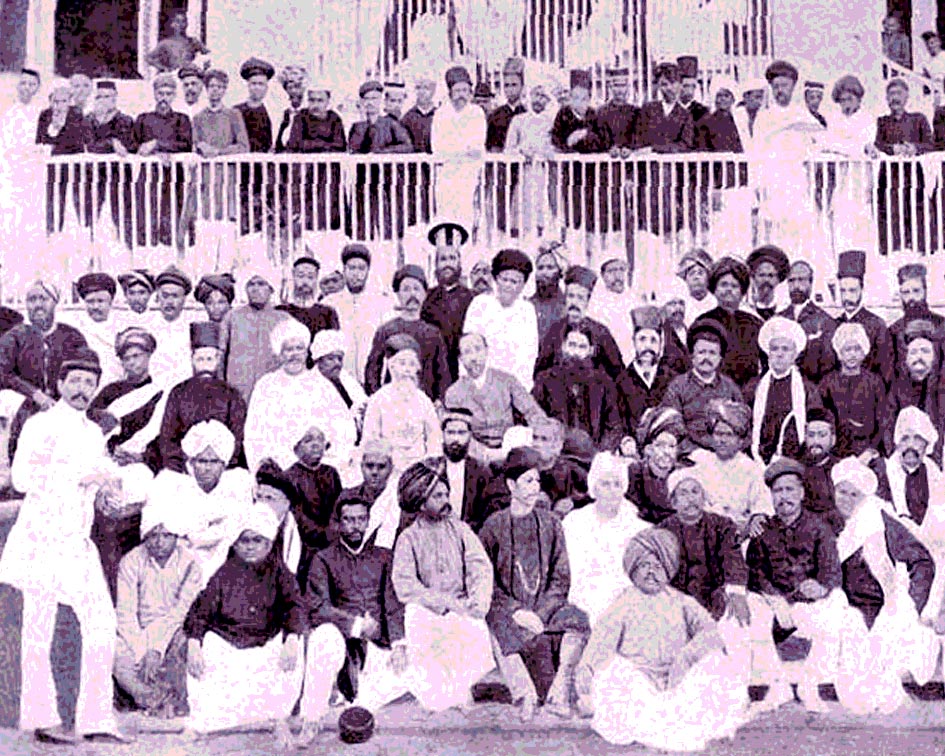 The foundation of the Indian National Congress (1885)
It is astonishing to think that the world’s largest democracy traces its origins to a civil servant born in St Mary Cray. After witnessing the 1857 Indian Rebellion, Allan Hume, the son of a Radical MP, came to the conclusion that Indians needed a forum to express discontent, especially concerning agrarian policy. Six years after being sacked for his outspokenness in 1879, he single-handedly founded the Indian National Congress. As a political entity, it made slow progress until, in 1924, Mahatma Gandhi took over as President and used it as a vehicle to propel himself to power and his homeland to independence. Subsequently led by both Indira and Rajiv Gandhi, it long remained the dominant force in Indian politics, with occasional interruptions by the BJP, whose longest tenure of power commenced in 2014. Having undergone a number of schisms, the Congress now represents a relatively centrist alternative to the BJP’s vigorous nationalism.
 The world’s first flying machine (1894)
Kitty Hawk, NC is famous for hosting the first powered flight, by the Wright brothers in 1903; but what of Bexley, Kent? In 1890, the innovative American immigrant Hiram Maxim announced plans to build a ‘Flying Machine’ within five years. This he undertook to do at his home, Baldwyn’s Manor, Bexley. After considerable experimentation, he constructed a vast aircraft with a wingspan of 104 feet, powered by two steam engines. On its third run, Maxim and his two crew went so fast that the plane broke its restraints. It reportedly flew for 300 yards at nearly 5 feet. The Prince of Wales, Arthur Conan Doyle, and Rudyard Kipling all saw it, and HG Wells based an 1895 sci-fi story on it; yet Maxim mysteriously abandoned the project. French inventor Clément Ader later claimed rather dubiously to have flown even earlier, but it seems more likely that only Maxim’s failure to commercialise his invention cost Bexley a place in history.
 The first British maritime film (1895)
Of the millions of hours of film ever made, the very first, in 1878, was Eadweard Muybridge’s short loop showing a horse galloping. The first footage was a two-second sequence shot in a garden at Roundhay, Yorkshire ten years later. It was not until March 1895 that the Lumière brothers presented their ‘cinématographe’ in Paris. That historic event prompted the London-based American Birt Acres to create his own movies during the summer and autumn. Two weeks after the Lumières staged their first commercial screening late in December 1895, he organised his own demonstration in London. He showed eight clips, one of which was ‘Rough Sea at Dover’. It showed 17 seconds of waves crashing against the Admiralty Pier. It was not the first ever maritime footage: one of the Lumières’ ten clips, ‘La Mer’, was a film of Frenchmen jumping off a jetty. It was however particularly popular, and a step down the road to ‘The Blue Planet’ 105 years later.
 The world’s first speeding ticket (1896)
Walter Arnold of East Peckham was something of a pioneer of the British automotive industry. He set up a dealership in London selling fashionable Benz cars under his own Arnold brand. On January 28th, 1896, he went hurtling through Paddock Wood at 8 miles an hour, well in excess of the 2 mph limit. A policeman on a bicycle managed to catch up with him after a half-hour low-speed pursuit. Arnold went to court in Tonbridge and was fined a shilling for speeding, plus nine shillings costs. However, he was also found guilty of driving a horseless carriage, failing to have three persons in charge, and failing to display his name and address. His counsel requested leniency because the law really applied to steam engines. Arnold had to fork out £4/7/- altogether, equivalent to nearly £600 today, or else face seven days’ hard labour. It did lead to changes in the law, and probably did his business no harm.
 Kent’s worst coalmining accident (1897)
Even before its first pit was operational, the Kent Coalfield suffered its worst accident. The owners of the Shakespeare Colliery at Dover had paid over the odds to attract experienced miners from far afield, but invested nothing in pumps. At 10.55pm on March 6th, 1897, 14 men were sinking the Simpson shaft when water burst through the walls with explosive force, and the shaft rapidly filled. A bucket was lowered and immediately raised along with three men who had climbed the shaft walls to reach it. Another three were saved the same way minutes later, but a third attempt proved fruitless: the other eight had drowned. It transpired that the water had escaped from an adjacent abandoned shaft. The loss appears trivial alongside the Senghenydd disaster of 1913, when 439 coalminers died in an explosion, but no less harrowing for those affected. Although safety was improved, the Shakespeare Colliery never proved at all economical, and closed in 1915.
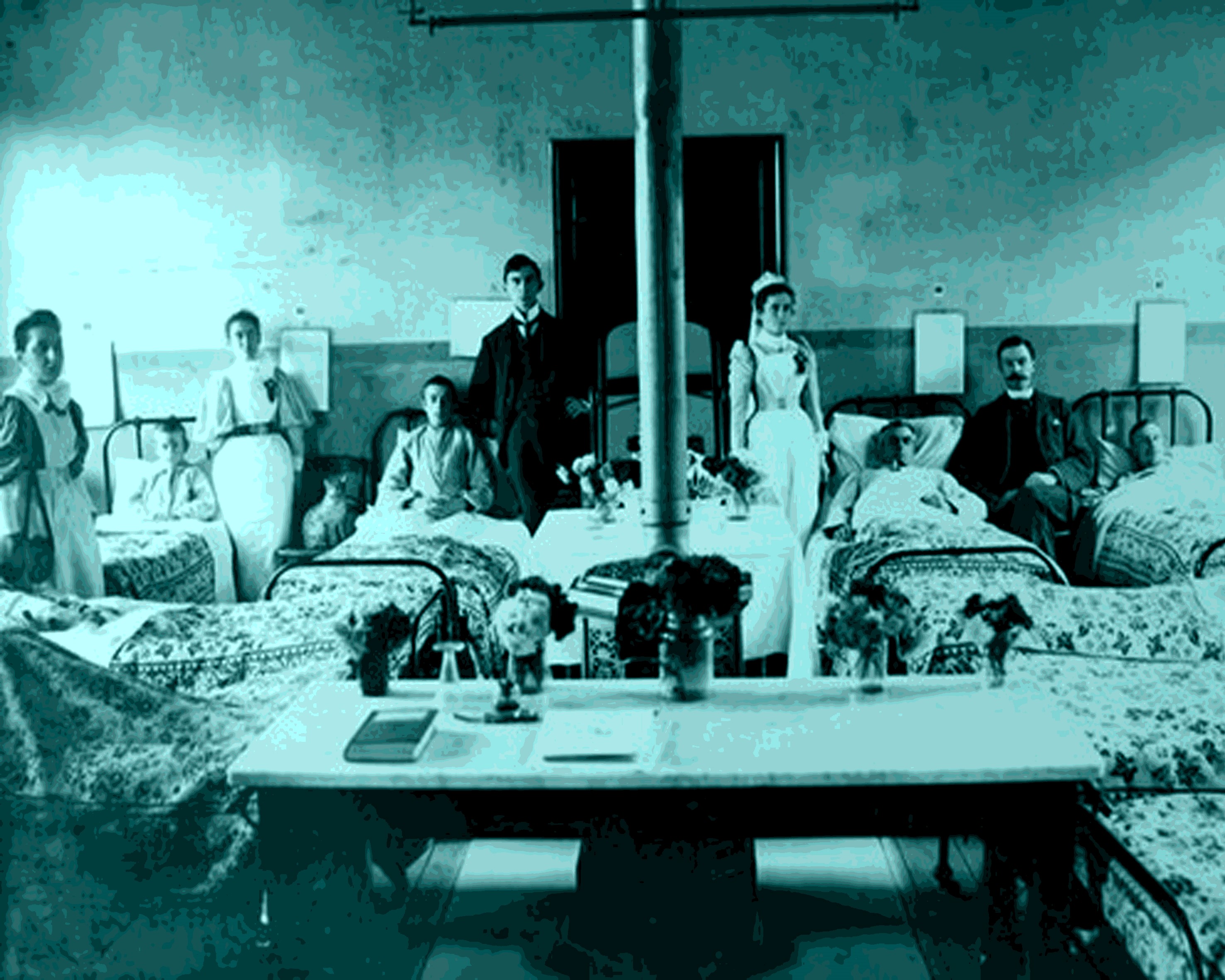 The Maidstone typhoid epidemic (1897)
In September 1897, the county town was struck by Britain’s worst-ever outbreak of typhoid. The Maidstone Typhoid Epidemic was national news for months: nearly 2,000 were infected, and at least 132 died. There was so much concern about it that even Queen Victoria sent a personal message of comfort. Scores of nurses were drafted in. Though some became infected, they regarded it as an occupational hazard. Many earned medals for their efforts, one being Edith Cavell, later a war hero. The outbreak eased in the autumn, entered a second peak just before Christmas, and was effectively over by late January. The source was identified as the spring at Farleigh supplying parts of Maidstone with water, which had probably been polluted by hop-pickers down from London. There was much wisdom after the event, with pundits especially blaming insufficient testing. Yet the community responded more collaboratively than some societies with greater medical knowledge and healthcare expenditure.
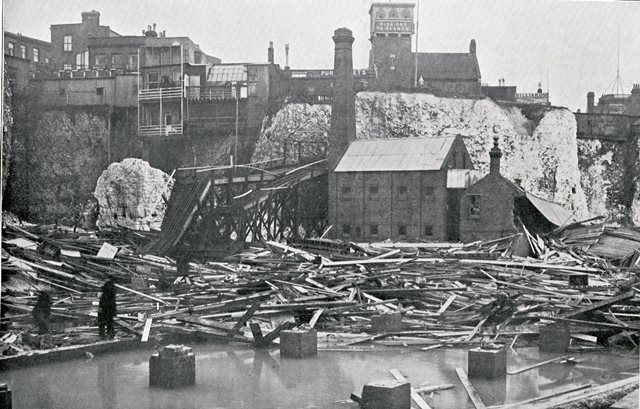 The great storm of 1897
Margate is no stranger to extreme weather, but the tempest that struck it on November 29th, 1897 did more than rattle windows. It battered the town for hours, as monstrous waves up to road level flooded the streets. Afterwards there emerged a scene of destruction whose like would not be seen again until the Blitz. The Marine Palace, an extensive entertainment complex on the site of the current Rendezvous restaurant, was obliterated, barring only its brick-built components: its concert hall, swimming-baths, switchback railway, and shops simply disappeared. So comprehensive was the destruction that the remains had to be demolished. There was a further trail of destruction at the jetty and sea wall, and numerous properties were inundated. Damage was estimated at over £10,000. Not everything could be made good with money, however. The lifeboat Friend To All Nations capsized with the loss of nine lives. The men’s courage is commemorated by the distinctive Surf Lifeboat Memorial on Marine Terrace.
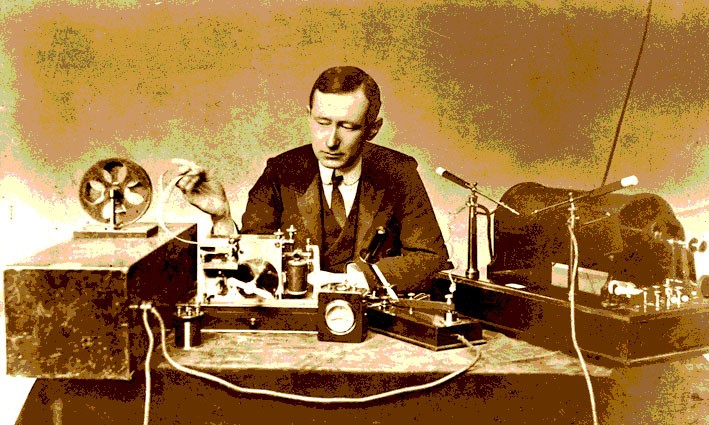 The world’s first ‘SOS’ message (1899)
Marconi‘s invention of wireless telegraphy was initially greeted with ridicule. Some even thought him a madman. Realising that a public demonstration was vital, he turned his attention to Dover. From there, he organised the first international transmission, and the first to a ship at sea. He equipped that ship, the East Goodwin Lightship, for radioing the South Foreland Lighthouse, which was instantly in touch with the Ramsgate lifeboat. The technology’s potential value suddenly became obvious. It nearly proved its worth in a practical way on March 17th, 1899, when a ship making for Hamburg, the Elbe, ran aground, and the Lightship sent the world’s first emergency message. It was a false alarm, as the Elbe refloated. Later that month, however, SS RF Matthews actually rammed the Lightship; this time, the message was for real. It was not until 1904 that a standard emergency code was introduced, namely ‘CDQ’, but this was soon superseded by the snappier ‘SOS’.
 The first cross-Channel powered flight (1909)
Only five years after the first ever powered flight, the ‘Daily Mail’ offered a £500 prize to the first pilot to cross the English Channel. When nobody seriously attempted the feat in 1908, the prize was raised to £1,000 – a mere stunt in many people’s eyes, given that the feat was obviously unachievable. Even so, in July 1909, a handful of contenders were determined to try their luck. The first away was Hubert Latham, who got within six miles of the English coast when he was obliged to ditch in the sea. Six days later, while Latham was preparing his next attempt, Louis Blériot leapfrogged him. At 4.41 am on July 25th, he set off from Sangatte, maintaining a steady 45 mph. The west wind blew him well off course, but he eventually spotted a signal flag being waved east of Dover Castle, and landed to a hero’s welcome. His 36-minute flight had turned a page in the history of aviation.
 The first two-way cross-Channel flight (1910)
Although it was magnificent, Blériot’s cross-Channel flight in 1909 was a blow to British national pride, since it handed leadership in world aviation to the French. One of the men determined to set the record straight was Charles Rolls, the dare-devil half of the Rolls-Royce partnership. In May of the following year, he took delivery of a Wright Brothers biplane constructed under licence by Short Brothers in Kent. His plan was simple: to take off from Swingate aerodrome, less than a mile from where Blériot had landed, fly to Sangatte, turn round, and come back to his start point. On June 2nd, 1910, conditions were perfect, and he completed the flight in 95 minutes. On his return, he was greeted by a crowd of over 3,000. Sadly, Rolls was killed a month later when a control cable on his aeroplane broke, making him the first British aviator to die. A statue was erected at Dover to mark his achievement.
 The Delhi Bomb Outrage (1912)
Following the Indian Mutiny of 1857, Great Britain took over administration of the subcontinent from the East India Company and appointed a viceroy. The new appointee in 1910 was Charles Hardinge, 1st Baron Hardinge (1858-1944), from South Park at Penshurst. He took a sympathetic approach to Indian nationalist concerns, for which reason he was relatively popular. As Tsar Nicholas II was discovering in Russia, however, liberality can serve as an incentive to anarchy. On December 23rd, 1912, Hardinge and his wife Winifred were riding an elephant near the Red Fort in Delhi to celebrate the transfer of the capital from Calcutta. A revolutionary called Basant Kumar Biswas lobbed a bomb into the howdah, which killed the Indian mahout (rider) and badly lacerated the viceroy’s back; the vicereine appeared unharmed. Three rebels were rounded up and executed. By the time Hardinge completed his tour of duty in 1916, his young wife had died back in Penshurst two years before.
 Britain’s first anti-aircraft defences (1914)
The idea of dispensing death and destruction from above must have been had as soon as hot-air balloons were invented; but it was not until November 1911 that the first bombs were dropped, by an Italian pilot on Ottoman Turks during Italy’s invasion of Libya. The Admiralty immediately realised the serious implications for its huge ordnance depots on the Hoo Peninsula. In response, plans were made for Britain’s first permanent anti-aircraft battery. Completed in April 1914, it was mounted on a 200-foot ridge north of the Lodge Hill depot, with extensive views along the Thames and Medway estuaries. Consisting of two pom-pom guns, it was initially intended to repel German Zeppelins, although Gotha bombers became the greater threat from 1917. The site was reused in WW2, and is still clearly visible from the sky, although the extensive ruins are inaccessible to the public. A twin site at Beacon Hill just south-west of Chattenden has largely disappeared.
 The foundation of RNAS Kingsnorth (1914)
With British military and civil aviation having both originated in North Kent, it was natural that the Admiralty should first look there in developing its air arm. In 1910, it accepted the Royal Aero Club’s offer of the use of its airfield, instructors, and two aeroplanes at Eastchurch. By the time the Royal Naval Air Service was inaugurated in 1914, the potential of airships had been recognised. An airship station opened in July 1914 on the Hoo peninsula. It was named RNAS Kingsnorth, not to be confused with RAF Kingsnorth, south-east of Ashford, an advanced landing ground in WW2. The emphasis at RNAS Kingsnorth was on airship experimentation, later developing into construction. It increasingly served as a training centre as WW1 elevated its significance, and provided a Royal Navy meteorological service as well as a base for anti-submarine patrols. In 1918, the RNAS merged with the Royal Flying Corps to form the RAF. RNAS Kingsnorth was decommissioned in 1921.
 The HMS Bulwark disaster (1914)
There was great enthusiasm for going to war in August 1914. Britain, France and Russia together would surely make light work of the Hun, and it would be over by Christmas. After all, Britain ruled the waves. It was not long before reality intruded. On November 26th, the destroyer HMS Bulwark was at Kethole Reach, five miles off Sheerness. Some of the crew had been re-stowing cordite charges for the ship’s guns. At 7.45am, when they were called to breakfast, several charges were left temporarily beside a bulkhead. Unfortunately, on the other side of that bulkhead, a boiler was heating up. At 7.53am, the charges exploded, igniting hundreds of 6- and 12-inch shells. The ship was literally blown to pieces. Somehow 12 crew survived, but 741 were incinerated. Only about 30 bodies were ever recovered. If the Royal Navy could suffer such disasters when the Germans weren’t even in sight, it looked like being a difficult war.
 The world’s first ground-to-air radio message (1915)
It is fitting that, 17 years after one corner of Kent saw the world’s first shore-to-ship communication, another hosted the first ground-to-air message. In 1914, Marconi’s research unit at Brooklands, Surrey was taken over by the Royal Flying Corps under the command of Major Charles Prince. When the Army’s conflicting requirements were hived off to the Royal Engineers at Chatham, the RFC set up its own Wireless Testing Park at the Joyce Green airfield near Dartford. Although the task of communicating with pilots in the air had seemed nigh on impossible, by April 1915 Major Prince was ready to attempt a conversation with Captain JM Furnival there. His first message was “Hello Furnie. If you can hear me now, it will be the first time speech has ever been communicated to an aeroplane in flight”. The pilot responded as instructed, by dipping his wings. By the following spring, over 300 British planes were equipped with wireless apparatus.
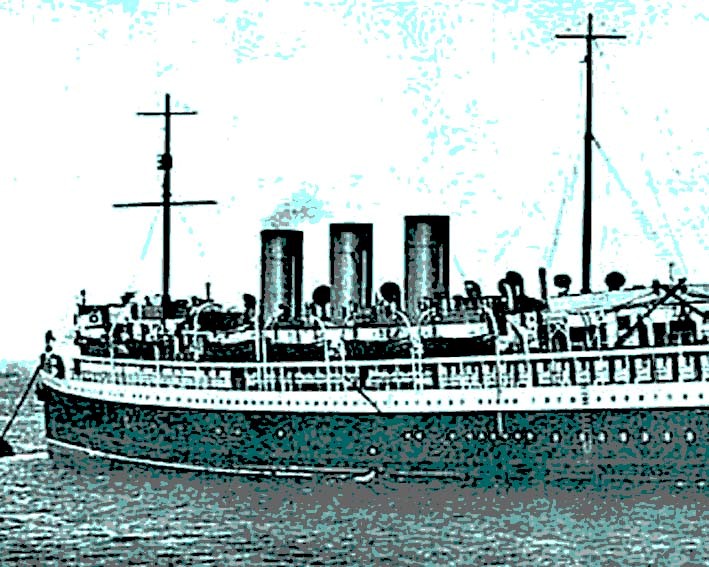 The HMS Princess Irene disaster (1915)
Six months after the HMS Bulwark disaster, a near carbon-copy occurred. It was also in Kent waters, but the explosion was even bigger. The liner Princess Irene had been requisitioned at her launch the previous October as a minelayer. She was moored off Sheerness while being loaded with mines. On May 27th, 1915, at 11.14 am, she exploded with ferocious force. Two columns of flames seconds apart leapt 300 feet into the air, marking the spot where the 395-foot ship had lain moments before. A pair of barges alongside had likewise disappeared. The consequences were shocking. 349 men died; just one stoker survived. A girl on land and a man on a ship half a mile away were killed by debris; another civilian died of shock. A crate of butter landed 6 miles away in Rainham, wreckage hit people in Sittingbourne, and severed heads were found in Hartlip and on the Isle of Grain. The accident was blamed on a faulty primer.
 The Brides in the Bath Murders (1915)
Any murder featured in the Chamber of Horrors at Madame Tussaud’s waxworks must be extraordinary. The ‘Brides in the Bath’ case was certainly that. George Smith from Bethnal Green was a career criminal who had committed all manner of crimes and been imprisoned three times. Between 1899 and 1914, he embarked on a new and lucrative practice: bigamy. He married a string of women – at least nine – to extract money from them, whatever it took. If that meant murder, so be it. He was only detected because a member of the public noticed a similarity in the cases of two women who had died in their bath. Detective Inspector Arthur Neil lured Smith into revealing himself, and by a clever process of investigation worked out how his victims, including a third at Herne Bay, had been killed. Smith was found guilty of murder, and hanged by inside Maidstone Prison on August 13th, 1915.
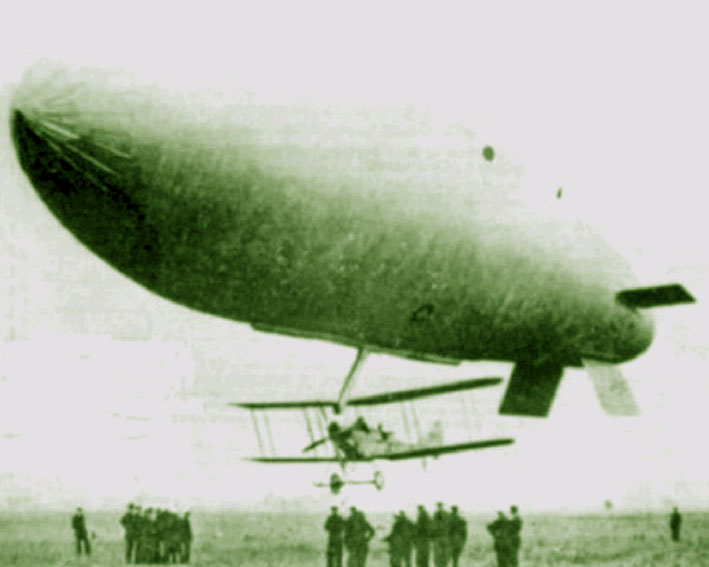 The failed airship-plane experiment (1916)
During WW1, Neville Usborne (b 1883) had the unique distinction of being both a Royal Navy lieutenant and a wing-commander, having taken command of the Royal Naval Air Service’s Kingsnorth station on the Hoo Peninsula. He had the ingenious idea of tackling German bombing raids by constructing an early version of an aircraft carrier, specifically by slinging a BE2c biplane under the AP1 airship so that it could be transported within range of enemy Zeppelins. The first manned trial was planned for February 21st, 1916. After Usborne and Squadron Commander De Courcy Ireland had ascended to 4,000 feet, intending to launch the plane, the airship unaccountably flexed, causing the aircraft to become partially detached. It briefly dangled nose-down before the stressed rear fixture sheared. The plane flipped over, and Ireland fell to his death. Usborne, unable to gain control, crashed into Strood station goods yard. The project died with its creator, who was buried at Gillingham.
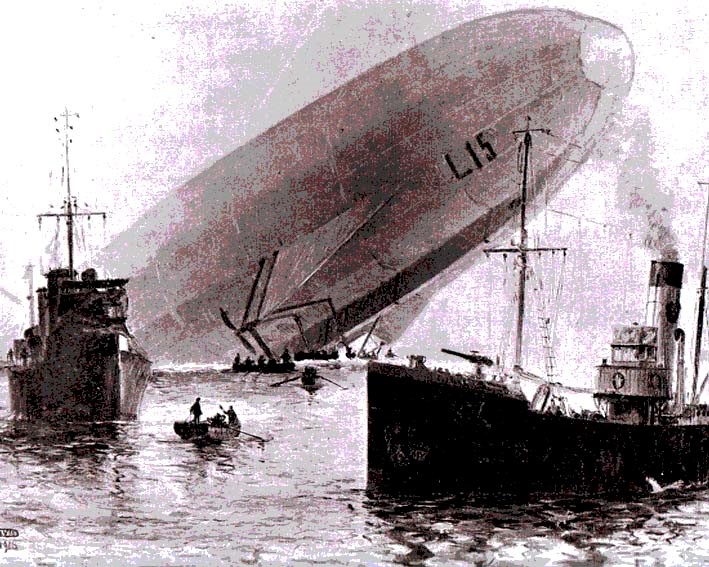 The destruction of Zeppelin L15 (1916)
Zeppelins now appear great lumbering affairs of little practical use. During the first two years of WW1, however, they were a weapon of terror. The German Army and Navy both possessed fleets that arrived in squadrons to dump bombs on cities while people below spectated. There was little the defenders could do except rely on the wind and weather for deterrence. That began to change in 1916, as counter-weapons emerged. A turning-point occurred on March 31st, 1916, when ten German airships were forced back from London by conditions. Claude Ridley, flying from Joyce Green near Dartford, intercepted Zeppelin L15 and fired off a few rounds from a distance. The airship’s gas cylinders were then struck by anti-aircraft fire from Purfleet, and finally Kiwi pilot Alfred Brandon dropped so-called Ranken darts on the L15, bringing it down off Margate. All the crew bar one were rescued. Much of the airship was salvaged before it broke up at sea.
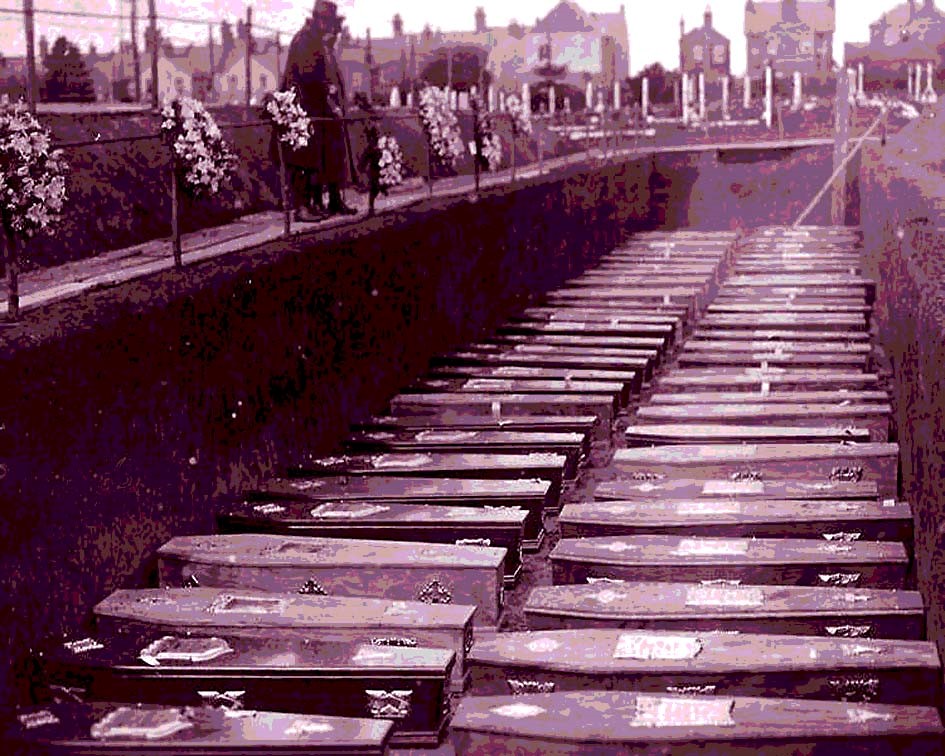 The Great Explosion of Faversham (1916)
As if accidental explosions at sea weren’t enough, WW1 also saw the worst-ever accident in the British explosives industry. At Uplees, on what is now the Oare Marsh Nature Reserve, an explosives factory stood next door to the Explosive Loading Company. On the afternoon of Sunday, April 2nd, 1916, some bags caught fire in a shed storing 150 tons of ammonium nitrate and 15 tons of TNT. Though 200 men battled frantically to put it out, the flames spread to the building, so all were ordered out. It was too late. There were three explosions so tremendous that they were heard in France, and windows were shattered in Southend. The blast left a 20-feet crater 40 yards wide. 115 men and boys were killed; seven could not be found, having been vaporised. A mass grave was dug at the site for 73 corpses. Despite the carnage, with a war on, the factory was soon rebuilt.
 The Gotha bombing raid (1917)
It was inevitable that, with its geographical position, Kent would be in the firing line when German bombing raids started. The first was on December 21st, 1914, amounting to two bombs dropped into the sea off Dover by a German seaplane. For two years, German bombing strategy depended on airships, but improved defences prompted the introduction of winged bombers under the codename ‘Türkenkreuz’: Operation Turks’ Cross. Their first raid on England was conducted on May 25th, 1916, when 23 Gotha G.IV bombers set off to bomb London. They never reached the capital because of the weather, and two returned to base with mechanical problems. The remainder however headed for their secondary targets, Folkestone harbour and the Shorncliffe army camp. Arriving out of the blue, they met with complete success: 95 men were killed, and 195 injured. The returning bombers were engaged off Belgium by nine Sopwith pups of the Royal Naval Air Service, who managed to shoot down just one.
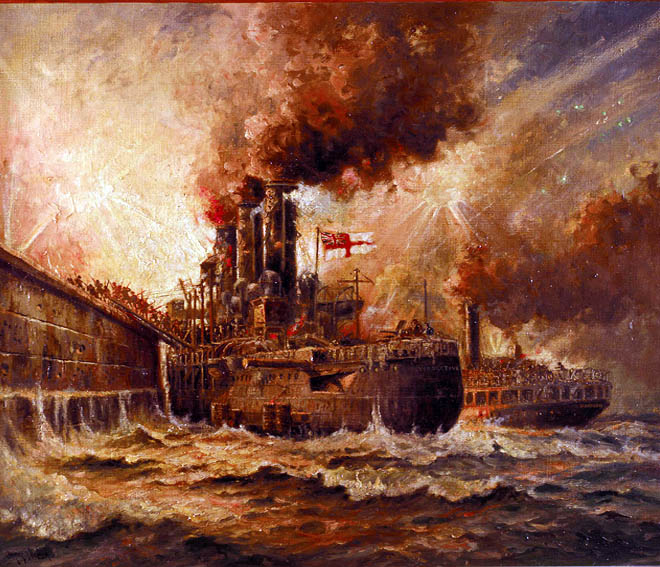 The Zeebrugge Raid (1918)
On April 23rd, 1918, Dover was the start and end point of one of the few memorable missions of WW1 outside the Western Front. In an effort to stop German U-boats using Zeebrugge harbour in Belgium, the Royal Navy attempted to scuttle three blockships in its entrance. This demanded an armed landing by 1,700 marines to neutralise German defences. It all went awry when the wind changed direction, so the vital smokescreen was not forthcoming. 227 marines were killed, and U-boats were still able to come and go afterwards. The Navy put on a brave face, awarding eight Victoria Crosses. One went posthumously to Old Dovorian rugby international Lieutenant-Commander Arthur Harrison, who was lost while leading an attack on the mole. Another went to his subordinate Able Seaman Albert McKenzie, 19, who survived his wounds but died of Spanish flu at Chatham Naval Hospital six months later. Of the dead, 59 were interred at St James’s Cemetery in Dover.
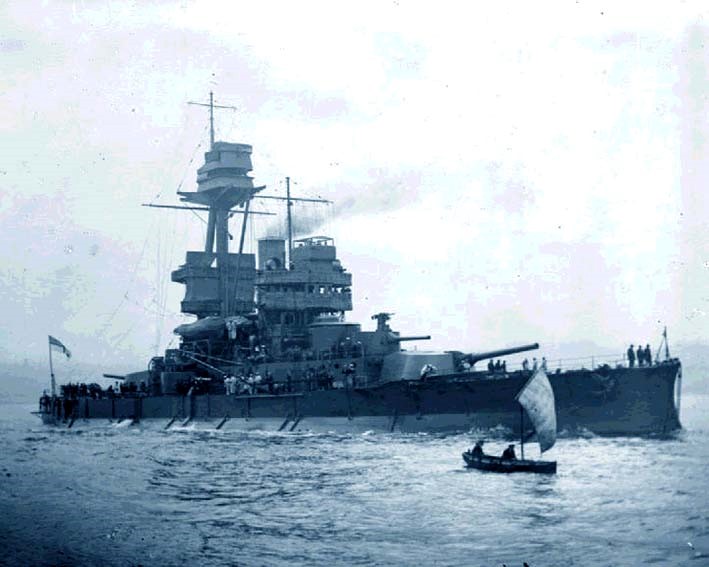 The sinking of HMS Glatton (1918)
The late stages of WW1 saw an incredible example of coolness under pressure. At 6.15pm on September 16th, 1918, Commander NW Diggle was on the Dover cliffs when he heard an explosion, and saw his ship HMS Glatton on fire. After hurrying out to her, he flooded the forward magazines but realised that, when the flames reached the magazines aft, the explosion would ignite the adjacent ammunition ship Gransha and obliterate Dover. He boarded HMS Cossack and ordered Glatton to be scuttled. Two torpedoes were fired, but only blew a hole in her. Diggle calmly transferred to HMS Myngs, and at 8.15pm sent another torpedo through the hole. At last, Glatton capsized. The wreck remained a shipping hazard until it was tipped into a gully, and now lies beneath the car-ferry terminal. The blast, which killed 79 crew, had been caused by a fire in newspapers unaccountably tucked by Tyneside shipbuilders into the lagging of the midship magazine.
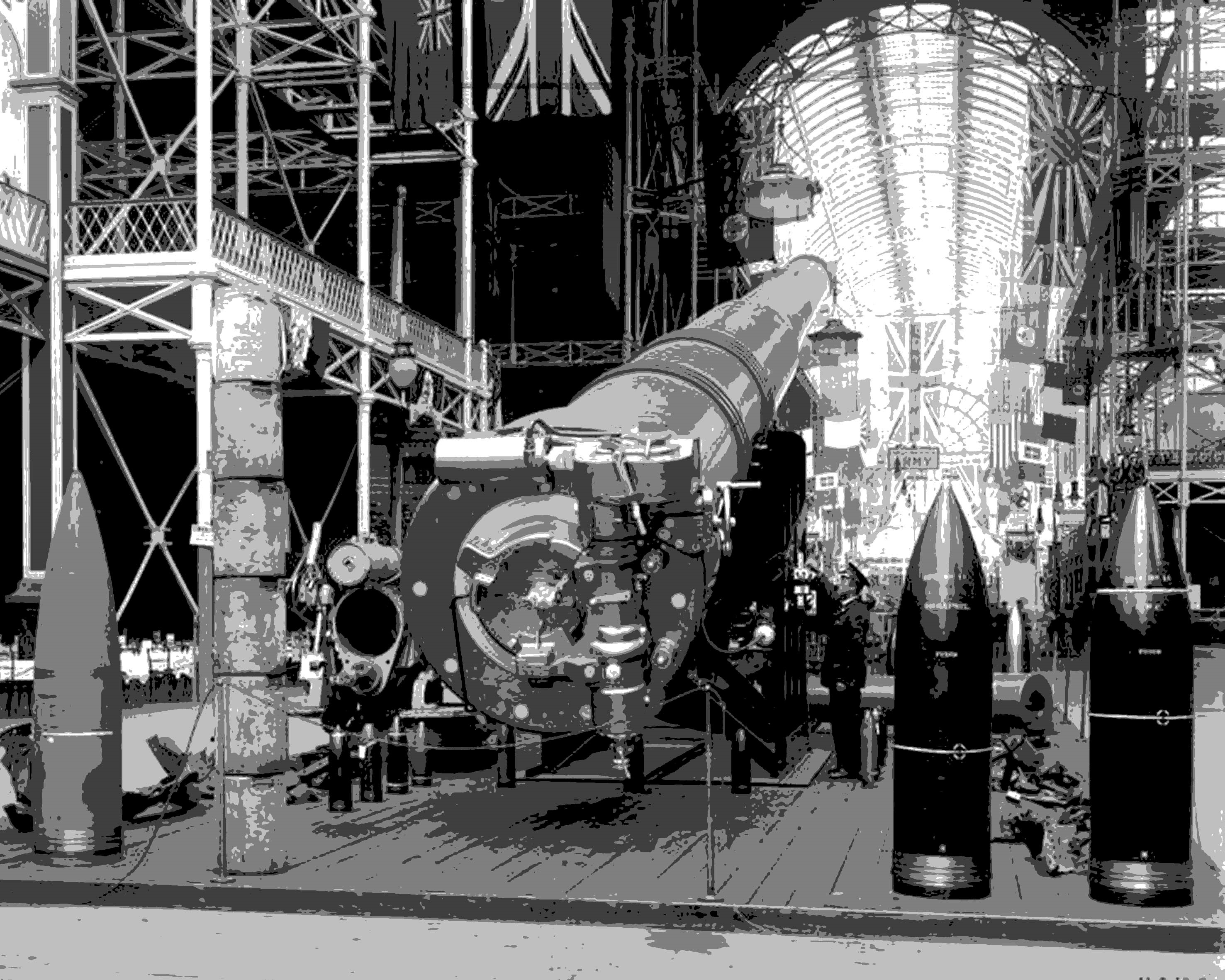 The opening of the Imperial War Museum (1920)
It might appear that Britain had enough on its plate in 1917, but that was precisely the time when Liberal MP Sir Alfred Mond proposed a National War Museum to celebrate Britain’s military achievements. The emphasis was not to be simply on displaying exhibits, but dramatising stories of courage and hardship. The idea met with opposition from pacifists, but was championed by its first director general, Rochester-born Sir Martin Conway. His belief in the project was vindicated by the fact that, when it opened at the Crystal Palace in Penge in 1920, 94,179 visited on the first bank holiday after its opening, and 2.3 million in the first 18 months. It remained there for four years, but was then taken to South Kensington. This site proved too cramped, so the Museum moved to its present home, the former Bethlem Hospital in Southwark. The name was changed to the Imperial War Museum, incidentally, in acknowledgement of India’s contribution to the British Army.
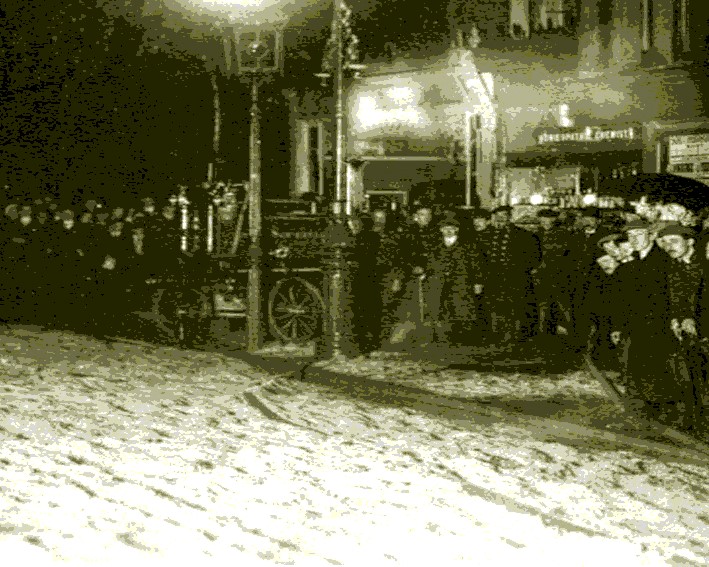 The Tunbridge Wells hailstorm (1922)
By 1922, the country was settling down again after WW1. At the beginning of May, spring was struggling to break out, and conditions remained generally miserable. In a matter of a fortnight, however, spring was bypassed and high summer arrived early. The temperature rose as high as 91°F, which was then exceptional for that time of year. The atmosphere was oppressively muggy, and eventually turned to storms; yet nobody expected what happened on Thursday, May 25th. A violent hailstorm hit the area south-east of London, Tunbridge Wells being particularly badly hit. The hailstones measured almost an inch in diameter, and fell in torrents. Many cars were damaged, thousands of windows broken, and the town centre covered in what looked like snowdrifts. Fortunately, the English were civic-minded in those days, and turned out in numbers to get the streets clear. Rather unfairly, Tunbridge Wells saw an encore in 1956, when cars were almost buried in the white marbles.
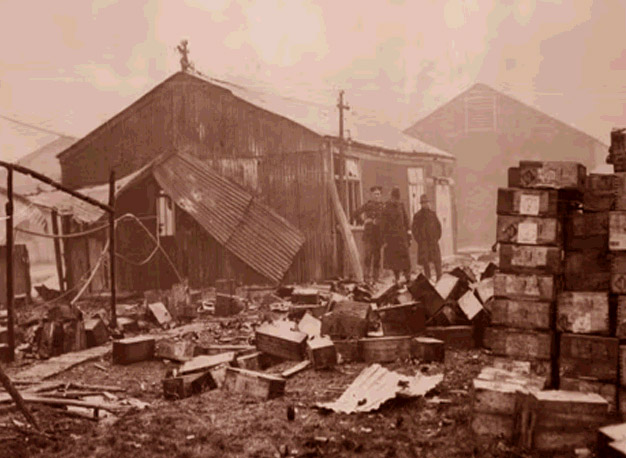 The Slade Green Disaster (1924)
On February 18, 1924, a hut at the former Trench Warfare Filling Factory at Slade Green near Crayford Marshes was occupied by 18 local girls aged between 16 and 24, who were dismantling signal and lighting flares known as Verey lights. With the clock approaching nine in the morning, there was suddenly a dazzling flash that caused the hut to catch fire. Eight of the women managed to escape, some with their clothes on fire; but the blaze reached the unemptied Verey lights, which exploded. Eleven women were killed, as was their foreman, 29-year-old Edward Jones of Forest Hill, who died while trying to help someone escape through a window. Seven victims were buried together at Erith cemetery, with a memorial cross recounting the disaster. On the 100th anniversary, a service organised by the nephew of one of the deceased took place at Slade Green parish church, attended by the Bishop of Rochester.
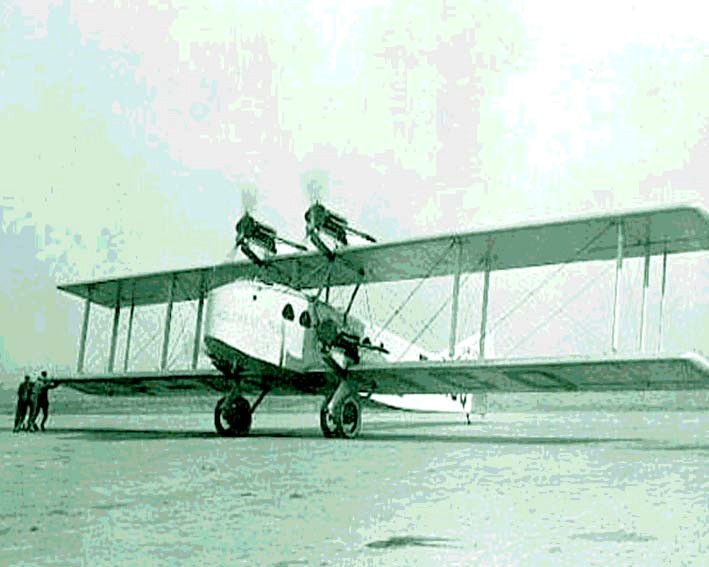 The Air Union Blériot 155 crashes (1926)
One reason why Kent played a singular part in the early years of civil aviation was that aircraft were popular for cross-Channel transportation; Lympne even had its own airport. Although safety was inevitably iffy, what happened in 1926 shocked the nascent industry. On August 18th, a brand-new Air Union Blériot 155 was travelling from Le Bourget to Croydon with two crew and 13 passengers when an engine failed. Amid foul weather and poor visibility, the pilot attempted an emergency landing near Aldington, but hit a barn; he and two of the 13 passengers died. Six weeks later, the only other Blériot 155 in existence was carrying seven passengers on the same route. An engine caught fire, and then the whole wing. The plane crashed at Penshurst Airfield, and all seven on board were killed. It was the first airline disaster involving an in-flight fire. About 6,000 ghouls came to gawk, their behaviour later being excoriated by the coroner.
 The Sevenoaks rail accident (1927)
The rail crash that occurred on Wednesday, August 24th, 1927 was not just fatal. It led to the withdrawal of an entire class of locomotive. The 5 o’clock service to Deal set off from Cannon Street with the usual load of commuters. The train behaved strangely, rolling excessively when going fast around bends. Passengers’ fears were realised on the straight between Dunton Green and Sevenoaks. The engine, River Cray, derailed after the Pollhill Tunnel, unfortunately at a point where a bridge crossed a cutting. The engine struck it and turned sideways, causing the following carriages to pile into it. The only wonder is that no more than 13 were killed and 21 injured. It transpired that another River Class engine had derailed and miraculously re-railed, though tests showed that it ran normally on a good line. No risks were taken, and all River Class engines were withdrawn until they had been rebuilt to a new design.
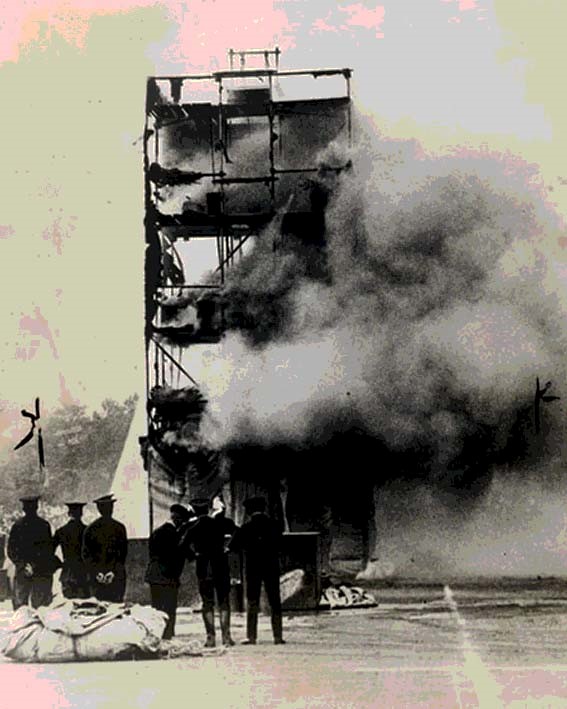 The Gillingham Park fire disaster (1929)
The calamity on July 11th, 1927 at the Gillingham charity fair was as harrowing as can be imagined, even in a nightmare. The local Fire Brigade had a set-piece entertainment that involved rescuing a spoof bride and groom and their guests from a three-storey structure while smoke bombs and flares went off. As a finale, the structure would be spectacularly burned down. The crowd was loving the show, convincing screams and all, when two boys plummeted from the top, plainly on fire. Another was picked out by the spotlight, slumped over the roof. As the horrible reality sank in, firemen leapt into action, but too late. By the time the inferno was brought under control, nine boys aged 10 to 14 and six men were dead or dying. Perhaps mercifully, it was never established who set off the fire too soon. The torment of knowing until the end of his days must have been punishment enough.
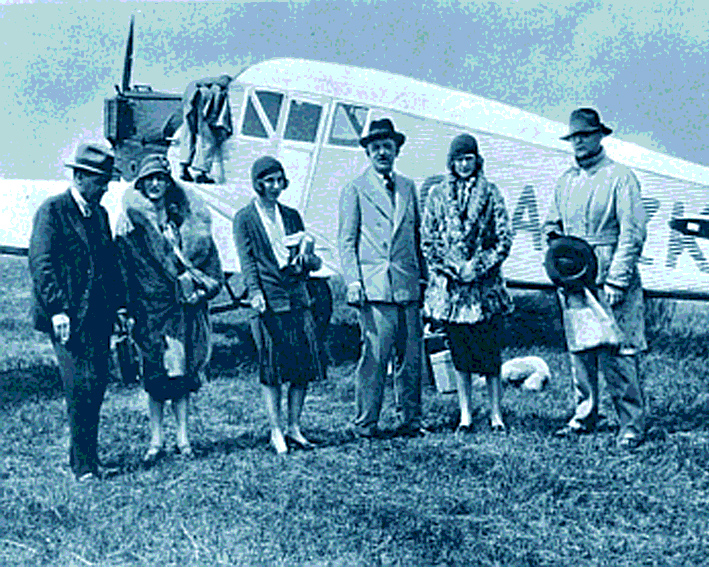 The Meopham air crash (1930)
Kent’s most poignant air crash occurred at Meopham. Rosemary Ward, Viscountess Ednam, 36, who had recently lost a young son in a road accident, was in Paris with her husband when he fell sick with typhoid. After booking her flight home from Le Touquet to Croydon, she accepted a vacant seat on an earlier flight with three other passengers. Over Kent, the tailplane of their Junkers F 13 failed in bad weather, and the resultant stall caused one wing to break off. All bar the pilot fell through the hole into an orchard, while the wreckage was strewn over a wide area. Before her unhappy marriage, the viscountess had been set to marry Edward, the Prince of Wales, but George V forbade it because he disapproved of two of her relatives. When Edward was told of her death, he shed tears publicly. The findings of the crash inquiry were the first ever to be published in Britain.
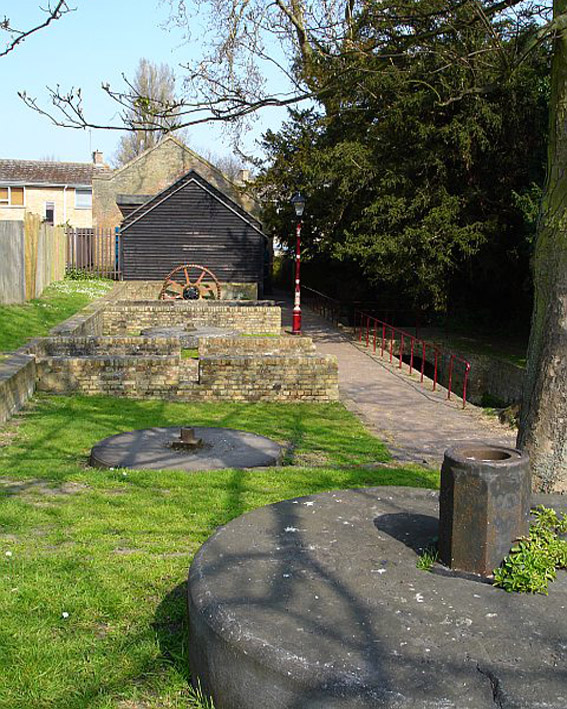 The end of the Faversham gunpowder industry (1934)
Manufacturing gunpowder required a millstream for power, easy access to the sea for importation of ingredients and exportation of the explosive product, and proximity to where it was needed. With its Stonebridge Pond and Faversham Creek, plus its North Kent location, Faversham was ideally suited to house the world’s first gunpowder manufactories in the early C16, a time when cash-rich monasteries were investing in new technologies. Consolidated as the ‘Home Works’, they faced competition in the 1680s, when Huguenots opened another plant to the north-west, using Oare Creek for access to the Swale. After nationalisation and expansion of the Home Works in 1759, a third works, called the Marsh Works, opened in 1787, also at Oare. A further plant was created in 1873 to make the high-explosive guncotton near Uplees, which witnessed a devastating explosion in 1916. Though the reprivatised gunpowder factories all closed in 1934, the Abbey Works founded in 1924 still makes industrial explosives under German ownership.
 The Crystal Palace fire (1936)
Having served its purpose at the 1851 Great Exhibition in Hyde Park, the Crystal Palace was rebuilt at the top of Sydenham Hill. Its value went beyond providing a wealth of leisure activities. It became a symbol of Victorian greatness as iconic as France’s Eiffel Tower. By 1936, it had stood there for 82 years. Then, abruptly, it was no more. On the night of November 30th, a small fire was detected. The conflagration soon grew so intense that nothing could be done, and the Crystal Palace burnt to the ground. The cause was never definitively established. In retrospect, it looks a symbolic funeral pyre. Britain was still reeling from the psychological catastrophe of WW1. Nevertheless, months before the blaze, British footballers had refused to kowtow to fascism as a condition of competing at the Berlin Olympics. Two years later, however, the appeasers had their way. World war resulted, costing Britain its world-power status.
 The destruction of the old Deal Pier (1940)
On January 29th, 1940, Deal’s second pier became the unlikely victim of German war action. The Dutch coaster Nora was sheltering in the Downs with a cargo of straw board – a building material – when she made contact with a drifting German mine. Though no one was killed by the explosion, the ship was holed, began to list, and had to be abandoned. Perhaps buoyed by her cargo, however, she remained afloat, and was towed ashore by two navy tugs. Local boatsmen warned that she was liable to be re-floated by the rising tide and blown onto the pier by the wintry gale, but were ignored. When this duly happened a couple of hours later, with a sizeable crowd now in attendance, the ship battered repeatedly against the pier until it collapsed. Nora was left lying on her side on the beach, and would not be salvaged until after WW2. A replacement pier was finally built in 1957.
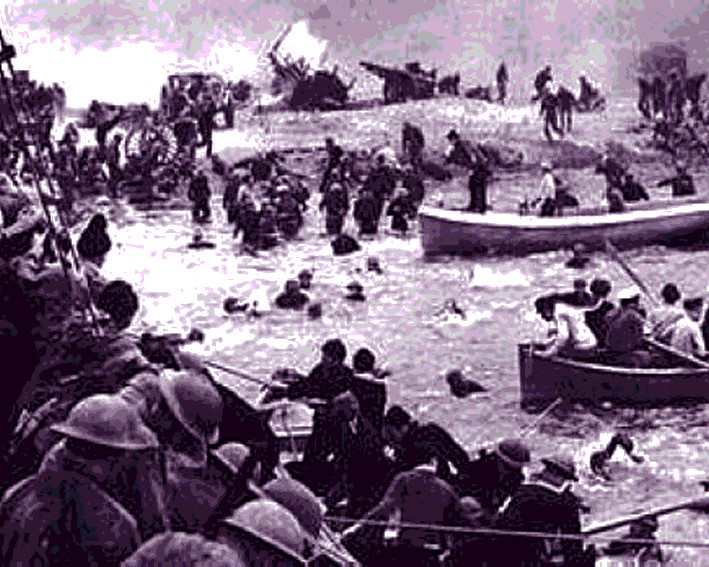 Operation Dynamo (1940)
Within a fortnight of the end of the phoney war in May 1940, a crisis had turned into a calamity. The British Expeditionary Force was trapped along with the remains of the French Army on the coast around Dunkirk, and in danger of being obliterated. Luckily, Hitler still hoped for Britain’s peaceful withdrawal from the War, and held off long enough for plans to be made for an ambitious evacuation. This ‘Operation Dynamo’ was not only conducted by Royal Navy vessels, but also a flotilla of 700 shallow-draught ‘Little Ships’ of every description from across the South East, most crewed by Navy sailors. The former operated out of Dover, the latter Ramsgate. Against all the odds, the RAF provided just enough air cover for a third of a million men to be rescued in ten days. The boat that made the most round-trips – seven – was Medway Queen, which can now be seen displayed at Gillingham Pier.
 Operation Sealion (1940)
After the fall of France early in WW2, the only logical next step for Hitler was the conquest of his last surviving enemy, Great Britain. The English Channel alone stood in his way. His invasion plan, Unternehmen Seelöwe (‘Operation Sealion’), originally proposed a symbolic repetition of the dark-age Germanic invasion of Britain, stretching from Ramsgate to the Isle of Wight. This was later concentrated to a narrower front from Dover to Hastings. The centre of the invasion force would therefore descend upon Romney, Hythe, and Dymchurch; though it is doubtful that Hitler was a steam enthusiast. A mass parachute drop beyond Dover was to secure the port, after which the ruination of battlefield Kent was assured. All the Germans needed was air supremacy to defend their transports from bomb and torpedo attacks; but this, according to Göring, was a formality. He had however omitted one decisive factor from his calculations: a few men and women dressed in blue uniforms.
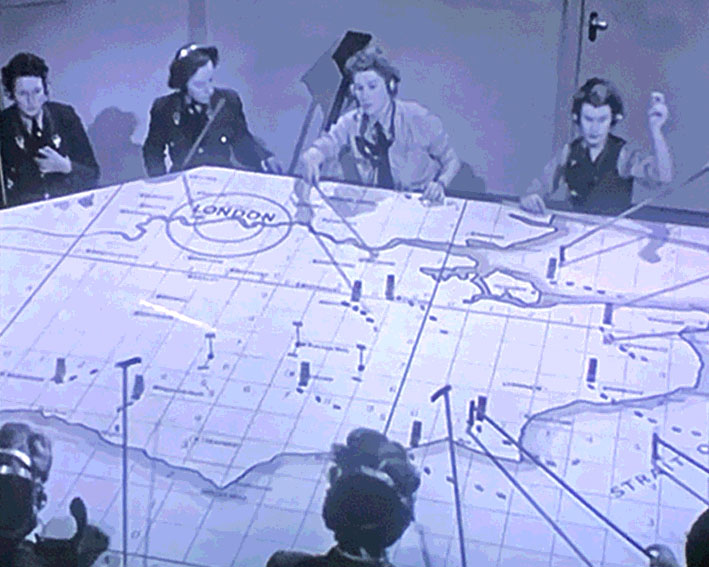 The Battle of Britain (1940)
As soon as France fell in June 1940, after just six weeks’ resistance to the German invasion, Churchill announced gloomily that the “Battle of Britain” was about to begin. He had in mind a full-scale invasion. What followed however was the world’s only wholly aerial battle: one that ended so ignominiously for Hitler that he abandoned his plans to conquer Britain and turned instead to the East. Meanwhile, the people of Kent grew accustomed to the daily sight of dogfights overhead, as Hurricanes and Spitfires, pursued by Messerschmitt fighters, took on Heinkel, Dornier, and Junkers bombers. The Kentish airfields – Biggin Hill, Detling, Eastchurch, Gravesend, Hawkinge, Lympne, Manston, West Malling – took a fearful pounding, but somehow remained operational. Although all the South-East was affected, it was Kent that took the brunt of it, and RAF heroism in Kentish skies that blunted Germany’s remorseless progress. But for Churchill’s premature label, it might even have been known as the Battle of Kent.
 The Battle of Graveney Marsh (1940)
September 27th, 1940 saw the last armed confrontation between British troops and a foreign enemy on home soil. Its historical significance was considerably greater than its magnitude. A Junkers Ju 88A-1 lost one engine after being hit by anti-aircraft fire over Upnor, and was brought down by fighters on Graveney Marshes. Four aircrew survived and, arming themselves with the plane’s machine guns, ran off after planting an explosive device. Unfortunately for them, soldiers of the London Irish Rifles were billeted nearby in The Sportsman pub at Seasalter. There was an exchange of fire. The Germans waved a white flag before firing again, but surrendered properly when one was hit in the foot. Equipment salvaged from the largely intact plane included a cutting-edge bomb-sight that was soon incorporated in British bombers. The encounter was all perfectly civilised. Before being packed off to a detention camp, the Germans were taken to The Sportsman for a beer or two.
 The death of Amy Johnson (1941)
A Yorkshire lass, Amy Johnson had it all: brains, looks, charm, skill, and guts. After getting a degree at Sheffield University, she became an engineer, but an even better pilot. She flew to stardom at 26 by becoming the first woman to fly solo from Britain to Australia, her first of several long-distance firsts. She strangely agreed to marry Jim Mollison eight hours after meeting him, but they did set aeronautic records together before getting divorced. Her life ended tragically. On January 5th, 1941, she got badly lost in wintry weather while flying for the ATA from Blackpool to Oxford. She was seen parachuting into the heavy sea off Herne Bay. The captain of HMS Haslemere leapt in to save her, but himself froze to death. It was reported that she ran out of fuel, but half a century later a British gunner claimed she had been shot down after twice giving the wrong password.
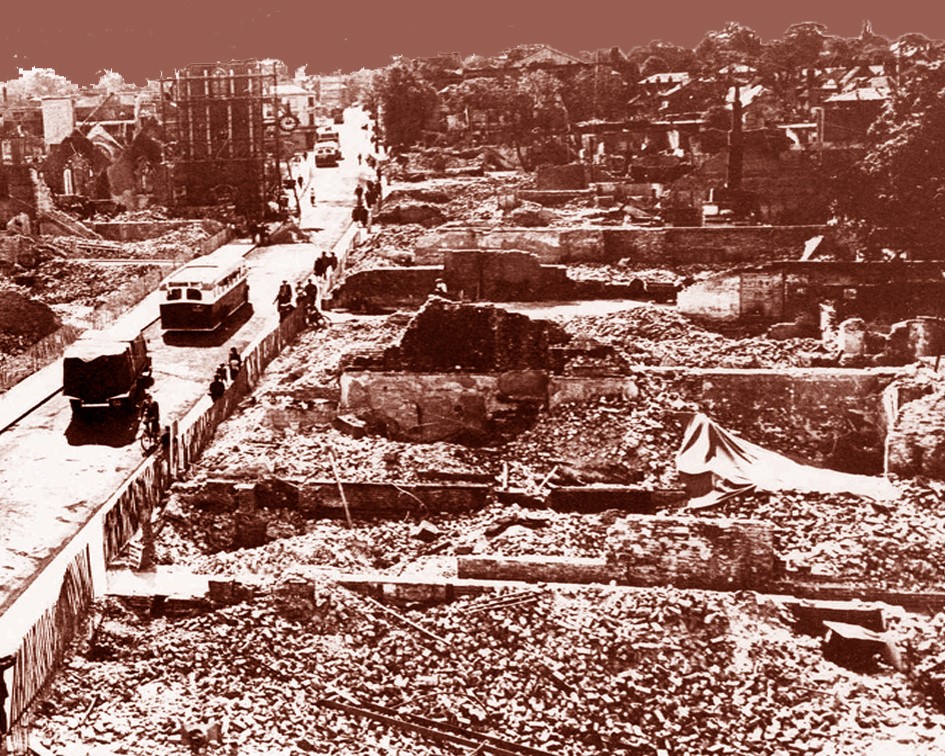 The Baedeker Blitz (1942)
After the RAF’s destructive and demoralising raid on Lübeck in March 1942, Hitler decided on a change of tactics. Henceforth, English cities of high cultural value were to be targeted by the Luftwaffe, with the aim of breaking popular resolve. Because targets were selected for having three stars in the Baedeker guide-book, the campaign was called the Baedeker Blitz. Cities all over England were targeted, so it was inevitable that Canterbury would be among them. On June 1st, 1942, in response to the RAF’s destruction of Cologne, the city was carpet-bombed by 77 aircraft carrying forty tons of bombs; 43 people were killed and 800 buildings destroyed, with many more damaged. Incredibly, the Cathedral survived. The bombers returned later that month, and in October a fighter-bomber attack killed 30 more. Maidstone too came in for rather pointless punishment. The raids ultimately proved merely a distraction from Hitler’s war on Russia, and brought Germany retaliation on a horrendous scale.
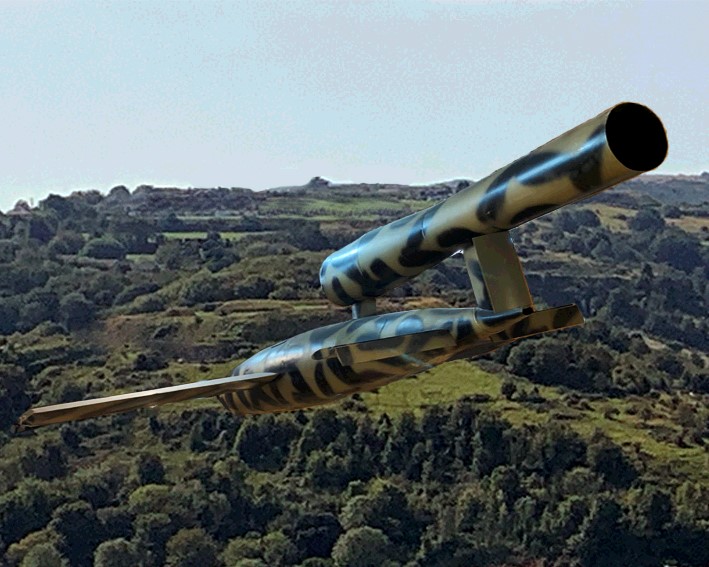 The Charing Heath flying bomb (1944)
On June 24th, 1944, at six in the morning, Brigadier Cliff Gough was shaving in the stables at Newlands House in Charing Heath that served as a washhouse for the adjacent Royal Electrical & Mechanical Engineers camp. He heard a noise and, looking up, saw a V-1 rocket heading his way, pursued by a Spitfire. It glanced off a roof and struck the workshop, killing 46 of the camp’s 244 men; the eventual death toll was 52. The Brigadier described a scene of total devastation. Ten buildings had been destroyed, along with 30 vehicles. The bodies and body parts were collected and identified as well as possible, a mass grave was dug at Lenham, and, after dark, all were buried together by lantern light. Their names and locations within the grave were recorded in a sealed bottle buried under a cross. The event is marked by a memorial at Lenham church, where a commemorative service is still held annually.
 The wreck of the SS Richard Montgomery (1944)
Being a Sheerness resident is not that different from living on the side of Vesuvius. There might never be a problem, but if there is, it won’t be trivial. The source of the uncertainty is the wreck of the SS Richard Montgomery, 1½ miles offshore. This was a so-called ‘Liberty’ ship – one built for Britain in the USA during WW2 – that the Americans had cheekily named after one of their Revolutionary War heroes. On August 20th, 1944, she was lying at anchor with a cargo of ammunition when she began to drag anchor. Other ships flashed a warning, but were ignored because Captain Wilkie was asleep. The ship drifted onto the Nore sandbank, and broke her back. She sank in shallow waters, her masts remaining forever visible. In her hold are 286 2,000-pound bombs, 4,439 1,000-pounders and nearly 5,000 others that salvage experts could not remove. Despite official reassurances, they could still explode at any time.
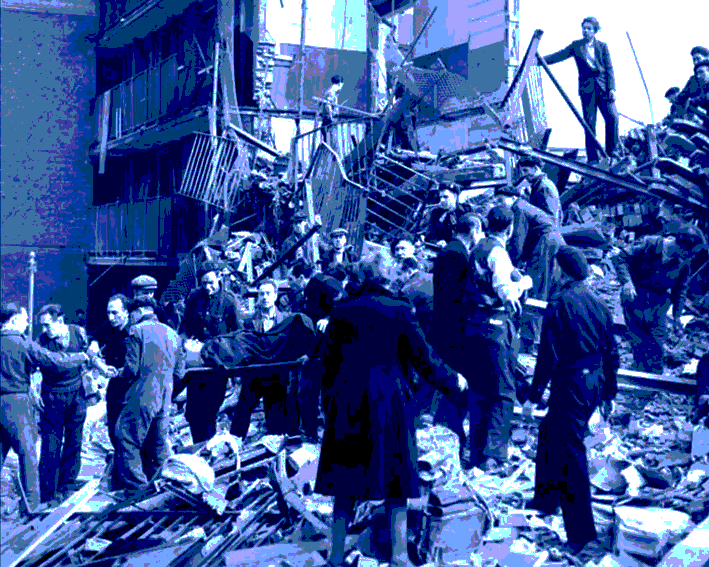 The Woolworth’s V-2 disaster (1944)
Hitler’s ‘retribution weapons’, the V-1 flying bomb and the V-2 rocket, caused a good deal of panic among those so inclined, but were strategically a failure. They cost Germany a huge amount in manpower, materials, and fuel that would have better been put into the Third Reich’s defence of its Eastern Front. It has been calculated that each terror weapon cost Britain just two lives, nothing like the carnage Hitler anticipated. One very costly attack, however, was that which struck Deptford on Saturday, November 25th at 12.26 pm. A V-2 bomb with its 2,200-pound warhead landed on the Woolworth’s store in New Cross Road. Needless to say, the effect was devastating. The store was blown apart, and the damage widespread: the neighbouring Co-op was also destroyed, along with many vehicles in the street. 168 people were killed, including 33 children, and another 122 injured. It was in fact one of the bloodiest civilian incidents of the War.
 The world speed record (1945)
Speed is normally vital in aerial combat, and the race to build the first jet fighter during WW2 seemed at one point crucial. Despite the jet engine having been invented in England by Frank Whittle, Germany led the way in making jet fighters operational, its Me 262 claiming over 500 Allied aircraft. The RAF got the Gloster Meteor flying by July 1944, too late to have any great impact. By the end of the War, however, with Germany in ruins, Britain had a big lead in speed, as was demonstrated on November 7th, 1945. From his base at Manston, Group Captain Hugh Wilson flew a Meteor Mk.4, the EE454 ‘Britannia’, four times over a course between Herne Bay pier and Reculver Point. He averaged 606 mph, a new world record. The record did not last long: the following September, another Meteor Mk.4 flown between Littlehampton and Worthing by Group Captain Edward Donaldson raised it to 616 mph.
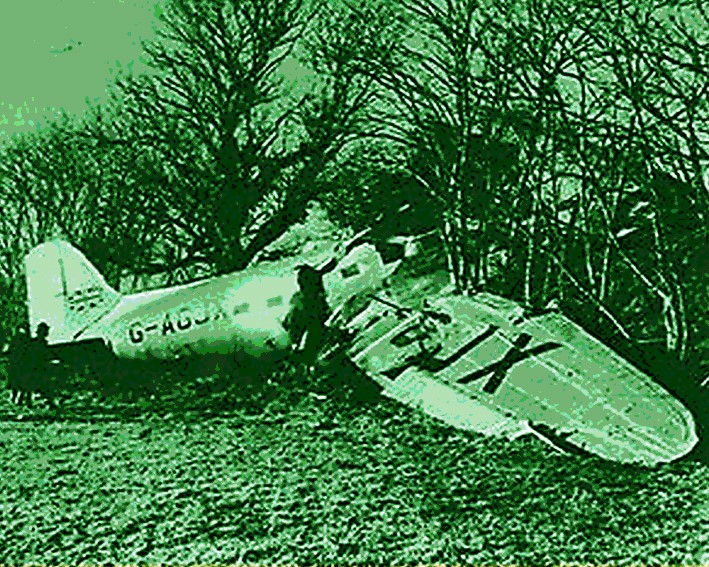 The Stowting air crash (1947)
Few young people are aware that, before British Airways was created in 1970, BOAC was Britain’s main long-haul carrier, and any incident involving the airline was big news. On January 11th, 1947, there occurred an extraordinary episode that left people wondering what had gone right. A BOAC Douglas C-47 piloted by Captain IR Goalen took off on its way to West Africa. Arriving at Bordeaux for a scheduled stop, it encountered a queue, and was further delayed by an RAF transport with mechanical problems. When the captain was finally cleared to land, he decided instead to head back north on account of the deteriorating weather. Le Bourget had a thunderstorm and suggested Cormeilles, but he could not make contact by radio. He therefore headed for Lympne Airport. Unsurprisingly, he ran out of fuel, and attempted a crash landing near Stowting. The plane struck trees, and half the 16 on board were killed. The inquiry pinpointed five contributory factors.
 The sinking of HMS Truculent (1950)
On January 12th, 1950, there was another fatal collision in Kent’s busy waters, this one leading to a change in nautical regulations. HMS Truculent, a submarine, had served in the Pacific during WW2. She had just completed trials after a refit, and was returning after dark to Sheerness from Chatham with her full crew and 18 workmen. Truculent’s captain, Lieutenant Charles Bowers, wrongly assumed a ship ahead to be at anchor. Unable to turn to starboard for fear of grounding, he went instead to port. He realised too late that the ship, the Swedish oil tanker Divina, was steaming straight at him. Truculent was cut apart by the impact and sank like a stone. Many men survived the impact, but soon died in the freezing cold; 64 were lost, and only 15 rescued. Bodies were washed up in Thanet and Belgium. The accident prompted the introduction of the ‘Truculent light’ on submarines to improve visibility.
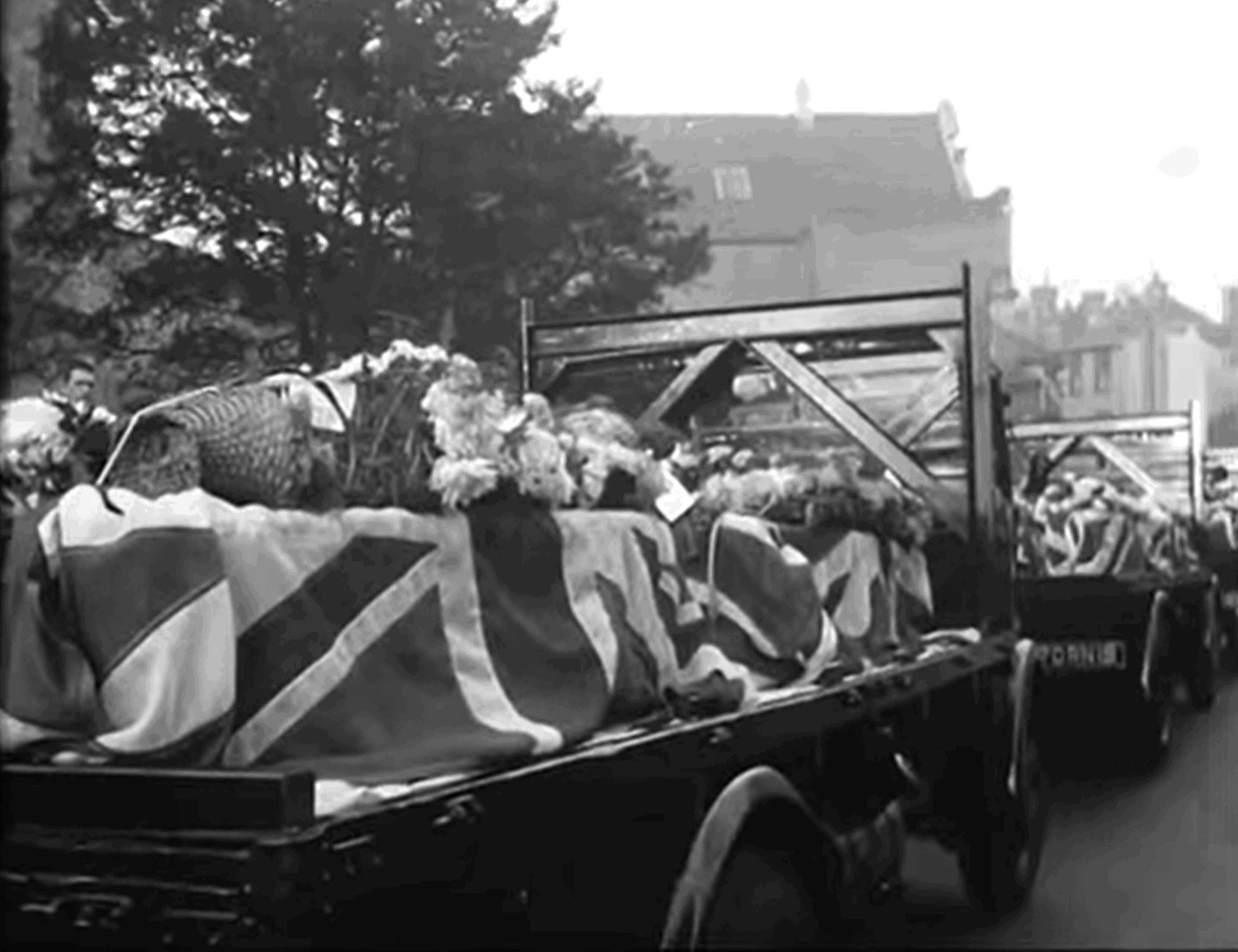 The Gillingham bus disaster (1951)
As if the 1929 Gillingham Park fire disaster had not been enough, the town suffered another such calamity in 1951. Shortly before 6pm on December 4th, a band of musicians from the Royal Marines Volunteer Cadet Corps was making its way along Dock Road from the Melville Barracks. Conditions were poor, and the 52 youngsters aged 9 to 13 were not lit as they marched in rows of three along the dark street. As they passed the swimming baths, a bus came up behind them with only its sidelights on. The driver, John Sansom, reported afterwards that he saw nothing, but simply felt an impact. He stopped to discover the grim reality. All but the foremost group of cadets had been mowed down. 24 were killed, and another 18 injured. It was at the time the highest loss of life in a British road accident. Sansom was found guilty of dangerous driving, but treated leniently on the jury’s recommendation.
 The defection of Donald Maclean (1951)
Donald Maclean was part of the Cambridge University tradition of serving one’s country by working for a hostile foreign power. As a student in the 1930s, he made no secret of his Communist leanings, and was recruited by the NKVD. Astonishingly, when he told MI6 that he had changed his views, he was believed and enrolled as a British spy. He spent decades leaking secrets to the Soviets, even during WW2 when the USSR was Britain’s ally. Along with fellow Cantabrigians Kim Philby, Guy Burgess, Anthony Blunt, and John Cairncross, he formed a fifth column that cost countless British agents their lives. Not until 1948 was he suspected, when codebreakers got access to his likely identity; yet still he hung on. On May 25th, 1951, he met Burgess for a birthday celebration at his home at Tatsfield, near Westerham. The next day, they slipped away to Southampton en route to Russia, where they spent the rest of their lives.
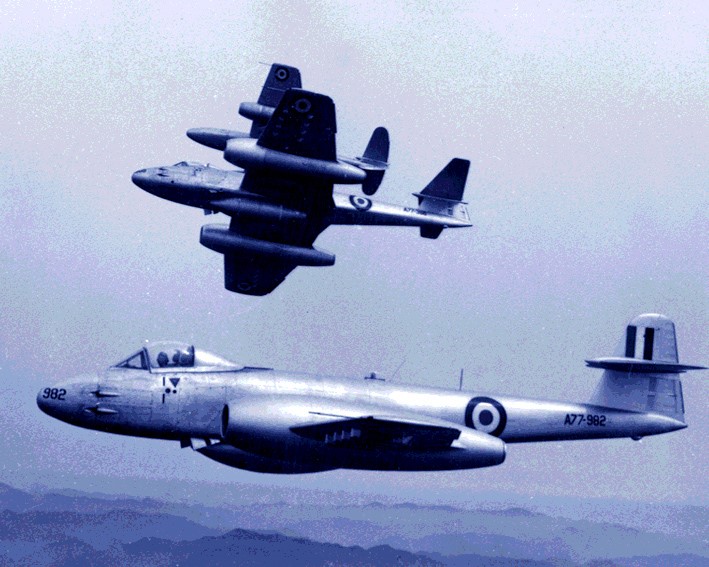 The Biggin Hill Meteor crashes (1951)
In the late 1940s, the Gloster Meteor was the fastest aeroplane in the world; but pushing the envelope meant that their safety record was less than satisfactory. In total, nearly 4,000 of them were produced. Of these, 890 RAF Meteors crashed, claiming 450 lives. One particularly startling accident took place on June 18th, 1951. Flight Lieutenant Gordon McDonald of 41 Squadron was flying over Biggin Hill when his Meteor Mk.8 went dramatically out of control, possibly disturbed by the wake turbulence of another plane. It spiralled down with pieces flying off, and crashed into a bungalow. Within moments, two Mk.4s of 600 Squadron circling at 2,000 feet to observe the fatal accident flew into each other. Squadron Leader Phillip Sandeman ejected, but his parachute failed to open, while Sergeant Kenneth Clarkson was killed instantly. All three planes came down within a radius of 100 yards. Despite its record, production of the Meteor continued until 1955.
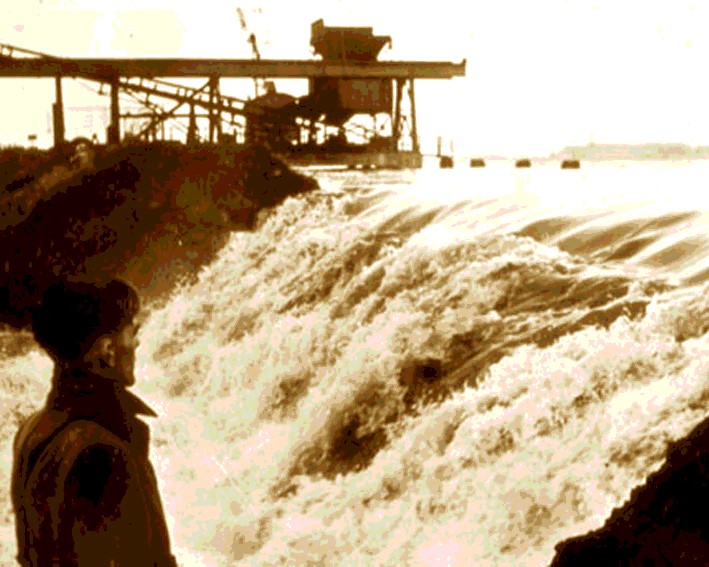 The East Kent flood (1953)
A rare combination of tidal and meteorological conditions on January 31st, 1953 had dramatic consequences. The sun and moon were pulling gravitationally in the same direction, and the consequent ‘spring tide’ was exacerbated by a storm on the North Sea. Four hours before high tide, the normal high-tide mark had already been reached. Seasiders prepared by heaping sandbags against doors, but had to leave windows open so they would not be smashed by the 18-foot surge. The whole east coast of Britain was affected, with 326 deaths caused by flooding. Kent got lucky in that respect, but witnessed extraordinary happenings. Sea defences were breached at Seasalter and Sandwich, and the consequent flooding was so serious that the two inundations met in the middle, Thanet temporarily reverting to an island. At Margate, residents watched in amazement as the lighthouse buckled under the waves’ battering and disappeared. It could have been worse, however. Over in low-lying Holland, 1,836 died.
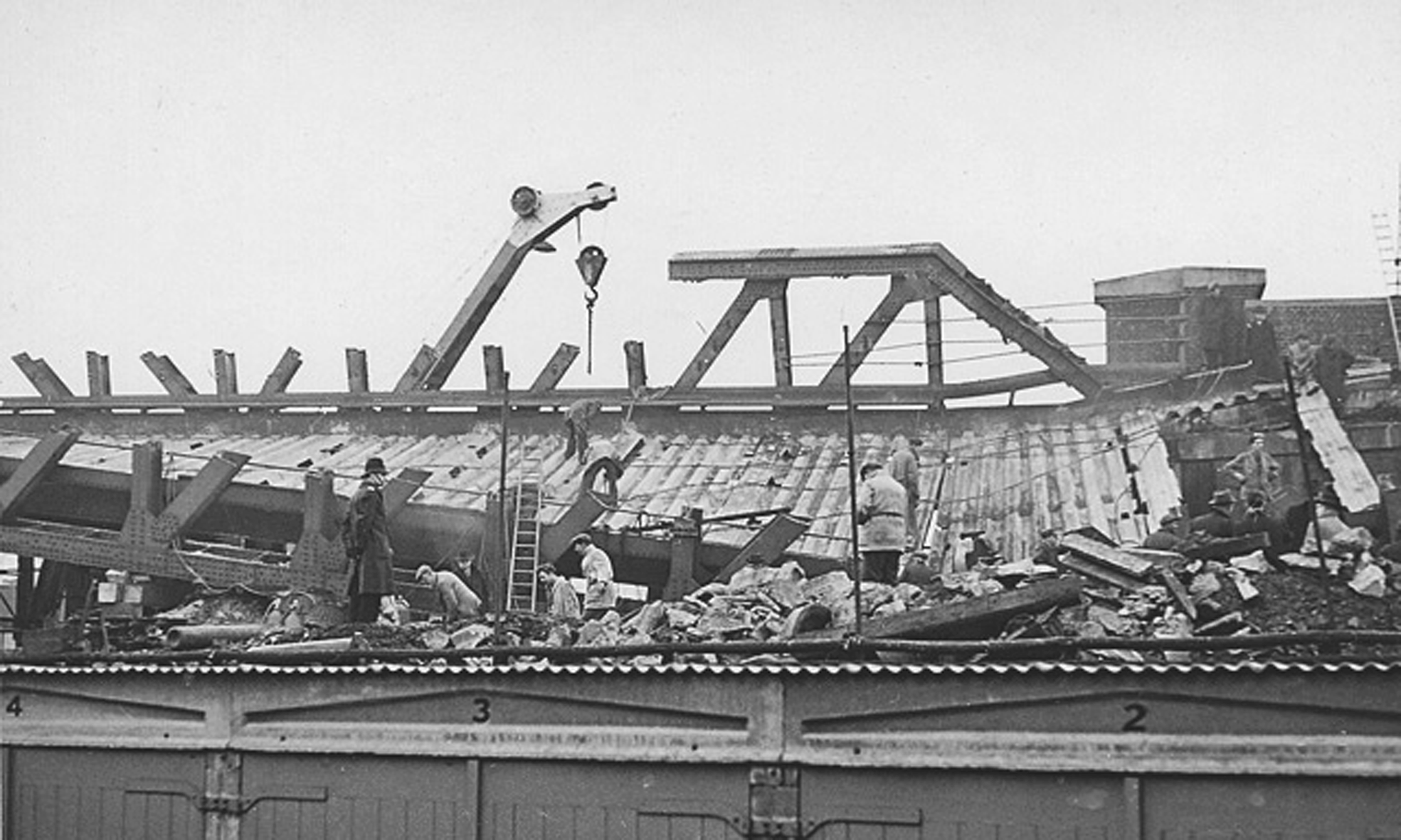 The Lewisham rail crash (1957)
On December 4th, 1957, the 5.18 pm electric train service from Charing Cross to Hayes set off with 1,500 commuters. It was late owing to a pea-souper, and at 6.20 pm was waiting at a red light near St John’s, only five miles out. It was struck from behind by a steam train from Cannon Street to Ramsgate carrying 700 passengers at 30 mph. The impact caused one packed carriage to be crushed by those behind it. Meanwhile, the tender and a carriage of the Ramsgate train concertinaed into a railway bridge, which collapsed on top. 90 passengers were killed and 173 injured. Despite days of disruption, the wreckage was removed, the bridge rebuilt, and the lines re-laid within six weeks. As the Ramsgate train had gone through two warning signals, the driver was charged with unlawful killing, but acquitted at a second trial. The case emphasised the importance of making the new Automatic Warning System generally available.
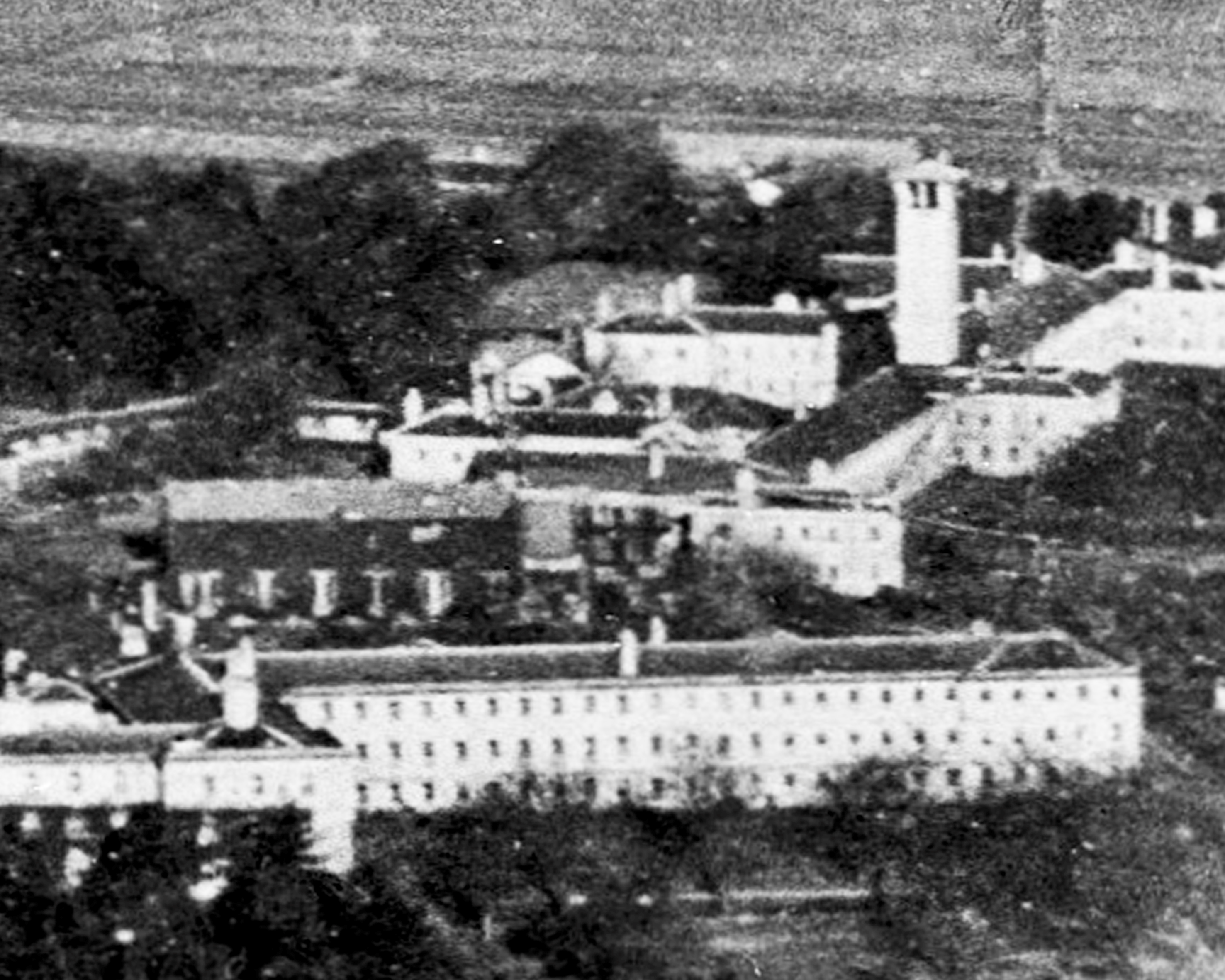 The Oakwood Hospital fire (1957)
On November 29th, 1957, Oakwood Hospital – formerly the Kent County Lunatic Asylum – saw a fire with a trivial cause but a terrible sting in the tail. It began in a first-floor tailors’ workshop adjacent to a ward housing 350 male patients. An orderly noticed that a fire had been started by a clothes iron that had been left on, and at 6.40 am alerted the Fire Brigade. Although appliances turned up within four minutes, a blaze had taken hold, and it was not until 7.30 am that it was brought under control. No one had been hurt, and the process of clearing up commenced. At 10.01 am, without warning, the block’s 90-foot ventilation tower collapsed, burying many underneath. Four firemen were killed, including the hospital’s chief fireman, as well as another staff member and a patient. Thousands lined the streets for the funeral procession, and 800 packed into Maidstone’s All Saints Church for the service.
 The first Channel crossing by hovercraft (1959)
When Christopher Cockerell’s hovercraft first crossed the English Channel in 1959, it was hailed as the latest proof of British invention leading the world. The prospect of this C21 technology speeding passengers from Kent to France was mouth-watering. The dream turned to reality when Hoverlloyd started operations out of Ramsgate in 1966. Three years later, a specialist hoverport opened in Pegwell Bay. There was competition, too, after Seaspeed set up a rival business. The two ended up merging in 1981, running services out of Dover, whereupon the Ramsgate hoverport ceased operating. Nevertheless, Hoverspeed’s days were numbered. The trouble was that, though faster and more frequent than ferries, even the advanced SR.N4 hovercraft were not terribly practical. They accommodated much smaller numbers of passengers and vehicles, making profitability difficult. They also coped badly with rough seas, when progress could be slow and passengers arrived green about the gills. The opening of the Channel Tunnel in 1994 sounded the death knell.
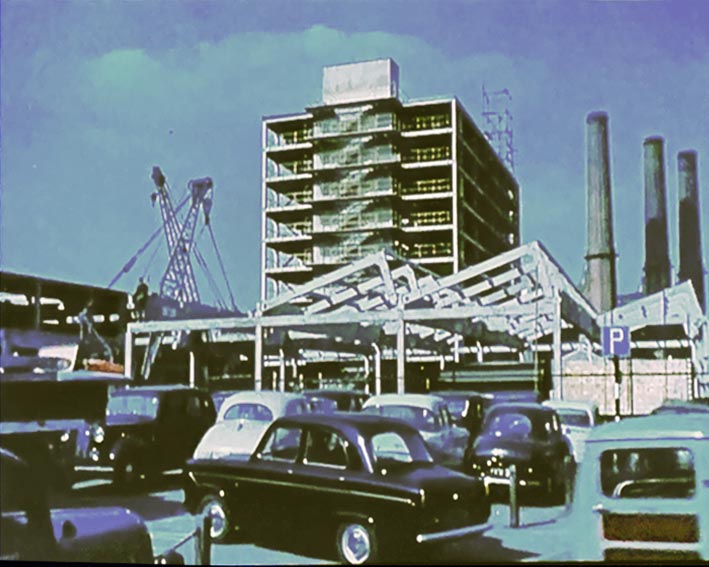 The Auto Stacker debacle (1961)
In 1960, the Metropolitan Borough of Woolwich embraced a futuristic new vision for municipal car-parking. It authorised the construction of an 8-storey, 256-space car-park with a difference: one using a system of lifts and pulleys to transport each car to its parking slot and later return it automatically for collection. Although the construction cost was an eye-watering £2 million in today’s money, it was expected to solve once and for all Woolwich’s chronic town-centre parking problem. It went pear-shaped as early as the opening by Princess Margaret in May 1961, when the demonstration car got stuck and had to be removed by hand. Its first TV appearance was similarly blighted. In fact, it never worked right, and was abandoned after a few months. It was finally dismantled in 1966 for another £1 million plus. Few Woolwich residents can have lamented the demise of their council, which by then had been subsumed into the Royal Borough of Greenwich.
 Beeching’s Axe (1963)
Born at Sheerness, ‘Kent Messenger’ reporter’s son Richard Beeching soon moved to Maidstone, where he attended the Grammar School before studying physics at Imperial College, London. After marrying in the Midlands and working in Canada, he joined ICI, where he spent the majority of his career. An unsentimental technocrat, he was an ideal hatchet-man to let loose on Britain’s nationalised railways, a fiscal black-hole that politicians had scarcely dared address. His ‘Beeching Report’, which he published as British Railways chairman, proposed slashing about a third of railway services, with the loss of 70,000 jobs. Beeching’s Axe became highly controversial, and was to prove short-sighted when, despite exponential growth in road transport, rail travel surged in the 1980s, although to be fair his recommendations for modern bus services were never implemented by government. After being sacked by the incoming Labour regime in 1965, shortly after being awarded a life peerage, Dr Beeching returned to ICI, later chairing AEI.
 The SS Kielce explosion (1967)
There is one word to say to anyone who demands that the wreck of SS Richard Montgomery off Sheppey be disarmed: “Kielce!” Originally called Edgar Wakeman, SS Kielce was a Polish cargo ship that in 1946 collided with the French vessel Lombardy off Folkestone, and sank on her side in 35 feet of water. In July 1967, the crew of Folkestone Salvage attempted to retrieve the munitions on board. The operation was proceeding well until it was discovered that 100 tons of explosives lay underneath a bulkhead. An attempt to break it up caused the whole lot to go off. A crater 20 feet deep and 50 yards long was blown out of the seabed, and seismographic equipment on the west coast of America recorded an earthquake measuring 4.5. There was significant damage in Folkestone four miles away. Chillingly, Kielce’s explosive payload was only a fraction of that still inside ‘Monty’ off Sheerness.
 ‘Magical Mystery Tour’ (1967)
September 1967 was a watershed for the Beatles. Their magnum opus ‘Sergeant Pepper’s Lonely Hearts Club Band’ was complete, and manager Brian Epstein had just died. Paul McCartney decided they needed a new project quickly, and so the ‘Magical Mystery Tour’ movie was born. They had left it late in the film production season; so, after spending a week on location in Devon, they turned to West Malling aerodrome to get the rest shot. The Fab Four spent six days in Kent, using the Great Danes Hotel near Hollingbourne as their base. For John Lennon’s psychedelic ‘I Am The Walrus’ sequence, locals were recruited as extras, playing ‘egg-men’; while McCartney’s whimsical ‘Your Mother Should Know’ became a song-and-dance spectacular featuring 160 of Kent’s own Frank & Peggy Spencer Formation Team. The end product, a slapdash affair, was lambasted by critics after its launch screening on Boxing Day, but the EP still reached No. 2 in the singles charts.
 The Hither Green rail crash (1967)
The Fifth of November was to be remembered for all the wrong reasons in 1967. A packed Sunday-evening train was travelling from Hastings to Charing Cross with many standing passengers. At 9.16, it derailed at 70 mph between Hither Green and Grove Park. Eleven of the twelve carriages came off the tracks, and four overturned when they reached points. The train took 250 yards to stop. There were 49 fatalities, and 78 were injured. The enquiry revealed that the cause was a broken rail. Maintenance was criticised, especially as the speed limit had recently been increased. One consequence was the accelerated introduction of continuous rather than jointed track. Among the survivors was Robin Gibb of the Bee Gees, who at the time were top of the charts with ‘Massachusetts’. Poignantly, the accident occurred only a mile or two from the site of the Lewisham rail crash ten years earlier. It is commemorated by a plaque at Hither Green station.
 The disappearance of Lord Lucan (1974)
Richard ‘John’ Bingham, the 7th Earl of Lucan, was central to one of the great criminal mysteries of the C20. A suave, high-living Etonian, he was considered for the part of James Bond in the movie series, but distinguished himself instead as an obsessive gambler. He hit the headlines in 1974 after his nanny Sandra Rivett was found battered to death in the cellar of the family home in Belgravia, and his estranged wife reported that he had also attacked her. After fleeing to a friend’s house in Uckfield, East Sussex, he was never seen again. Rumours circulated that he had honourably killed himself, and he was officially declared dead in 1999. It was claimed in a 2014 book, however, that he had actually been taken by taxi to Headcorn Aerodrome, whence he had been flown to Le Touquet on his way to southern Africa. His now dead associates never divulged the truth, and his fate remains unknown.
![]()
 The IRA bomb outrage in Maidstone (1975)
The Irish Republican Army’s 28-year campaign of terror was a war of attrition intended to wear down HM Government’s resolve. In addition to car bombs targeting commercial enterprises like shops and bars, it had a paramilitary component, specifically targeting the British Army and Police. On September 25th, 1975, an alert sapper called David Campbell noticed something suspicious beneath a car parked opposite the Hare and Hounds, a pub facing Maidstone Prison that was frequented by soldiers from the adjacent Royal Engineers barracks. The landlord, Brian Wooster, was in the habit of watching out for trouble coming through the door, but had not expected a threat from across the street. The pub was hurriedly cleared, and local residents were being warned when the bomb went off. A lot of damage was done and two policemen were injured, but mercifully no one was killed. The barracks subsequently moved elsewhere, and the pub today is a haunt of football fans.
 The destruction of Margate Jetty (1978)
As early as 1815, Margate had the stone harbour-arm that doubles as a pier. Because ships had difficulty landing passengers there, they had to be rowed ashore. Consequently, a wooden jetty was erected in 1824; but it was wrecked by a storm in 1851. Four years later, work began on the first iron pier. For the avoidance of confusion, it was called ‘Margate Jetty’, but confusion resumed after it was impressively transformed in 1875 into a tourist destination popularly known as ‘Margate Pier’. Over the following century, it often suffered wind and sea damage, but remained in use until 1976, when it was closed for safety‘s sake. In these situations, a mysterious fire normally comes into play, but this case was different. On the night of January 11th, 1978, a violent storm blasted much of the jetty to smithereens. Clearing the debris was a major task. Efforts to blow up the remainder failed, and in 1998 it was dismantled.
 The Leeds Castle Summit (1978)
On Sunday, July 30th, 1978, the eyes of the world were on Leeds Castle. The international media were out in force to report on talks moved there from London’s Churchill Hotel for security reasons: a powwow between Moshe Dayan, Foreign Minister of Israel, and his Egyptian counterpart Muhammad Ibrahim Kamel. Thirty years earlier, Israel had triumphed in the Arab-Israeli War, and now occupied the Sinai Desert after reasserting its military dominance in 1967 and 1973. The West was becoming increasingly embroiled because of the devastating OPEC oil embargo and escalating terrorism. The US Secretary of State Cyrus Vance had called the meeting more in hope than expectation; yet it went off amiably enough and, incredibly, Egypt and Israel signed the historic Camp David Accords in Maryland seven weeks later. Although it won the signatories the Nobel Peace Prize, the pact was fiercely resented in the Arab world, and before long cost the Egyptian president Anwar Sadat his life.
 The first man-powered cross-Channel flight (1979)
Most early attempts at man-powered flight were based on the supposition that birds provided a good model. All foundered because human arms cannot generate enough power to lift even a small person’s weight into the air. That all changed in 1962, when the Puffin, a pedal-power assisted glider designed by a de Havilland engineer, flew nearly a thousand yards. By 1979, the technology had developed sufficiently that an American team took on the challenge of crossing the Channel in pursuit of a £100,000 prize. Their aircraft, the Gossamer Albatross, resembled a large glider with a tall cockpit suspended beneath that housed a propeller-driving cyclist. Pilot Bryan Allen got it airborne at the Warren, Folkestone, and 2 hours 49 minutes later landed on Cap Gris-Nez, having travelled at an average height of 5 feet and speed of 8 mph. Any hopes of establishing a novel form of transport have thus far come to naught.
 The Kent miners’ strike (1984-5)
After Margaret Thatcher returned to power in 1983 with a landslide, the hard left reverted to its 1970s strategy of causing economic disruption by industrial action. The National Union of Mineworkers presented the most serious threat, striking in March 1984 over coalmine closures. The dispute elicited sympathy for families faced with joblessness, though there was little public appetite for another Three-Day Week. Violence between police and flying pickets became commonplace, the so-called ‘Battle of Orgreave’ in June 1984 signalling the Government’s zero-tolerance intent. The strike folded after a year, albeit not in Kent. Ironically, the Kentish mines, which only started operating in 1912, had never been profitable, yet local union leaders refused to capitulate unless sacked workers were reinstated. The Kent Area aggressively picketed mines around the country that were returning to work, including Arthur Scargill’s own Barrow Colliery. After a very Kentish show of defiance, they gave up. The last Kent mine closed in 1989.
 The great storm of 1987
The cyclone that raced through southern England in the early hours of October 16th, 1987 is often mistakenly called a hurricane because of its ‘hurricane-force’ gusts. It proved so damaging because trees were still in leaf and rooted in sodden ground after torrential rains; over 15 million were lost nationally, including six of the Seven Oaks. Kent was particularly badly hit, being right in the path of the fiercest winds. The damage to woods like those at Toys Hill and Knole Park took years to remedy. Structural damage was also widespread. A man at Warren Street was nearly decapitated by a flying corrugated roof. Several others were not so lucky. Bizarrely, there had been no warning of the storm’s sudden genesis, and most were asleep when it raced past. Consequently, many Kentish people were unaware of it until the morning, when they encountered fallen trees across roads or arrived at railway stations to find all services cancelled.
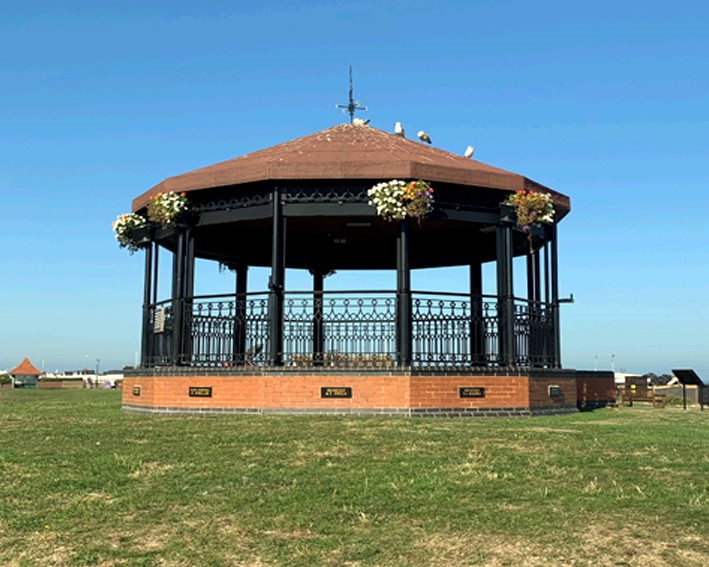 The IRA bomb outrage in Deal (1989)
In retrospect, some of the IRA outrages during the ‘Troubles’ defy understanding. On Friday, September 22nd, 1989, a 15-pound time-bomb went off at 8.22am in the Royal Marines depot in Deal. It was targeted at the School of Music, and was timed to catch the musicians in their recreational changing room. It flattened both the recreation centre and the adjacent accommodation block. Fortunately, many bandsmen had already gone outside to exercise; but 11 were found dead in the rubble, and 21 injured. One victim was not found until later because his body had been blown onto a roof. The attack was an echo of the Regent’s Park outrage of 1982, when seven Royal Green Jackets bandsmen were killed. The usual condemnations were issued, a solemn funeral procession took place, a commemorative bandstand was built, and the perpetrators went to ground. At least it raised a cheer in the fundraising Irish nationalist bars of New York, Chicago, and Boston.
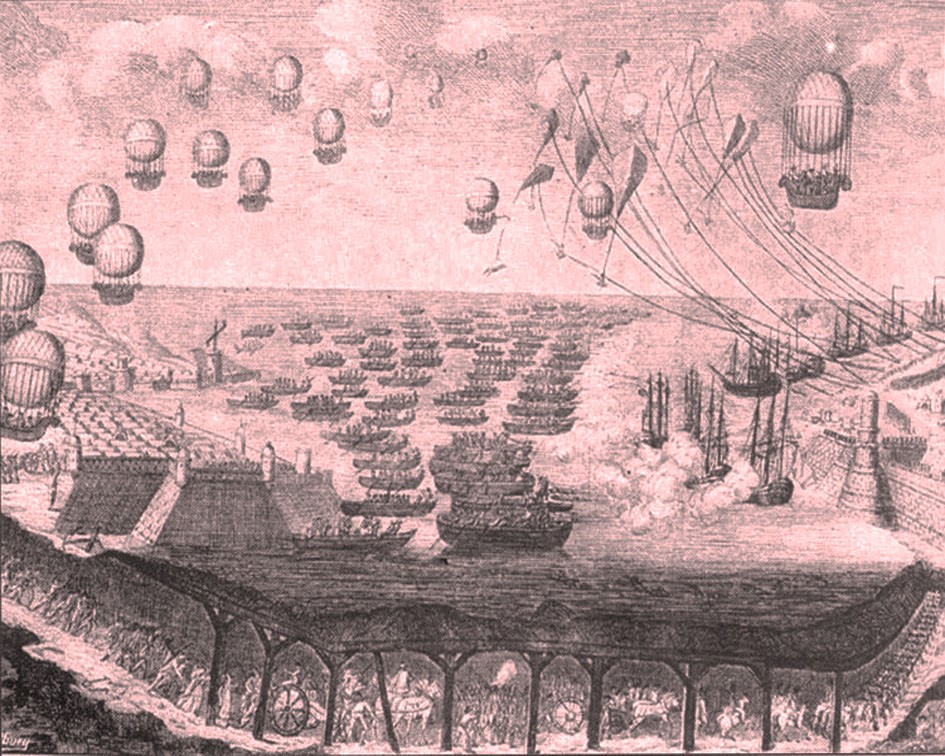 The opening of the Channel Tunnel (1994)
A tunnel between England and France must have been mooted as soon as the land bridge connecting them was severed ten thousand years ago. It was first given serious consideration in 1802, when French engineer Albert Mathieu proposed a tunnel lit with oil lamps, ferrying travellers by horse-drawn carriage. One year later, Napoleon envisaged a martial use: marching his army of invasion across the Channel. The practical difficulties were always insurmountable, but discreetly masked by such objections as the threat to national security. Work did once start at the Kentish end, but it was just a gesture. Not until the affluent 1980s did the Channel Tunnel get the go-ahead. For safety reasons, it was only a rail tunnel. The aggrieved Margaret Thatcher insisted on a second tunnel for road traffic, but it never happened. The project came in 80% over budget, the tunnel was long underused, and it is most familiar now for problems associated with illegal immigration.
 The Aitken perjury trial (1999)
Disgraced Cabinet Minister Jonathan Aitken was the MP for South Thanet (formerly Thanet East) for 23 years, albeit not a Man of Kent. His father, a nephew of Lord Beaverbrook, was born in Canada, and his mother in Peshawar. He himself was born in Dublin, and went to Eton and Oxford. He seemed the model of respectability in John Major’s government, until he was accused by Granada’s ‘World in Action’ of involvement in an arms deal. His mistake lay in attempting to brazen it out. After blustering about the “Sword of Truth”, he started a libel action. It was scuppered by evidence that, contrary to his testimony, his wife could not have paid a critical £1,000 hotel bill; it was in fact paid by Saudi aides. Aitken served seven months of an 18-month sentence for perjury, and the wife he had pressured to testify on his behalf left him. After leaving politics, he discovered God.
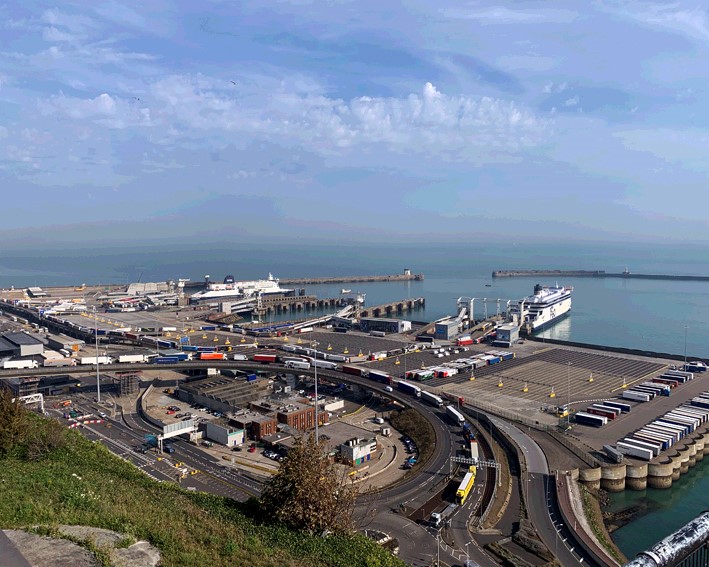 The Dover incident (2000)
Kent was the scene of an unwanted record on June 18th, 2000. Around midnight, a Dutch truck that had arrived from Zeebrugge was taken aside for investigation by customs officials. What they discovered inside was horrific. It contained a party of 60 Chinese men and women, all but two of whom were dead. This was hardly surprising, as temperatures that day had reached 90°F, and they had been inside for 18 hours. Investigation revealed that it was a people-smuggling exercise organised by a Chinese snakehead gang. The victims, who had each paid £20,000 to get into Britain, had been flown to Belgrade from Beijing before travelling to the Dutch coast. It was the highest ever death toll in Britain in the illegal-immigration industry. The driver, Perry Wacker from Rotterdam, got 14 years for manslaughter, and nine Chinese gangsters were jailed in Holland. The two survivors were given leave to stay in Britain for four years.
 The Ashford retail park murder (2000)
The Warren Retail Park in the west of Ashford is so mundane that it is the last place one would expect to see a cold-blooded murder. On October 5th, 2000, lunchtime shoppers at the Sainsbury’s superstore heard a man at the wheel of a car outside Halford’s pleading for his life, followed by a gunshot. A suspect in a woolly hat was seen running off. The victim turned out to be Alan Decabral, a particularly interesting character, since he had expressed fears for his life after testifying as a key witness in the recent M25 murder case. It was however more complex than it at first appeared. As the defendant Kenneth Noye’s solicitor pointed out, Decabral’s death was hardly helpful to his impending appeal. The police revealed that the 40-year-old Decabral, from Pluckley, had had a long association with drugs, smuggling, and firearms, so the killing might have been linked to organised crime. The case remains unsolved.
 The British rail speed record (2003)
Having invented rail travel, Britain naturally held the first world speed records; but it was the French, with their far greater land area and open spaces, who made TGVs (high-speed trains) their speciality, exceeding 200 mph as early as 1955. Although Eurostar first connected London to the Channel Tunnel in 1994, the lack of a high-speed track over the Medway slowed its TGVs considerably. In 2003, however, the 40-year-old viaduct between Borstal and Cuxton carrying the M2 motorway – incorporating one 500-feet span, then the biggest in the world – was supplemented by a second to take all the westbound traffic. By the time it opened, a third had been completed alongside to provide a high-speed rail link. On July 30th, 2003, a Eurostar test train achieved 208 mph between Folkestone and Fawkham Junction, two months before services started. It remains a British record, but raised unfulfilled expectations: simply running services profitably is challenge enough nowadays.
 The Piano Man (2005)
A very old-fashioned mystery made the national news when a 20-year-old man was found standing around in Sheerness in a suit and tie: nothing unusual about that, except that it was April, and he was soaking wet. He spoke not a word, and remained silent when questioned at the Medway Maritime Hospital at Gillingham. After he made a detailed sketch of a piano, however, he was given access to one, and reportedly played classical music effortlessly, although that detail was possibly a journalistic invention. He did eventually reveal his identity, at the Little Brook mental hospital in Dartford: Andreas Grassl, a Bavarian farmer’s son. The German embassy sent new travel documents, and he went home, still claiming to have no recollection of what had happened. A fringe play was written about him in 2014, but whether he was mentally disturbed, a failed suicide, or just another attention-seeker like his fellow Bavarian Kaspar Hauser is still anyone’s guess.
 The Great Securitas Robbery (2006)
On the night of February 21st, 2006, the Securitas depot in Tonbridge saw the world’s largest ever civilian heist. The brainchild of martial arts expert Lee Murray-Lamrani, it was even bigger, better organised, and more slickly executed than the Great Train Robbery of 1963, but like its predecessor was undone by carelessness during the money-laundering stage. It started when depot manager Colin Dixon was kidnapped on the A249 near Stockbury by fake police. Simultaneously, his wife and child were abducted from their Herne Bay home. All were taken to the depot, where a multi-national gang armed with AK-47s was waiting. They stole £53 million in cash. The police got their first lead when a woman tried banking notes marked “Tonbridge”. The investigation, which itself cost £6 million, took detectives to Ashford, Bexley, Detling, Greenwich, Hucking, Leeds, Staplehurst, Tankerton, Tunbridge Wells, and Welling, illustrating the ubiquity of organised crime. Six men received long sentences, including one in Morocco.
 The Sheppey Crossing incident (2013)
One of the most spectacular pile-ups in British history took place on September 5th, 2013 on the A249 bridge from the Isle of Sheppey. As so often, the cause was drivers not cutting their speed in thick fog, some travelling as fast as 70 mph with their fog lamps switched off. By the time the traffic came to a halt, 130 vehicles had become embroiled in the mayhem, even though vehicles coming in the opposite direction had been frantically flashing their lights as a warning. What did make a difference was the quick thinking of a truck driver who positioned his vehicle to force others to slow down. The aftermath was a scrapyard a mile long that took nine hours to clear. Amazingly, although 68 were injured, there was not a single fatality. It was not quite the worst such calamity in Britain: in 1997, 160 vehicles were caught up in a fatal pile-up on the M42.
CREDITS ON THIS PAGE
All text: © Old Bunyard 2020-4. Unauthorised reproduction prohibited.
Images:
Battle of the Medway: © John Fawkes, 2020 from BritishBattles.com.
Flight of Amminus: © Chris Rudd Ltd, 2024, www.celticcoins.com
Foundation of King’s School: © Old Bunyard, 2020.
Siege of Dover: © Old Bunyard, 2020.
Great South-Eastern Flood: ‘Kent Cinque Ports‘ by Clem Rutter, Rochester, Kent, licensed under CC BY 2.5. (Cropped, minor text edits).
Banquet of the Four Kings: © Old Bunyard, 2024.
Blackheath Army: ‘Blackheath‘ by Mark Fosh, licensed under CC BY 2.0. (Cropped, stretched).
Dering vendetta: © Old Bunyard, 2024.
HMS Victory: © Old Bunyard, 2024.
Chetney Hill fiasco: © Google Earth, 2024.
Winter of 1836-7: © Old Bunyard, 2024.
Britain’s first anti-aircraft defences: © Google Earth, 2024.
Faversham gunpowder industry: ‘Chart gunpowder mill – geograph.org.uk – 397987‘ by Penny Mayes, licensed under CC BY SA 2.0. (Cropped).
Charing Heath flying bomb: © Old Bunyard, 2020.
Wreck of SS Richard Montgomery: ‘Thames Richard Montgomery KC 7722 (Modified) (cropped)‘ by Clem Rutter, Rochester, Kent, licensed under CC BY 3.0. (Cropped).
Lewisham rail crash: ‘St Johns Lewisham Rail Crash – Geograph-2042851‘ by Ben Brooksbank, licensed under CC BY 2.0. (Cropped).
Gillingham bus disaster: © British Movietone, 1951.
Oakwood Hospital fire: ‘Barming Asylum now Oakwood Hospital. Wellcome L0010915‘ by Wellcome Images, licensed under CC BY 4.0. (Cropped).
IRA bomb outrage, Maidstone: © Old Bunyard, 2021.
Margate Jetty: ‘Margate pier after the storm of January 1978‘ by Nick Smith, licensed under CC BY-SA 2.0.
Great Storm: ‘Station closed October 1987‘ by David Wright, licensed under CC BY-SA 2.0. (Cropped).
IRA bomb outrage, Deal: © Old Bunyard, 2020.
Dover incident: © Old Bunyard, 2020.
British rail speed record: ‘Ctrl-testing-Medway viaduct‘ by Matt’s photostream, licensed under CC BY-SA 2.0.
Piano Man: © Mike Gunnill, 2005.
Great Securitas Robbery: © Old Bunyard, 2021.
Sheppey crossing incident: © Old Bunyard, 2021.
All other images on this page are believed to be public domain, fair use/dealing, or royalty-free. Please do not reproduce any image without first establishing that you are free to do so.
 Old Bunyard’s Kent